How a west Cork farm became a life-sized piece of art
I AM standing in a field in west Cork looking at a cow hanging upside down in a tree. The stunning sea view beyond and the blazing sun are probably helping but the cow is definitely bestowing a sense of enormous wellbeing. Before I am accused of revelling in animal cruelty, I should point out that the cow is square and made of bronze.

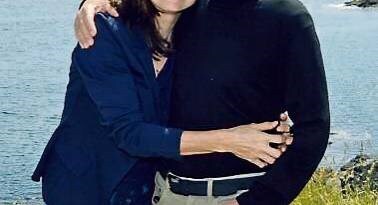
It is the work of artist John Kelly, on whose farm it stands, anchored in the cliffside, framed by the Stags rocks and the Atlantic Ocean. John and his wife Christina have lived at Reen Farm, outside Union Hall, for 15 years now.
John may have three passports — Australian, British and Irish — but this glorious parcel of land is definitely his home.
John’s father Ben was originally from Lismire, Co Cork, but moved to England to work, then on to Australia shortly after John was born. John and Christina, who is also from England, have lived at Reen Farm for 15 years, having fallen in love with west Cork when visiting.
“We had seen this place advertised in Dublin when we came,” says Christina. “We said if there was ever a dream place, this was it….We came down the hill into Rosscarbery and I said to John, ‘Oh my God, there’s an energy here’. That’s when he said, ‘you know that place we saw, that’s down around here somewhere’. Margaret, his mum, and Ben his father, who passed last year, they came every summer. This was all fields. They helped us create the place, really.”

John, a painter, sculptor, printmaker and writer, studied art at university in Melbourne, and at the prestigious Slade School of Art in London, going on to exhibit in many top British galleries. He is particularly known for his paintings and large sculptures inspired by the creations of William Dobell, an Australian artist whose papier-mâché cows were used during WWII in an attempt to confuse enemy aircraft as to the location of the Australian airbases.
Kelly’s cow sculptures have been exhibited on the Champs Elysées, Paris; Monte Carlo, The Hague, Glastonbury, Cork city and there is one permanently situated at Melbourne Docklands.
Reen is not a working farm, instead the landscape is populated by various abstract sculptures.
“I had always said my dream was to open my curtains and see sculpture,” says Christina.
“And I delivered,” laughs John.
At the back of the extended cottage where John and Christina live with their teenage son Oscar, is a green lawn dotted with bronze kangaroos.

“We call it the top paddock, an Australian term. Means you’re a bit crazy,” laughs John.
While the sculptures are joyous and playful, John and Christina tell me about their latest project, one that is centred on a more painful story that unfolded on Reen Farm and the land beyond.
“When we came to live here, we were told the story of NM Cummins coming to Reen Farm during the Famine having heard of the terrible suffering of the people of Reen village. As a result he wrote his now famous letter (originally an open letter to the Duke of Wellington) which was published in The Times of London on Christmas Eve 1846, describing the horrors he had witnessed,” says Christina. “It is heart-rending.”
“Around this time, John went to a talk by Catherine Marshall (then of IMMA) about the art of the famine at the start of which Catherine explained there was very little contemporary fine art depicting the Famine as artists had been actively discouraged to do so,” says Christina.
“NM Cummins paints the picture the artists weren’t allowed to.”
Adds John:
It paints it more vividly than they ever could. He came out here with five men with bread to feed these people and found it was too late. The whole village had died or were dying.
John and Christina have been invited to participate in the Coming Home: Art and the Great Hunger exhibition in Skibbereen; the event on Reen Farm will include an inaugural public reading of the NM Cummins letter.
The letter is also linked to another installation at Reen, a 40ft scale model of the Tate Modern museum, crafted in glass.
The piece is inspired by the sugar magnate Henry Tate, who was also one of the UK’s greatest art benefactors. Tate’s collection of art was based on history painting, and, according to John, his focus was definitely not on how people were suffering across the water in Ireland at the time.

“John wrote a conceptual piece on a room at the Tate found in west Cork somewhere and inside was NM Cummins’ letter. Then he was invited to a sculpture exhibition in Australia and decided to build a 40ft glass Tate and ship it to Australia with the NM Cummins letter in it. Something went wrong and the exhibition never happened so we were left with this Tate so we put it in a field in west Cork,” laughs Christina.
The reading of the letter will be accompanied by a rendition of “I Am Stretched on My Grave” by musician Jessie Kennedy, a tour and explanation of the work by John, a talk by artist Susan O’Toole on her neighbouring sculpture, Sentinel and a viewing of Alison Glennie’s ‘Point of Departure’, which was performed publicly and filmed at Reen Farm last year as part of the Skibbereen Arts Festival. While it was initially envisaged that the letter would be read inside the Tate model, now it is planned to use another unique feature of the farm for the reading.
Reached through a stone tunnel, crafted by John and a local builder, is a sunken circle, which has been carved from the landscape and surrounded by stone. Another tunnel forms a window onto the sea. The area has an emotional as well as artistic significance for John, representing his family’s story, one which was repeated throughout Ireland. His father Ben worked in a quarry after he left the country when his eldest brother inherited the family farm.
“This is about my own personal history with my family and my wife. It is far more enriching to me as an artist to think like that,” he says.

“John’s dad was forced, as were many, to leave Ireland, and all he ever wanted to do was come back. John came back for him,” adds Christina.
The farm is a constant work in progress, which chimes well with the curious and creative personalities of its owners. It is planned to open the garden on occasion over the summer, with proceeds going to charity.
“The whole property is a work of art,” says John.
“John and I could live anywhere in the world, because being an artist and with the internet, you are free to work anywhere these days.” Adds John: “But this place is special.” I couldn’t agree more.
The Coming Home day at Reen farm takes place at the end of July (date to be advertised through the West Cork Art Centre), €15, includes cost of bus from Skibbereen to Reen and light refreshments at farm. www.westcorkexperiences.com















