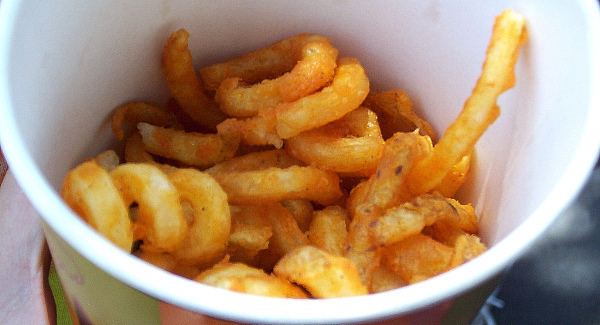
Clever people eat curly fries
The things you like on Facebook apparently reveal more about you than you think – even your IQ level and sexual orientation.
You can see for yourself, without answering any questions, here - you might be surprised at some of the results.
Experts from the US Proceedings of the National Academy of Sciences say that by studying “likes” reveals intimate details about their personality which could allow strangers to accurately predict what a person is like in real life.
Whether it is drug users being more inclined to show approval for ‘Big Momma’ movies or people with high IQ showing a taste for curly fries, the patterns are not always immediately obvious to the untrained eye.
People who liked terms such as “swimming”, “Jesus Christ” and “Indiana Jones” tended to be more satisfied with life than those who like “iPod”, “Gorillaz” and “Stewie Griffin”.
Some seemed more straightforward, though.
For instance, those who liked “Oscar Wilde” and “Leonard Cohen” were more liberal and artistic than those who liked “NASCAR” and “I don’t read”.
If you’re well-organised, you probably into “Accounting” more than “Wes Anderson” and “Serial Killer”.
The extroverts among us tend to prefer “Cheerleading” and “Beerpong” more than “Programming” and the popular video game “Minecraft”.
Fans of the game, as well as those who liked Iron Maiden and 'The Dark Knight' are also more likely to have fewer friends, according to the report.

The study is based on the Facebook profiles of 58,000 people in the US, drawn from millions of users who gave their consent to compare their survey results with their Facebook likes, on an anonymous basis.
It found that online behaviour can be used to make surprising accurate predictions about users’ race, age, IQ, sexuality, personality, substance use and political views.
After feeding Facebook preferences into an algorithm, they created models which were able to determine male sexuality with 88% accuracy, race with 95% accuracy, political leanings with 85% accuracy and religion 82% of the time.
But few users clicked “likes” which explicitly revealed these traits.
For example, fewer than 5% of gay users clicked obvious links such as “Gay Marriage” and instead inference were drawn from more popular likes such a music and TV shows.
Michal Kosinski, operation director at the University of Cambridge’s Psychometrics Centre, said: “We believe that our results, while based on Facebook Likes, apply to a wider range of online behaviours.
“Similar predictions could be made from all manner of digital data, with this kind of secondary ’inference’ made with remarkable accuracy – statistically predicting sensitive information people might not want revealed.
“Given the variety of digital traces people leave behind, it’s becoming increasingly difficult for individuals to control.”
The finding could be used to direct personalised marketing to web users but also highlights potential threats to privacy.
Mr Kosinski said: “I am a great fan and active user of new amazing technologies, including Facebook.
“I appreciate automated book recommendations, or Facebook selecting the most relevant stories for my newsfeed.
“However, I can imagine situations in which the same data and technology is used to predict political views or sexual orientation, posing threats to freedom or even life.
“Just the possibility of this happening could deter people from using digital technologies and diminish trust between individuals and institutions.”















