Book Review: Leabhar na hAthghabhála - Poems of Repossession
This poem, referencing the Australian wind instrument, more commonly spelled ‘didgeridoo’, is by the editor of this weighty book, Louis De Paor.
He spent time in Australia and tapped into the Aboriginal experience, its uniqueness and how it has been oppressed.
In broad terms, a parallel could be drawn regarding the historical suppression of the Irish language.
De Paor, determined to adopt Irish to his own contemporary suburban experience (he writes about growing up on the Model Farm Road in Cork) and his impressions of Australia, is refreshingly rooted in a recognisable world that isn’t always associated with Irish.
At least, that is the perception of people uninterested in Irish language poetry, assuming that its subject matter is primarily from the Peig Sayers’ school of misery.
But that is an ill-informed view, writing off the scores of contemporary Irish language poets such as the controversial Cathal Ó Searchaigh whose influences include the Liverpool poets and the Beats.
Then there’s Biddy Jenkinson who has described being “in the present among the outnumbered and beleaguered but determined survivors of Gaelic Ireland.”
In ‘A Female Student in Paris’, she writes amusingly of a woman who is on her uppers and can only afford to spend the night “fully dressed in a one star hotel.”
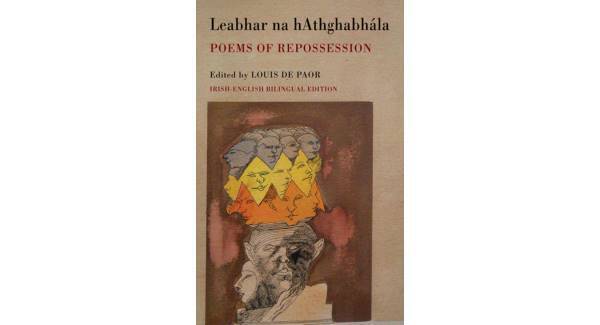
There is no paucity of voices in this anthology. De Paor features more than 160 poems in Irish and English in more than 500 pages of poetry from the 20th century.
Biographical notes on each writer are given, as well as the names of the various translators, many of whom have been newly commissioned.
This bilingual anthology is aimed at readers of English “who do not otherwise have access to material in Irish, and for those with some knowledge of the language who may find the English versions helpful as a bridge towards a fuller engagement with 20th century poetry in Irish.”
De Paor writes that more than three decades after Seán Ó Tuama and Thomas Kinsella introduced a new readership to poetry in Irish from the 17th to the19th century in “their groundbreaking An Duanaire: Poems of the Dispossessed 1600-1900, an ‘act of repossession’ is still required for Irish language poetry produced between the cultural revival of the Celtic Twilight and the economic insanity of the Celtic Tiger that brought the second millennium to a close.”
This well laid out book “takes its title and inspiration from Ó Tuama’s and Kinsella’s landmark publication, offering a selection of the best poems produced in Irish in the last century, with English translations...”
The poets selected “reflect a defining aspect of 20th century Irish life and identity in the aftermath of language change and destruction, following centuries of colonialism.”
De Paor writes that “whether the commitment to Irish is motivated by aesthetic or cultural political reasons, or both, the choice of a minority endangered language over a majority world language represents a significant act of cultural repossession in post colonial Anglophone Ireland.”
Poets represented include Pádraig Pearse, Liam S Gógan (who writes about the tension between religious belief and physical desire), Máirtín Ó Direáin, Seán Ó Tuama, Máire Mhac an tSaoi, Michael Davitt, Nuala Ní Dhomhnaill, Deirdre Brennan and Liam Ó Muirthile.
Nearly half of the poets in the anthology were born in Munster. Cork city and the various gaeltachtaí provided “periods of incubation for many poets who produced their best work after moving to Dublin and its environs, as well as for those born there.”
This well thought-out anthology proves that in a niche poetic circle, the Irish language is being proudly repossessed.
CONNECT WITH US TODAY



Be the first to know the latest news and updates