Don’t suffer in silence with pain, get a diagnosis
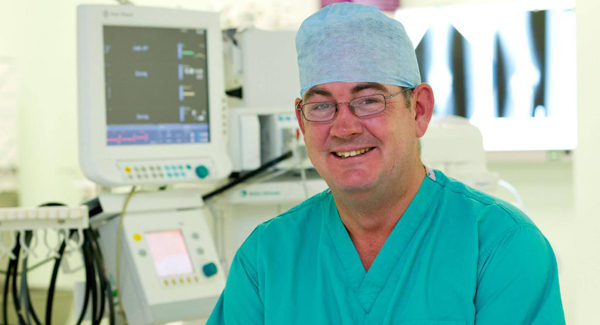
NOBODY should live with debilitating pain but as consultant orthopaedic surgeon, Mr Stuart Edwards (SE), explains, watching patients regain their mobility after hip replacement surgery gives him huge job satisfaction.

SE — The age range for hip replacements in Ireland is wide. My youngest hip-replacement patient in Ireland was 31 years old, the oldest was 91 years old.
It is a procedure more for the 60 to 80-year-old age group but there is a large proportion of women in their early 50s who are getting hip replacements because the socket of their hip joint didn’t form quite right when they were a baby.
Normally hip pain is felt in the groin and it can go down to the knee. In fact, about one in seven patients who come to see me with knee pain, have no trouble with their knee at all, it is originating from their hip. It can be very difficult to convince them that the pain is coming from their hip.
Patients can also struggle when putting on shoes and socks or when clipping their toenails, as they have stiffness and arthritis in the hip.
SE — It actually isn’t normally a very painful procedure, unlike the knee, which can be sore. Most patients get up the next day amazed that their arthritic pain has simply disappeared.
We put a shell in the socket and inside that shell you have a liner that is made of a special plastic that is long wearing, or made of ceramic.
Inside the thigh bone we put in a stem that is made of titanium, which has a porous coating, allowing the bone to grow into it. You have a ball on top of that and that is the premise of a hip replacement.
SE — There are five questions that you must ask yourself:
1. Do you have pain on a daily basis?
2. Is it disturbing your sleep at night?
3. Are you taking pain killers?
4. Is it more of a misery than a nuisance?
5. Are you struggling to walk a mile?
SE — You are in hospital for about three or four days and on two crutches for three or four weeks, a single crutch for three or four weeks, and then by three months you should be walking a mile with ease. Depending on your type of work, it takes between eight and 12 weeks.
While with a knee, there is a lot of rehabilitation, with the hip, the only rehabilitation is walking. You don’t need to do much else. And there are no real physio requirements.
SE — Yes, most definitely. The best part of doing what I do is seeing how it helps people live fuller lives. It’s phenomenal to see the pain going from patients’ faces. It is life changing.
SE — Don’t suffer in silence. Go and get a diagnosis. Just because you are seeing a surgeon, it doesn’t mean you have to have surgery. Half the battle is the fear of the unknown.
If patients have the understanding that they can consult their surgeon and he or she will give them options and advice, then that takes a bit of the fear out of it.
www.materprivate.ie/cork