America marks 30 years since loss of Challenger space shuttle
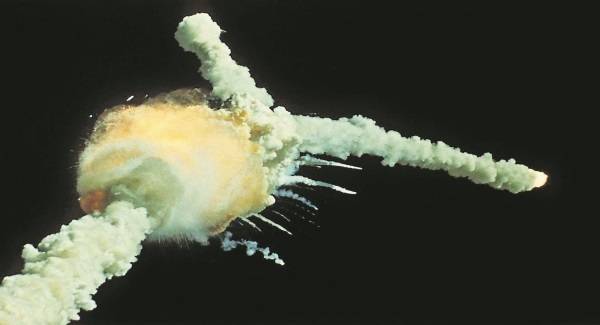
JUST 73 seconds into take off, Space Shuttle Challenger’s pilot Mike Smith uttered the words, ‘Uh Oh.’ He was never heard from again.
On January 28, 1986, 30 years ago this month the NASA space shuttle Challenger disintegrated shortly after take-off. All seven of Challenger’s crew died, with the tragedy having a major impact in America and throughout the world. Upwards of 17% of the American public watched the launch because of one significant crew member, Christa McAuliffe. McAuliffe was to be the first teacher in space.
Sharon Christa McAuliffe was one of 11,000 applicants competing to be part of the ‘Teacher in Space Program’ . The idea was to send an ‘ordinary person’ into space at a time when budgeting for the shuttle programme was being scrutinised by Washington. It was also a opportunity for NASA to show the world the reliability of spaceflight. With this in mind, Christa McAuliffe eagerly posted her application form. McAuliffe had long had an interest in spaceflight and keenly remembered the excitement of the first moonlanding in 1969.
On her application form she wrote, “I watched the Space Age being born and would like to participate.”
She was selected in the summer of 1984 for the mission two years later and her role on the shuttle was to give lessons to students from space. McAuliffe had an engaging personality which captured the imagination of the American public. The ‘Teacher in Space’ tag gained NASA much media attention in advance of the launch and so the public relations fall out was even greater than it would have been when the mission crashed into the Atlantic ocean.
On the morning of the launch, family and friends of the flight crew gathered at the Kennedy Space Centre in Florida for Challenger’s 11:38 am launch. Ice covered the launch pad and icicles could be seen hanging from the Launch Tower. Administrative hold-ups and bad weather had already delayed the launch with countdown originally planned for January 22 before it was pushed back . Eventually NASA committed to the 28th of the month.
In little over a minute, television viewers saw a mood of excitement give way to horror as Challenger broke into pieces a little over a minute into take off. As debris fell towards earth the NASA flight controller was heard saying, “ Flight controllers here are looking very carefully at the situation. Obviously at a major malfunction.”
President Ronald Reagan later that evening gave an address from the oval office saying “we’ve never lost an astronaut in flight, we’ve never had a tragedy like this”. He ended his address stating “Nothing ends here: our hopes and our journey continue.” President Reagan then launched the biggest naval rescue in American history.
The Rogers Commission of Enquiry found a technical fault within a seal (the 0-ring) as the main cause of the accident. The commission also blamed NASA’s structure as a contributing cause. This was thanks to the diligence of the commission’s Richard Feynman who unearthed significant dirt on NASA. Feynman was threatened with his findings being left out of the concluding report. Feynman, who despised corruption, insisted on their conclusion.
Another hero to emerge was an aerospace engineer named Roger Boisjoly, a man who had repeatedly warned NASA to cancel the launch. Boisjoly had major reservations about the 0-ring’s capacity to operate effectively in cold weather. He was dismissed by his manager, who snorted: “When do you want us to launch- next April?” Months prior to the launch Boisjoly had sent several memos stating that unless the problem with the 0-ring was addressed, we could be looking at a “catastrophe of the highest order with loss of human life.” Boisjoly’s concerns were also dismissed by his co-workers.
Later Boisjoly was later given an award by the American Association for the Advancement of Science for his bravery.He continued on to have a successful career in forensic engineering and corporate ethics and died four years ago.
After the Challenger disaster shuttle flights were suspended for three years;. Another tragedy befell US space exploration in 2003 when Space Shuttle Colombia disintegrated on re-entry into the earth’s atmosphere; all seven crew members died. Every January NASA pauses to remember those who died in the cause of space exploration. A monument to the crew of the ill-fated Challenger crew can be seen at Arlington National Cemetery in Washington DC.

CONNECT WITH US TODAY



Be the first to know the latest news and updates






