Colour blindness can affect people more than you think
A heartwarming video clip has circulated online showing colour-blind people wearing glasses that enable them to see a world of colour. According to EnChroma, the US company that produces the glasses: “Experiences like a rainbow, or a sunset, seen for the first time with EnChroma, are magically transformed beyond any rational description”.
However, while a father’s first sight of his son’s drawings would bring a tear to any eye, colour blindness can have more than just an aesthetic impact on people’s lives.
Kathryn Albany-Ward founded the advocacy group, Colour Blind Awareness, after she discovered, “by pure chance”, that her then seven-year-old son was colour blind: he couldn’t tell the difference when teammates used reversible rugby tops at school.
“He knew some of the kids had turned their tops over for games, but he couldn’t see the difference. It was a big shock to me, because I didn’t know it was in my family. It had come down my mother’s line, so I was a carrier — but I had no idea.”
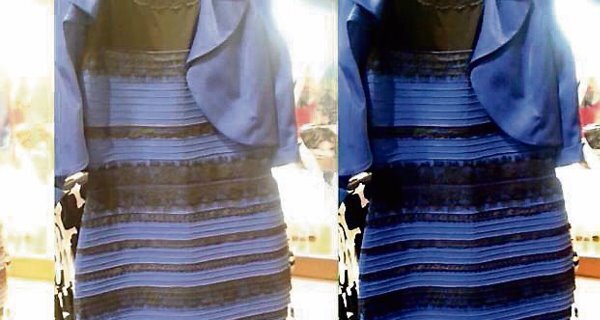
See if you can pass this colour blind test
She found it difficult to source information on colour blindness, and was surprised at the lack of awareness when she asked her son’s school for assistance.
“They knew nothing about it. That shocked me even more, because I knew, even then, that one boy in 12 is colour blind,” Albany-Ward says.
There is a widespread lack of understanding about colour blindness, even though it is the most common congenital disorder in humans, affecting more than 300m people. Colour blindness is a common term for colour-vision deficiency (CVD), which is the inability to distinguish between colours. CVD ranges from mild to severe and affects one in 12 men and one in 200 women. It is the result of an abnormality in the retina, which is made of rod and cone cells that respond to light. There are three types of cone cells, and each type has a different sensitivity to light wavelengths. If you have a colour-vision deficiency, then one or more cones will be missing or won’t function normally. This means you’ll be unable to see the full spectrum of colours. The myth is that colour blind people only confuse reds with greens, but many colour combinations can cause problems, particularly blues and purples.
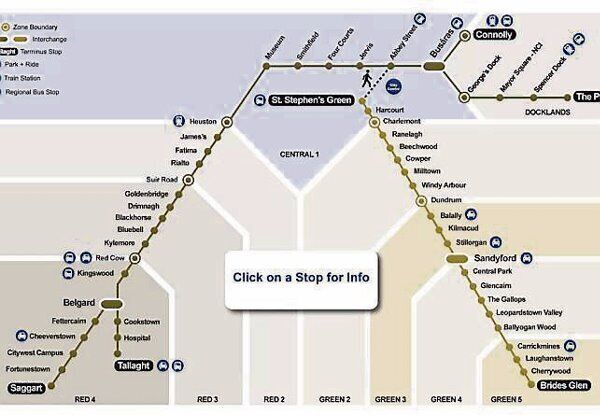
Colour blindness is a particular problem when people are playing sports, using public transport, reading maps, cooking, sorting out the recycling, and even playing computer games. But colour blindness is often treated offhandedly or light-heartedly. “My brother-in-law is colour blind and I used to joke about that. I wouldn’t do it now,” says Albany-Ward. “The problem is that it’s so common everybody knows someone who’s colour blind, and they think that person is getting on fine. But they don’t have an appreciation of the issues that affect that person, and it can be quite extensive, depending on how severe it is.”
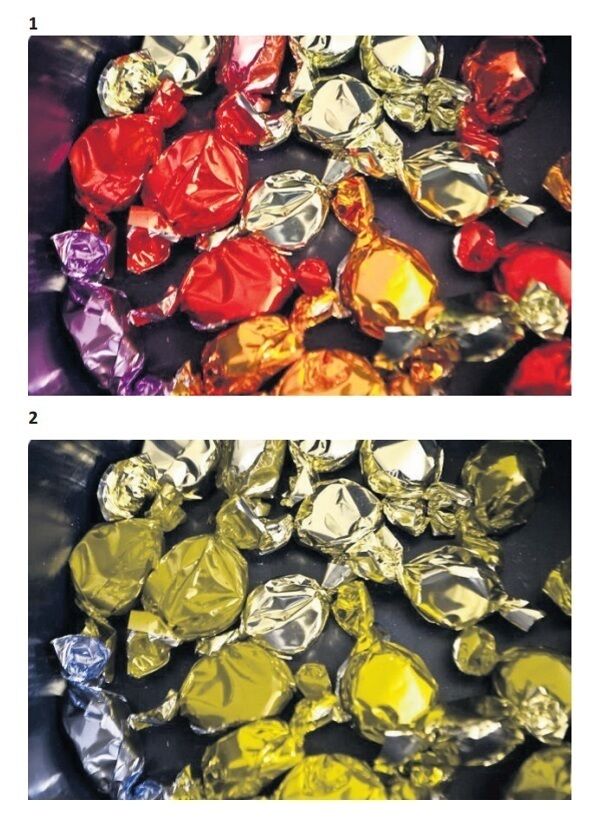
For example, Albany-Ward crossed swords with the British shopping chain, Sainsbury’s, over its chocolate wrappers, which can confuse colour-blind people. That’s risky if they have allergies, and are susceptible to anaphylactic shock.
“If you’re colour blind, you can’t tell what kind of chocolate you’re eating. What’s significant is that one had hazelnut in it, which could have dietary implications for people with allergies,” says Albany-Ward.
Sainsbury’s has agreed to change the wrappers to make it clearer to people what each chocolate contains.
Problems for people with colour blindness start in school, because education is reliant on colour and teachers don’t know how to identify and support children who have the condition. Even most of the children will be unaware they have it. Like dyslexia, before it was well-understood, colour blindness is a hidden disability that can disillusion children about learning. When they leave school or college, certain professions, such as flying planes, are obviously off limits, but issues can also arise with other careers.
“For safety reasons, you can’t be a train driver or an electrician; a GP who’s colour blind couldn’t spot a rash or differentiate between fresh and old blood. Web design would be difficult. Horticulture — you can’t see the colours of fruit or flowers. Even graphs and charts aren’t colour-labelled, so if you work with those, it’s hard. It doesn’t mean you can’t do those jobs, it just takes more of an effort,” she says.
As for the EnChroma ‘miracle’ glasses, Albany-Ward is less than convinced, saying they only work for people who have mild colour blindness: “The video is fantastic for the people featured in it, but they don’t work for severe colour blindness. I get cross, because they’re heralded as a cure, when they’re not. They cost about $400 and people are buying them not knowing they won’t work for them.”
Albany-Ward’s son is now 13, but she is still surprised by the lack of information and support available for people with colour blindness. Why does she think more colour-blind people do not campaign for change?
“It’s the 21st century — I couldn’t believe I had to be the one to do it. Until you see what it’s like through the eyes of a colour-blind person, you don’t know what they’re missing. Half the problem is they don’t know either, because they don’t know any differently. If you could give someone who is colour blind full colour vision, so they know what they’re missing and then take it away, you would then see colour-blind people looking for change.
“But people have ridiculed them their whole lives, so whenever anything involves colour, they take a step back and let other people get on with it. We colour-normal people are the only ones who can fight their corner, because we can see what they can’t see.”
colourblindawareness.org
twitter:@colourblindorg
See if you can pass this colour blind test
DISCOVER MORE CONTENT LIKE THIS
CONNECT WITH US TODAY



Be the first to know the latest news and updates









