And the winner is? Only two men have the answer
THE Oscars are a serious business. As the high point of the year for the film industry, which measures its worth in billions, Academy Awards night remains one of the biggest annual events across the globe.
Watched by a billion people in 100 countries, every detail of the marathon evening is measured and practised to the nth degree.
While the world waits anxiously for that iconic announcement — “And the winner is…..” — a pair of anonymous accountants hidden in the wings are the only ones who know the winners days before — even before the US president.
Brad Oltmanns seems an unlikely keeper of the world’s biggest secrets.
Yet, this affable and mild-mannered PriceWaterhouseCoopers accountant has for 13 years possessed information for which people might kill.
Oltmanns and his partner, Rick Rosas, know the Oscar secrets ahead of the stars, the studios and even the best-connected Hollywood agents.
Having retired a few months ago, Brad personally counted all 5,808 Academy members’ votes every year dating back to 2001, and has etched his name in the 80-year-old membership roster of the most glamorous annual event in the world.
In a city that thrives on gossip and knowing the inside line, this career PwC man needed no reminding of just how important a job he was tasked with as the keeper of Hollywood’s biggest secrets.
“PwC’s connection to the Academy Awards goes so far back, and it is, without a doubt, one of the most interesting jobs an accountant can have, because of the tremendous visibility, exposure and glamour associated with it,” he says.
“I never dreamed that I would have had a chance to do something like this in my career. I’ve been with PwC for many, many years, and I can say, with complete honesty, that it was truly one of the most exciting events of my professional life.”
In a job where confidentiality can make or break careers, Brad and his trusty partner, Rick, knew who was going home with Oscars a full 48 hours before anyone, including the nominees themselves, discovered the truth.
“In 2015, PriceWaterhouseCoopers will have been tabulating the Oscar ballots for 80 years, so, as you can imagine, we have built up a very important relationship with the Academy over that time,” Brad says.
“Our association goes back to the 1930s, so that certainly makes it one of the longest working relationships that our firm has — and we obviously take it extremely seriously.”
The firm boasts that it has never had a security breach in those eight decades. Each of the 5,808 ballots mailed to Academy voters in December contains a control number that corresponds to the voting member.
If a voter’s ballot is lost or stolen, as happened back in 2000, PwC immediately voids it and replaces it with a new number.
“If somebody was trying to print up duplicate ballots and then mail them in, we would know,” he says simply.
In an age in which electronic voting and the spectre of hanging chads have cast their own dubious legacy across America, all of the 5,808 votes are counted by hand without recourse to anything technological — neatly averting the danger of anyone hacking these secrets before their time.
“It is the system that’s operated for the last 80 years and we see no reason to change it now. In the same way Rolls-Royce continues to build cars by hand, we continue to count by hand,” he says with a smile.
The PwC accountants take three days to count the final ballots, finishing on the Friday evening before the Sunday night Oscar show. They tabulate in a secure, windowless conference room at a secret Los Angeles location, with just a few carefully chosen assistants and 5,808 pieces of paper.
“We never disclose where the location is. It is not necessarily within the company building — but I can tell you that there is a secret room,” he says mysteriously.
The only access to this inner sanctum is through daily, changed key codes and double-check security procedures.
“All the ballots are required to be received by us Tuesday of Oscar week, and we begin the count first thing the next morning. A very small team of us are cloistered away for two days tabulating the ballots, with each of us checking and double-checking the counts at every stage of the process,” Brad says.
The small count team is divided into three units, each in different sections.
No team has the full count, and thus has no idea who the winners might be.
With such a huge audience watching the Oscars, the affable Brad needs little reminding of how important it is to anticipate any, and every, angle of difficulty that could possibly emerge.
“An audience of this size does make you focus on the importance of what you’re doing, and the long and unblemished track record that our company has had of doing it without a hitch,” he says cautiously.
“The fact that there’s never been a breach of security, or a leak of information, surrounding the event is a reflection of just how important this whole process is for us. If anyone wants to think that tabulating votes for two days is a tedious thing, I remind them of just how big a deal this really is,” Brad says.
He does concede a certain satisfaction in monitoring the non-stop TV entertainment shows in the lead-up to Oscar night: “It’s fun to watch those talking heads forecasting who they’re certain is going to win, and why. I’m sitting there watching them and thinking — ‘You’re way outta the ballpark on that one, fella’. It’s another little thrill of the job,” Brad says.
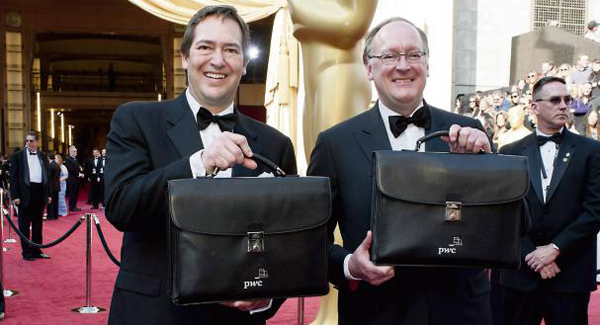
On the day of the Oscars, accompanied by armed, tuxedo-clad Los Angeles police officers, the men from PriceWaterhouseCoopers take separate routes to the Kodak Theatre, carrying briefcases that contain two sets of envelopes with the winners’ names.
“The police officers are not there for us, they are there to protect the envelopes,” he says.
Up to six different routes from the ballot-counting location to the theatre are worked out in advance, but decided on only at the last minute.
While the briefcases are not handcuffed to the two accountants, like the White House agents carrying the nuclear codes, the pair memorise the winning names in each category, in anticipation of any possible mistakes on the night by the movie-star presenters.
This occurred in 1995, when actress Sharon Stone accidentally sent an unopened envelope off with a previous winner and was left onstage with nothing to say. Proving herself handy with a cover-up quip, Stone recovered her composure with the aid of the offstage PwC operatives, who seamlessly stabilised the rocky moment.
Having stuffed 3,000 envelopes since the system was introduced in 1941, the PriceWaterhouseCoopers accountants originally delivered the envelopes right to the podium in full view of the audience — hence that famous “the envelope, please” phrase.
Nowadays, the PwC men stand in opposite wings for the four-hour event, handing out the appropriate envelopes to the various presenters as the show progresses.
As well as knowing in advance of the world what names are written in the sealed envelopes, they also get first look at the raw emotions of the winners, away from the glare of the television cameras.
“That has to be one of the biggest thrills of the night for us, being present to see the unalloyed joy of those who’ve just won the biggest prize in their profession, as they step off the stage into the momentary privacy behind the curtain,” he says.
“Being there to witness the most recognised names in the world, as they reflect privately on the enormity of what’s happened, is nothing less than a true privilege.”
As well as knowing the most anticipated secrets in the world for a full 48-hours in advance, there’s another bunch of secrets Brad Oltmanns will carry to the grave. Namely, the runners-up.
“Those are the secrets that are never disclosed, not even to the Academy itself,” he says evenly. “The focus remains on the winners only, so if someone lost the Oscar by just one vote, they will never know.
“For us, in PwC, it’s a secret we never get to tell anyone — even when we retire from the firm.” Not even to your wives? “Especially not wives.”
So what happens to the unused envelopes at the end of the show? “Some are given to winners as souvenirs; others are destroyed. I’ve actually got a bunch of them at my house,” he says.
Might he ever be tempted to sell them on eBay? “That would definitely place one into the fireable offence category,” says Brad Oltmanns with another, knowing smile.

CONNECT WITH US TODAY



Be the first to know the latest news and updates

















