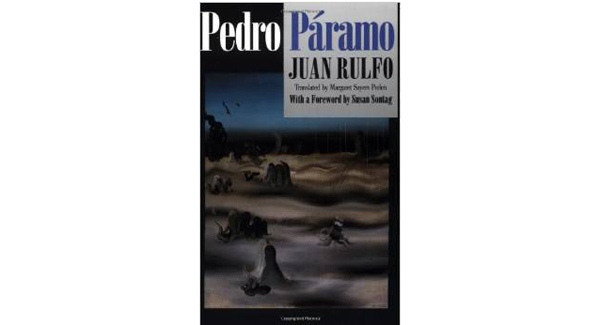
Pedro Páramo
Pedro Páramo
Juan Rulfo
Translated by Margaret Sayers Peden
Serpent’s Tail, £8.99 Kindle: £4.51
Following the recent passing of his mother, and determined to fulfil her last dying wish, Juan Preciado sets out for her hometown, Comala, a forgotten speck folded within the barren Mexican plains to find Pedro Páramo, the father he has never known.
“Don’t ask him for anything,” she’d said. “Just what’s ours. What he should have given me but never did... Make him pay, son, for all those years he put us out of his mind.”
But Comala is unlike any town that Juan has ever known. It is a ghost town, a place of relentless paradox, where the dead continue to exist, where time seems to have lost all substance, and where past, present, and future fuse together in the ugliest of ways.
Even Pedro Páramo is dead, though that does nothing to limit the overwhelming sense of his presence in every dark, bleak corner of the town.
Here, death is not only never the end, it seems to insinuate every pore of life.
The story’s narrator quickly learns that he is merely one of many children fathered by Páramo, the town’s dominant figure and principal landowner, a cruel type given to rape and thievery who wields his power well and who, following a genuinely broken heart, condemns the town, and himself, to dust.
Juan Rulfo wrote just one collection of short stories, The Burning Plain, and one short novel. When published in 1955, Pedro Páramo suffered poor initial sales and met with a harsh and even cruel critical reception. Within a decade, though, it had become one of the acknowledged masterpieces of Spanish-language fiction, and tops a very short shortlist of the essential works responsible for inspiring the Latin American boom of the 1960s and 1970s, the literary movement that pushed to the fore a generation of writers which included Cortazar, Fuentes, Mutis, Vargas Llosa and, probably most significantly, Gabriel Garcia Marquez.
The latter provides a captivating foreword for this newly reissued Serpent’s Tail edition, and his adoration is not only heartfelt but bordering on the obsessive, to the point where he claims to be able to recite Pedro Páramo in its entirety, without a single appreciable error.
After completing his fourth book, and still failing to achieve anything in the way of significant success, he’d been mired in a bout of writer’s block, and he credits Rulfo’s novel with opening the way for him to write his own masterpiece, One Hundred Years Of Solitude.
The acclaim is not hyperbole. Few novels boast such startling originality and technical nous.
With a language as close to poetry as to prose, the non-linear narrative structure is dizzyingly complex, a kind of magical realism that actually feels too muscular and inventive for such neat categorisation, delivering a fractured story that swings back and forth between a first-person evocation of present-day Comala, and a third-person vision of the town’s history, replete with Juan’s mother’s memories and the life story of the tragic monster, Pedro Páramo.
Yet for all its challenges and apparent convolutions, the vibrancy of the tale makes for compelling, even addictive, reading. It should be a difficult undertaking, but it’s not; every sentence and paragraph exists in their proper place, the way notes do in a great symphony.
This is a book to be read and savoured not just once but many times, a book of almost endless revelation.















