Vintage View: Tin-plate toys
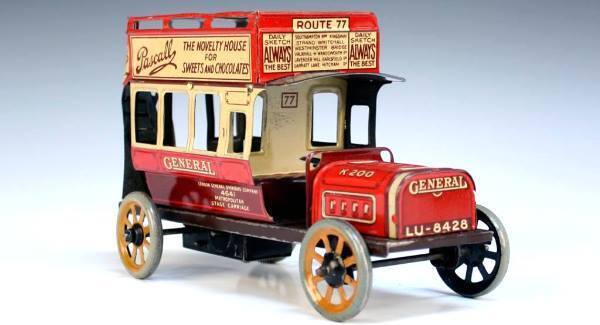
Gaily painted or printed up-vehicles, characters and creatures in tin-plated steel, were the mainstay of toy making for over a century.
Available in commercial form since the 1850s, vintage tin-plate toys generally refer to pieces manufactured before 1965. Germany had led the world in tin-plate and lithographed toys before WWI, but the loathing of the Allies for anything made by their former enemy, opened up manufacturing in other countries.
Tin was easy to work, light to export, widely available and consequently inexpensive for doting parents. Sadly in the 1960s, the invasion of cheaper plastics and die-cast metal together with safety concerns regarding sharp edges, decimated the industry.
Still rudimentary to produce, today the manufacture of replica and outright fake tin-plate pieces, complete with convincing wear, rust and period style screws, is big business in the Far East.
Toys from the 1930s featured the latest celebrity brands in rail, industry, aviation and motoring in Europe and America. Scaled down models in authentic colours, provided little boys with an exciting glimpse of a brave new world of cities, race-tracks and battlefields, where someday they might play a real and heroic part.
Tin could be used to make whimsical mechanical scenes — twitching mouse bands playing jazz, cowboys that could stiffly make a draw and menacing robots that chinked pleasingly across the carpet. Dolls furniture and beach pails, (gorgeous in sun drenched Art Deco designs), were also made in tin-plate. In a time when a puddle and a stick were standard playtime props, there was a maniac fascination for a single treasured toy — even as time-worn responsible adults, they speak to us and stir shivers of memory.
The bulk of tin-plate toys that come to market are British, American or Japanese. Pay close attention to this last set, as they are setting the market alight right now. Great names in American toys include Wolverine USA, Louis Marx, the Spanish Paya Company, and the Ohio Arts Company, and there are dozens of lesser known makers.
The Japanese presented some of the first battery- powered toys to fascinated youngsters only familiar with wind-ups and push-alongs. They were equally ingenious at fairground styling such as the bi-plane that revolves on a tower.
Large Japanese-made robot figures and space ships are the Tiffany of mid-century tin-plate toy collecting today. Names to look for include Yonezawa, Marusan, Ichiko, and Mitsuhashi. Of the German toys that made it through the wars, the best known are by Ernst Paul Lehmann, Fleischmann (known for their steam powered boats) and Schuco (famed for their wind-up animal menagerie).
Most German firms continued to hand enamel and stencil their wares rather than print imagery onto the tin. For British makes, look out for Tri-ang, an old and responsible brand from the 19th century, William Britain and of course Hornby, the king of train makers, who also made Meccano.
Look for toys with good detailing, for example a nicely printed face to a figure, neatly meeting seams, (a sign of carefully engineered quality), and as good a condition as possible. Original boxes, packaging and instructions add considerable value, and the condition of the box itself with its illustration is important.
Toys are subdivided into ‘played condition’ and ‘unplayed’ condition. Avoid toys with splits to the finish, dents, Philips-head screws, (unknown before the mid-1960s), and missing parts. Rare escapees complete with perfect paint jobs and boxes do turn up. Sunday toys, produced by grandparents for the weekend visit and then carefully replaced in tissue, may be close to pristine, but in general toys are vandalised with infant joy.
Large tin toys and unusual pieces such as carriages are highly desirable. Find out more about your chosen maker or theme by joining a dedicated collector’s club online, where toy buffs chat late into the night about the wonders of their Distler Porches and Structro tractors.
If a mechanical toy is rubbed of large areas of paint and its working parts broken, except in the case of high profile rarities, much of its value is gone. If you think a piece is just lightly seized, a light application of sewing machine oil may get it moving. Don’t attempt to scrub off rust or re-paint a toy, as light wear is part of its accrued history and you’re likely to just commit further damage.
Rub it over lightly with a damp cloth and dry thoroughly. For parts you can’t reach, a can of air, puffed lightly into the crevices will shift dirt and dust that hasn’t penetrated the finish. Many collectors recommend enzymatic fluid (spit) as ideal for a tin surface, but it’s probably a good idea to buy the piece before gobbing on the goods.
CONNECT WITH US TODAY



Be the first to know the latest news and updates

















