Puppetry and pageantry combine to bring Morpugo's War Horse to life
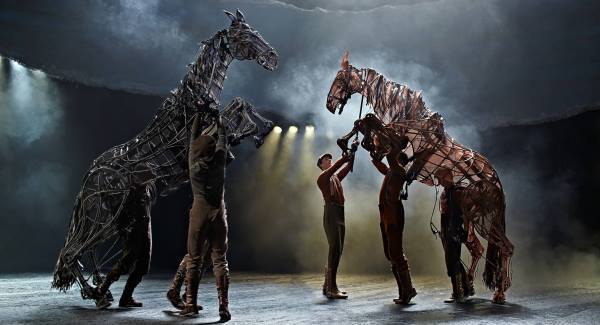
Since opening in 2007, it has broken records on the West End, toured the world to acclaim, played for over 750 nights on Broadway, and been turned into a Steven Spielberg film.
The life-sized puppets of the Handspring Theatre Company are the most striking and original thing in the stage production, but War Horse began as a simple children’s story by Michael Morpurgo.

His book, written in 1982, follows a farm horse from Devon that is sent to the front lines during the First World War. It is, in its understated way, a beautiful work, but there is one key difference. Where Morpurgo gives a voice to his horse, Joey, who narrates the book, on stage there is a silence, filled with great eloquence by those Handspring puppets.
“The problem with the first-person story is that it can be seen as a bit juvenile and only acceptable to a child,” admits the author.
“And of course they couldn’t have done a Mr Ed on stage, that would have been ridiculous. But I had no idea that they would bring to the voice of the horse this silent puppetry to which all the actors have to respond.
“And somehow that works much better — don’t tell the National Theatre that! Leaving the audience to think what the horse is saying, or seeing, gives them more respect than my book, which tries to tell it.”
Morpurgo is in Dublin ahead of War Horse’s arrival at the Bord Gáis Energy Theatre next spring. The show will run for a month, from Mar 26. That’s a lot of seats to fill — the theatre’s confidence a testament to the show’s appeal.
As a book, “War Horse didn’t do well at all,” says Morpurgo.
“It didn’t win the prize it was meant to win. It almost died, but they kept it in print. It never sold more than about a thousand, 1,500 books a year. It was out to grass on my back list when the National Theatre rang up and said they wanted to make this play with these puppets. I’d like to think that was because of something in the book, but I think they wanted to find a vehicle for the genius of Handspring Puppets.”
Despite that genius, and two years in production — which Morpurgo is quick to acknowledge as one of “the unbelievable advantages of a subsidised theatre” — War Horse did flirt with disaster. The first preview, says Morpurgo, was dreadful.
“All the bits were amazing, but somehow the jigsaw didn’t fit. I didn’t sleep for two nights after it. I thought, after all this work for two years, and high expectation, it’ll be off inside a week. But they did something miraculous, Nick Hytner, Tom Morrisso and Marion Eliot, the directors, did an amazing job. They spent 10 days getting this thing into shape.”
Opening night, recalls the author, was extraordinary. “You could see people completely wrapped up in this, deeply moved, people weeping all round me. Then when it ended, it was rapturous.”
“The most extraordinary thing that was said to me after one of these performances was by an actor coming out from the show who came over to my wife and I and said, ‘I’ve just sat through the greatest anthem to peace I’ve ever seen on stage’. You then realised what the connection was.”
Another key to War Horse’s universality is its focus on an animal’s experience, allowing Morpurgo to tell a fresh and universal story, rather than the view of just one side, as we get in Journey’s End or All Quiet on the Western Front. Writing from an animal’s viewpoint is a hallmark of Morpurgo’s fiction, coming from his own experiences running a farm near the Devon village of Iddesleigh. Part of his work there has involved bringing city children to his farm to experience living and working with animals.
“I’ve been in this privileged position of being able to watch them working alongside animals and I see the effect of the one upon the other … I’ve been seeing it as part of my profession and I’ve seen the beneficial effect, psychologically, of both sides of it.”
The story of War Horse, too, is rooted in the writer’s Devon village. When he moved there over 40 years ago, Morpurgo remembers meeting three veterans of the First World War.
“One day I got talking to them, and one of them opened his heart about how the experience had been as a 17-year-old. I had read all the great poets, Sassoon and Wilfred Owen, seen the plays, read the books, but here I was talking to the real thing. Someone who’d been there and seen it and wasn’t using the artifice of literature or anything like it to pass over to me what his idea was. I was both touched and horrified by it.
“Then the other soldier I met, I asked what regiment he had been in. He said, ‘I was there with ’orses’. Then he started, not going on about the war, but about the relationship he’d had with his horse: the respect he had for him, how he would go to the horse lines at night and tell that horse things he couldn’t possibly tell his friends. He said, ‘that horse was my best friend’. This was not a sentimental old man, he was a good old country boy and had no sentimentality about animals at all. He just said, ‘that was my best friend because I could open my heart to him’. I thought, there’s something here, something that moved me toward telling it from the horse’s point of view.”
* War Horse opens at the Bord Gáis Energy Theatre on Mar 26. See http://bordgaisenergytheatre.ie













