China’s fashion queen
In downtown Beijing, a one-mile stretch of Jianguomen Inner Street is lined with half a dozen of them. Each the size of London’s Shepherd’s Bush Westfield, together they present an A-Z of international high-end retail — from Armani to Louis Vuitton, any brand that’s any brand has a shop there.
In the heart of this kingdom of haute consumerism, you find the offices of Vogue China, where editor-in-chief Angelica Cheung holds court.
When we visit, she is wearing a fitted, dark-green, leopard-print Louis Vuitton dress with vintage jewellery picked up on one of her many trips to Europe.
She smiles as she says: “A big proportion of my day is devoted to meeting overseas fashion people, from regulars like the people from Chanel and Dior, to niche brands. When they come to China, I am on their agenda.”
She’s no stranger to this corner of the world — her husband is from Yorkshire and it’s not uncommon for them to spend holidays stomping around the British countryside. “I love the Dales, the Peak district, the areas around Whitby. It is so green, the sky so blue and air so clean. Coming from Beijing, where the pace is always so hectic and the pollution is so bad, I find the sheep on the hills and the cows in the fields so soothing and calming.”
When the magazine launched in September 2005, some questioned whether there was a market for it. Cheung, despite having previously led ELLE China and Marie Claire Hong Kong, wasn’t sure of success. She reflects: “We were prepared for it to take three years, before we saw results, but it sold out from day one.”
Seven years on, Chinese Vogue has a total readership of 1.2m. This is an upwards trend that seems likely to continue. According to a report by the Boston Consulting Group, fashion spending in China will triple from 2010 to more than £130 billion by 2020. As Vogue China’s influence has grown, so has Cheung’s. With more than 600,000 followers on Weibo (China’s equivalent of Twitter), her backing can make or break careers. After she chose Du Juan to grace the launch issue cover, the former ballerina became China’s first international supermodel, soon appearing on the cover of TIME, strutting down the Paris catwalk, and in advertising campaigns for brands ranging from YSL to Gap and Swarovski. When Cheung promoted designer Uma Wang in the magazine, Uma’s designs were chosen to appear in Milan Fashion Week.
In between meetings with models, designers and the heads of fashion houses, Cheung somehow finds time to the run the magazine, putting out 16 issues a year. The most recent, gold-embossed September issue, ballooned to 592 pages and weighs so much that a complimentary bag is provided to allow readers to more easily lug it home.
“It’s hard to do what Anna (Wintour) does with American Vogue — to look at every outfit before it goes to shoot,” she admits. “We are located far from the brand head offices; clothes sometimes arrive on the day of the shoot. (But) I can be very specific and hands-on with the pictures and layouts. And I give a lot of importance to the words too.”
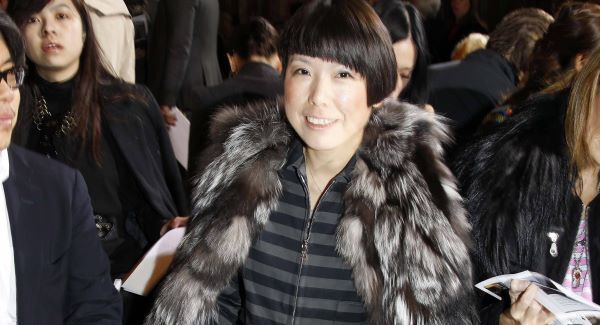
With her attention to detail, her influence and her dramatic bob, it’s easy to see why she’s often compared with Wintour.
“I do get a bit fed up with the comparisons,” she says. “Even my hairstyle. I’ve had this for over 20 years, long before I came to Vogue. And it’s not her bob anyway.”
She does like to wear Prada, but her personality is quite different from the unapproachable editor who reportedly inspired the film The Devil Wears Prada. Her voice warms as she talks about the five-year-old daughter she has with her husband Mark.
“Before, it was very normal to stay in the office until 11, 12am, but after I had my child I decided to take on my responsibilities as a mum. These days, there might be two or three times a month like that, but usually I leave by 6 or 7pm.”
Cheung tries to schedule all her meetings during the daytime, imposing “a quota of one night out for business a week”, so she can eat dinner with her family. Aside from the occasional business brunch, her weekends are “all about my daughter”. “You’ll find me in jeans and a T-shirt, playing with her in the park,” Cheung says.
On holiday too, she turns down the chance to play dress-up on designers’ yachts, instead preferring to relax with her family on a secluded Thai island or in England. (“I understand why trenches are so popular in England now; they’re so invaluable with all that volatile weather,” she jokes.)
“When I’m on the job, I dress well. But on the other hand you also know it’s just a dream you are creating. Life with my family is real. Yes, I have more clothes, shoes and jewellery, and my daughter thinks it’s normal to go to fashion shows. But I believe there’s life after Vogue.”
Cheung’s insistence that there’s more to life than fashion comes through in the magazine. She introduced a section “Vogue Attitude” to profile successful working women and prefers cover stars who have “done valuable things”, such as Russian supermodel Natalia Vodianova, who is renowned for her charitable works.
“We have tried to create a new identity for the Vogue woman. This is where Vogue China is different from other editions, which focus on looks.”
Far from a clotheshorse, she directed readers in a recent issue to simplify their lives by streamlining their wardrobes and has edited her own working wardrobe to about 20 outfits per season.
“I look at my schedule and plan for Monday to Friday, hanging all my outfits the previous Sunday evening. Then I can just pull it out and put it on.”
Her business-like attitude to apparel should not be surprising given her background. Cheung grew up in a China where fashion officially didn’t exist.
“Clothes were just clothes then. My grandmother was a tailor. She made me dresses and skirts. But it was the Cultural Revolution era and people all wore uniforms, so I couldn’t wear them to school.”
When Cheung hit her teenage years, China opened up and began its quick march to fashion modernity. She chose a degree in law and stumbled into the glossy world of women’s magazines after first gaining journalistic training at a Hong Kong newspaper.
Returning to the Chinese mainland in the 1990s, Cheung was surprised by the fashion faux pas she encountered. “You’d go to a casual lunch and there would be young women dressed in evening gowns. At black tie events, you felt terribly over-dressed as people turned up in old jeans. You just had to smile.”
But fashion sense in China has come a long way since then. Not so long ago, Chinese consumers were passed off as logo-obsessed arrivistes, but, says Cheung: “We all underestimated Chinese women. Subtle tastes, rather than in-your-face bling — they actually get it.”
The market has become multi-layered. “In fourth-tier cities, people are still acquiring new wealth and want to show it off. But the ‘old new money’ have moved on,” Cheung says. “They’re wearing Ackermann, Balmain and Marni and are choosing haute couture items over ready-to-wear. They don’t want something that is being worn by too many people.”
China’s industry is maturing too. Seven years ago, Cheung struggled to find four designers to feature in the Vogue launch issue. Today, several feature on one page as “there just aren’t enough pages”. A new generation of well-travelled designers are returning to create quality clothes. Some grace international catwalks and are sold in Europe’s top boutiques (see left).
But Chinese brands are still a long way off from competing with the likes of Prada.
“The biggest problem for these designers,” Cheung says, “is that they cannot hire good people. The good people are snapped up by the big name houses like Gucci and LV.”
One day, China might become the world’s biggest luxury producer as well as consumer and its “Made in China” image will be replaced with the quality “Designed in China” label.
But by then, Cheung, no doubt, will be enjoying her “life after Vogue”.















