Séamas O'Reilly: A working Assembly is better than nothing - I won't hold my breath
"Any hopes I had about Northern Irish politics being reliably normal died around that time, even if blips of competence and — whisper it — progress appeared on the radar here and there."
Séamas O'Reilly: A working Assembly is better than nothing - I won't hold my breath

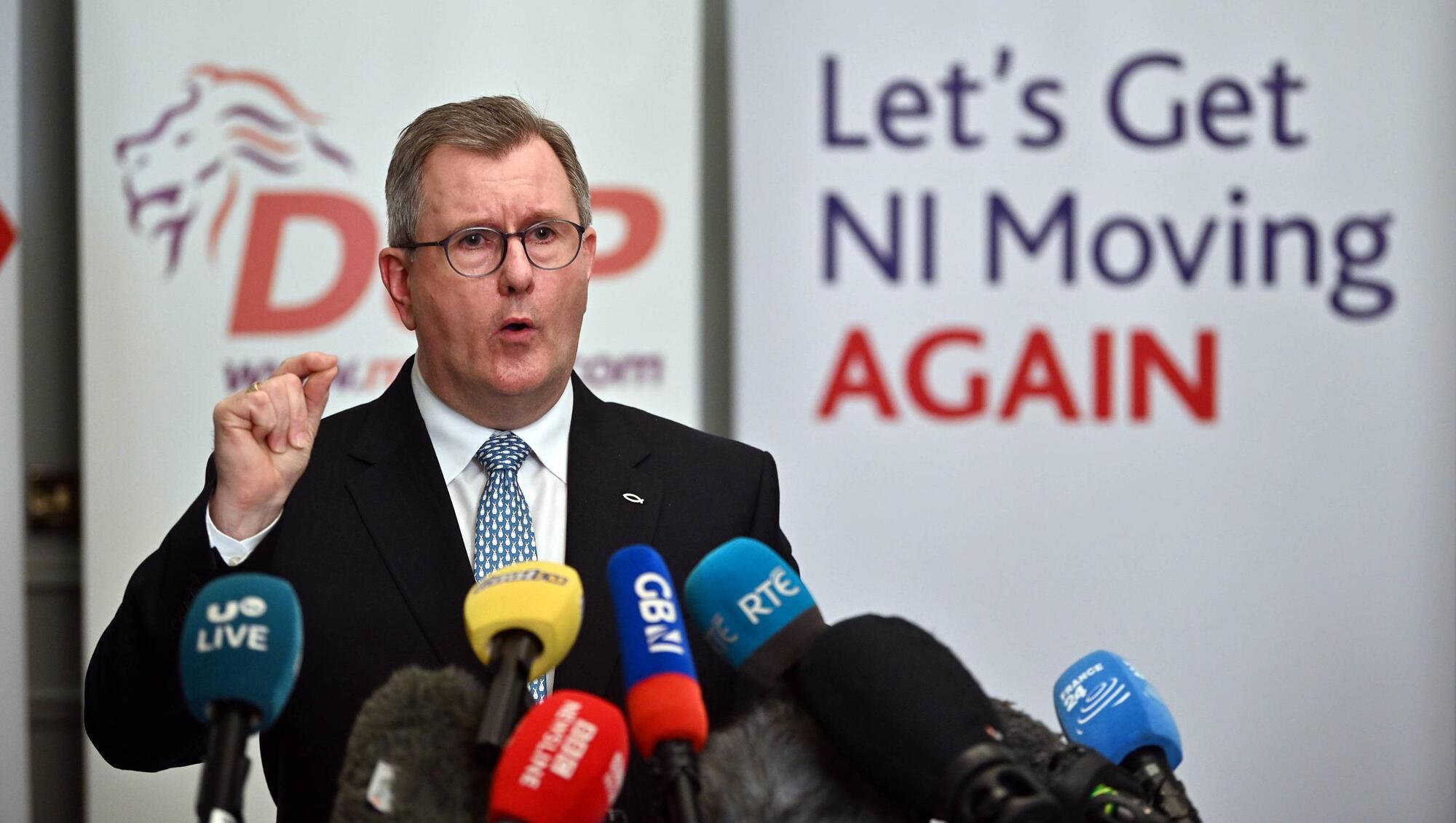
Democratic Unionist Party (DUP) leader Sir Jeffrey Donaldson addresses the media following a meeting with 120 executive members of the DUP on a possible deal to restore the devolved government on January 30, 2024 in Belfast, Northern Ireland. The province has been without a government for two years since the DUP triggered the collapse of the power-sharing executive in a protest against post-Brexit trade checks between Northern Ireland and Great Britain, known as the Windsor Framework. (Photo by Charles McQuillan/Getty Images)

I turned 18 in November 2003. Handily enough, there was an Assembly election three weeks later, so I got to cast my first democratic vote almost immediately.

As a socialist teen, I had little enthusiasm for the utter shambles that is local Northern Irish politics. But I’ll admit that voting for the first time did offer me a small, warm glow.

It’s good that it did, because that glow would have to sustain me for some time. Having been suspended for over a year before I entered the polling booth, Stormont wouldn’t resume until May 2007.

By then, I was nearing the end of my third year in college in Dublin. The freckled teenager who’d cast that first vote in his school uniform seemed a rather distant version of myself.

There are many who say a week is a long time in politics.

To those people, I’d simply say: Try 238 of them.

Any hopes I had about Northern Irish politics being reliably normal died around that time, even if blips of competence and — whisper it — progress appeared on the radar here and there.

As of February 3, 2024, Stormont’s modern incarnation has existed for 8,821 days. Of those, it has been suspended for 3,764. That’s 42.6% of its entire total.

I don’t think it’s asking too much for a government to have a better rate of operation than the ice cream machine in a service station Burger King.

This most recent stoppage has its roots in the DUP’s refusal to take their seats after the 2022 elections, which dethroned them as the single biggest party in favour of Sinn Féin.

Critics have claimed that this, by itself, explains a large part of the DUP’s reluctance to resume government. The DUP, however, claim their absence is due to the imposition of a customs border across the Irish Sea.

In their defence, this latest collapse of Stormont was on this very issue and predates that last election. However, it should be added that their votes and approval were instrumental in passing the very Brexit deal they claim to so despise.

And so, Stormont has been in its familiar standby mode for the last two years. Unfortunately, the people of Northern Ireland have no such option. 

The region remains the poorest in Britain, with the longest NHS waiting lists and the worst financial mobility. 

It is currently experiencing the biggest wave of industrial action in half a century, with over 170,000 workers striking over dire conditions and pay long since outflanked by inflation.

This, during a cost-of-living crisis that’s hitting Northern Ireland worse than any other part of Britain — a situation rendered almost comically cruel when one considers that senior members of the assembly received a pay increase of 15% in the last 12 months, without once having to actually sit in their chamber.

Loyalist commentator Jamie Bryson at Stormont, at a joint press conference with TUV leader Jim Allister explaining the legal analysis of Sir Jeffrey Donaldson’s deal with the government in relation to Northern Ireland’s place in the United Kingdom by former Northern Ireland Attorney General John Larkin.

In this light, Monday’s decision by DUP leader Jeffrey Donaldson to break the deadlock with a big party meeting could be seen as a welcome one — a sign, perhaps, that adults had returned.

On Monday night, however, such optimism seemed short-sighted. For one thing, while the DUP’s intransigence is not supported by the majority of Northern Ireland, it is popular with a diehard cohort of its most radical supporters — and those unionist parties flanking them on the right.

So it was that their entry to the negotiations was flanked by protesters, branding Donaldson a “sellout” for even daring to countenance a return to government. One might, for a moment, wonder at the cognitive dissonance of those hardline unionists.

People who have — for years — mocked the refusal of Sinn Féin MPs to take their seats in Westminster, now finding themselves shivering in the January cold, screaming “traitor!” at their own elected leaders for the crime of wanting to take their seats in Stormont.

Once indoors, the fireworks continued. Proceedings were brought to several stops when it was alleged, from the stage, that events were being live-tweeted by unionist activist and schadenfreude vending machine Jamie Bryson.

This was a hard charge for Bryson to deny since, with a flourish of absurdity that was remarkable even for unionist politics, he himself tweeted out the words: “DUP meeting descends into mayhem. JD saying texts being sent to Jamie Bryson who is giving a blow-by-blow account of the meeting.”

Previously most famous for staging a hunger strike so short-lived it amounted to little more than a late lunch, Bryson had managed to outdo even his own sterling reputation for self-administered humiliation.

Shortly before 1am, Donaldson emerged with what he claimed was a new plan to restore honour to the union.

Its topline items gestured toward a cash injection for NI and a rejigging of the Windsor Framework, to remove checks for goods crossing into wider Britain. 

Details are scant, as you might expect of any deal which purports to solve a reality that has proved stubbornly immutable for the past eight years: Economic blocs exist, and you are either in them or you are not.

Noises from Westminster suggest they might be willing to accede to EU market rules across Britain — which would be a post-Brexit climbdown so stunning, it’s hard to believe. 

Not just because it would set brains on fire within the Brexit hardliners, but because such a move would seem ill-timed for a prime minister who could leave such a surrender to Brussels as a measure for a coming Labour government to enact; one for which Keir Starmer would be promptly crucified by the Tories and right-wing press.

However, it shakes out, a working Assembly in Northern Ireland could be on the way. 

I’d like to think that’s better than nothing, but I won’t hold my breath. 

That’s the one good thing about not having any hopes left; you’re never in fear of getting them up.

x

More in this section

Lifestyle

Newsletter

The best food, health, entertainment and lifestyle content from the Irish Examiner, direct to your inbox.

Cookie Policy Privacy Policy Brand Safety FAQ Help Contact Us Terms and Conditions

© Examiner Echo Group Limited