Séamas O'Reilly: The search for the Next Big Thing - and VR's permanent tomorrow
"...the company that owns Facebook and Instagram has spent two years pushing a free online virtual world to their user base of 4 billion people, and you have never used it, nor met anyone who has."
Séamas O'Reilly: The search for the Next Big Thing - and VR's permanent tomorrow

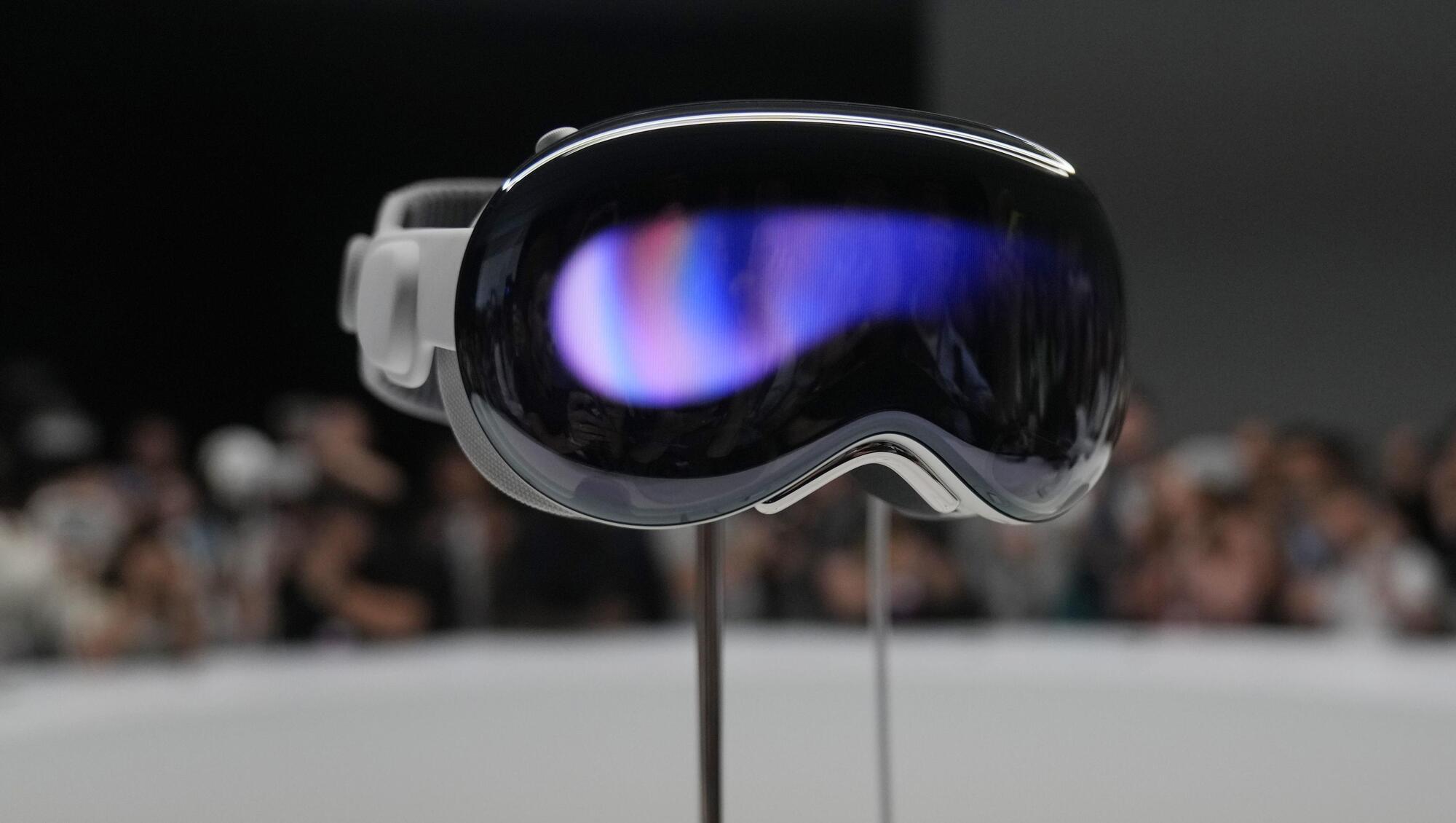
The Apple Vision Pro headset is displayed in a showroom on the Apple campus in Cupertino, Calif., at the company's annual developers conference, Monday, June 5, 2023. (AP Photo/Jeff Chiu)

Gazing at the promotional blitz for the new Apple Vision Pro, I couldn’t help a feeling of déjà vu. 

And no, unlike the man heavily featured in their advertising, I wasn’t scrolling through pictures of my kids as if I’d just murdered them, my tears obscured by the scalding hot, €4,000 computer clamped to my face. 

No, I was merely recalling all the times in the past four decades where I’ve been bidden to embrace virtual reality.

Through its many cycles, I’ve used VR a few times, and often found it very enjoyable. 

As a gaming peripheral, it can do great, immersive things, so long as the game in question is built with it in mind, as anyone who’s played Half-Life: Alyx or the space travel sections of No Man’s Sky can attest. 

But none of these experiences have ever made me want to part with several months’ wages to have it on hand, and face, to do much else. 

This would still be true if VR had arrived as a fresh, new killer app, at the bleeding edge of entertainment technology, but it’s been sold to me as the next big thing since the days when people could smoke on planes. 

It’s somehow managed to remain the Next Big Thing for decades, frozen in a permanent tomorrow that’s now lasted 40 years.

QUESTIONS NOBODY ASKED

There are certain innovations that could be placed in a category I call ‘answers to questions nobody asked’; putting cucumber slices in water; bars and restaurants that use QR codes instead of menus; those jokey emails from banks that say things like ‘whoopsie, epic fail — we’ve suffered a cyberattack’. 

VR is more like an answer to a question everyone has already answered, every single year, for four decades, and to which no one is willing to take no for an answer.

What’s more bizarre about Apple’s VR pivot is we’ve just emerged from the most comically inept attempt at virtual reclamation in many years. 

Mark Zuckerberg’s Meta shredded a billion dollars off its share price and led to massive layoffs across one of the most successful tech companies on the planet, in creating its VR-adjacent product, Horizon Worlds, the tentpole feature of its abortive Metaverse project. 

It spurred the company to change their name to Meta, cost them tens of billions, and has thus far proved about as popular as Guinness Breó. 

Rarely, in modern times, has a tech company bet so much, so publicly, on such an immediately and hypnotically terrible product.

It wasn’t merely bad, it was pointless, complicated, and so poorly executed that almost every article written about it has to bend over backwards explaining what, exactly, it is. 

This is, primarily, bad because any such explanation will likely be “it’s a bad version of Second Life, twenty years later”, but also because the very fact an explanation is necessary hints at how few people are actually using it. 

Let me put it another way; the company that owns Facebook and Instagram has spent two years pushing a free online virtual world to their user base of 4 billion people, and you have never used it, nor met anyone who has.

If I’m honest, what disturbs me about the Metaverse, or Vision Plus, is the sense that I must be wrong. 

Séamas O'Reilly. Picture: Orfhlaith Whelan

THE PETE BEST OF VIDEOCONFERENCING

For Facebook and Apple to make the same, terrible bet on the future stretches even my black-hearted arrogance to its hilt. 

I am not a futurologist, and I’ve been wrong before. 

Video chat was slow, buggy, and rarely used for a decade before Skype made it slightly less buggy and a lot more common. 

And then, I was also wrong in presuming that Skype would use its 17-year head start to its advantage when covid made in-person meetings illegal for an entire year, only to see it leapfrogged by Zoom while Skype become, very much, the Pete Best of videoconferencing.

History is not kind to those who make bold denouncements of new inventions. 180 years ago, US commissioner of patents Henry Ellsworth reported to Congress that “the advancement of the arts, from year to year, taxes our credulity and seems to presage the arrival of that period when human improvement must end”. 

In other words, the man expressly in charge of tabulating every new invention in America, figured we were quite close to having invented everything. 

This might seem careless, since he was speaking on May 31, 1843, when humanity was still six years away from inventing the safety pin.

Sometimes inventions move at strange speeds. 

Consider that the Wright Brothers achieved the first, halting twelve-second-long flight in 1903 and, within seven years, bomber planes were active in the Italo-Turkish war. 

By 1958, the longest commercial flight on Earth was Honolulu to LA (6 hours, 21 minutes). Eleven years later, a man would land on the moon.

This at least makes it seem as if progress, however oddly paced, tends to travel in a straight line. 

But then we’re forced to reckon with the fact that the first patent for a fax machine was issued in 1843, just 28 days after Ellsworth publicly reckoned that inventions were winding down. 

Wheeled luggage, on the other hand, was not invented until 1972, which means that when Neil Armstrong viewed Earth from space, he did so from a literal spaceship, and gazed upon a planet that didn’t yet have suitcases with wheels.

In short, it’s hard to imagine which inventions will catch on, or be necessary, no matter how unlikely they seem at the time. 

It’s just that I can’t help thinking innovations should seem new. For me, VR hasn’t passed that test for a long, long time.

If I’m wrong, and the whole world finally goes for virtual reality goggles at the 400th time of asking, please feel free to revisit this article in five years’ time.

Perhaps I will too, browsing the archive and sharing your mocking laughter, via a scalding hot computer pressed to my grateful, melting face.

x

More in this section

Lifestyle

Newsletter

The best food, health, entertainment and lifestyle content from the Irish Examiner, direct to your inbox.

Cookie Policy Privacy Policy Brand Safety FAQ Help Contact Us Terms and Conditions

© Examiner Echo Group Limited