Putting vegetables first: The Cork chef who has led the way in plant-based eating
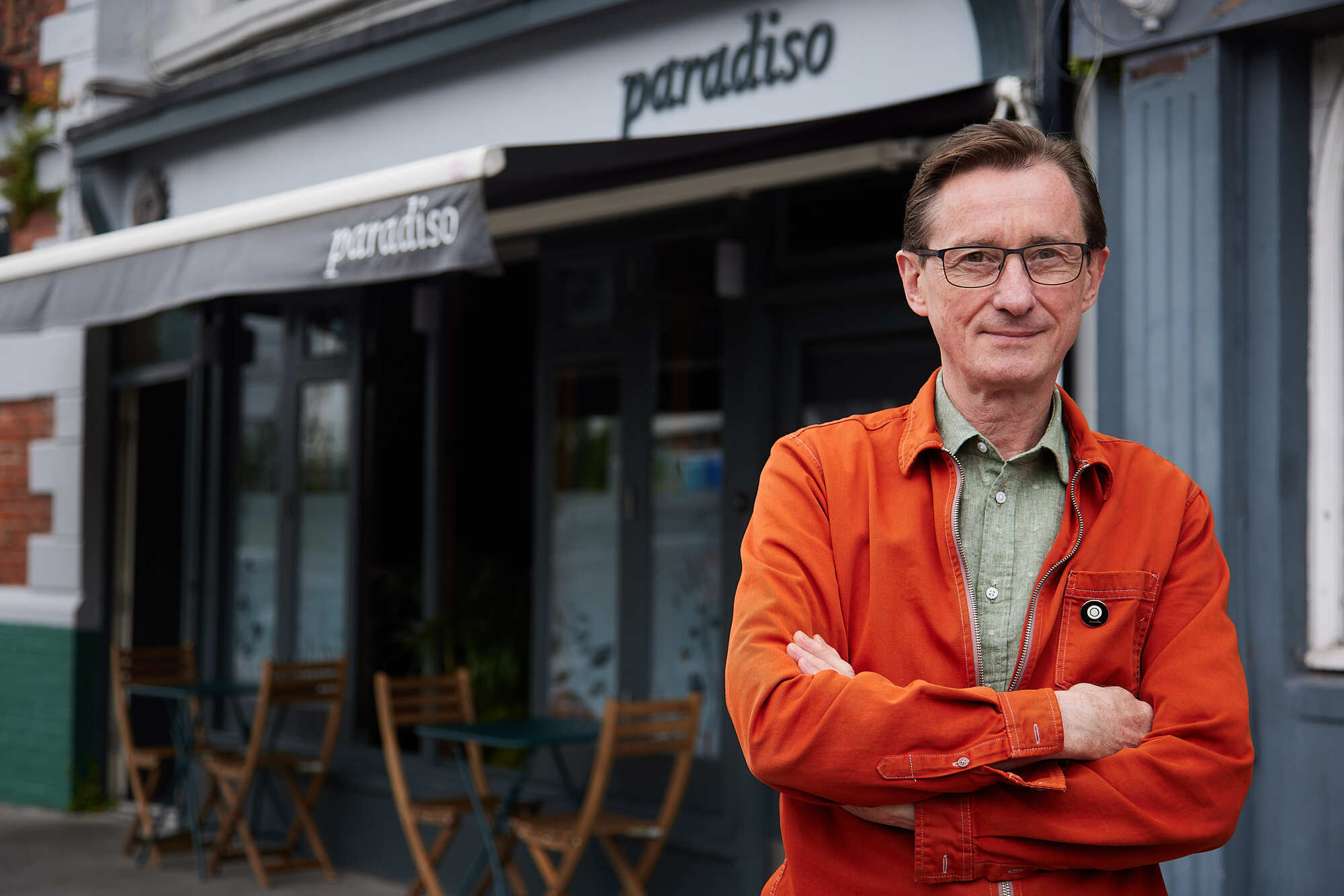
Chef-Patron Denis Cotter at Cafe Paradiso, Cork. Picture: Miki Barlok
Limp carrots, sulphurous cabbage and waterlogged turnips: in the 1990s, Ireland was not a good place for vegetable lovers. But there was a bright light in that overcooked world. In 1993, Macroom man Denis Cotter opened Café Paradiso on Lancaster Quay in Cork City, proving that you could make simple Irish vegetables exciting — and that there was an audience for it.
By putting vegetables at the centre of the plate, Cotter was a man ahead of his time. Almost 30 years later, the rest of the world has caught up with him. Plant-based eating is no longer niche, locally sourced food is king and Paradiso is a much-loved institution frequented by anyone with an interest in food.
Cotter, who had worked at wholefood vegetarian restaurants in Cranks in London and the Quay Co-Op in Cork, was determined to focus on a different kind of vegetarian offering at Paradiso, taking his cues from the fusion food that he had experienced while living in New Zealand. “It was not so much about vegetarian food as about developing a new style of cooking,” says Cotter. “I wanted to produce great food in a casual setting. I had eaten at [New Zealand chef] Peter Gordon’s restaurant in West London and he was doing very simple food with really interesting combinations. He was the king of the antipodean version of fusion but it was also popular in California. It was a very Pacific thing, grabbing flavours from all over that region and mixing them with traditional European cooking.
Moving away from a health food focus —“brown rice and chickpea” vegetarian meals — meant that Cotter refused to put rice and pulses on the menu for the first few years after the restaurant opened. This had unexpected consequences for the way he cooked. “I had to put a distance between Paradiso and other vegetarian restaurants. In terms of developing my cooking, it meant I had to concentrate on vegetables rather than pulses or grains and that was the foundation of me learning to cook in my own style,” says Cotter. “It was, ‘What are we going to do with carrots, broccoli and asparagus?’.”
Cotter’s long-term association with his vegetable suppliers, Ultan Walsh and Lucy Stewart of Gort na Nain Farm, near Nohoval, was noted internationally when they won a World Restaurant Collaboration of the Year Award in 2019. “It’s an absorbing and engaging relationship,” says Cotter, a relationship he also celebrated in his 2007 cookbook (Collins). At that time, it was a new way of looking at how a restaurateur and grower could work together: “There were things that we needed — artichokes, beetroot— and Ultan would grow them a certain way. There were also things he wanted to grow and we had to figure out how to use them. The kitchen had to learn to respond to the farm, and farm to the kitchen.”
For Cotter, this way of working developed over time. “It wasn't a philosophy and I certainly wasn’t lecturing people. It was about community. I liked the idea of buying things from people I liked and knowing the person who produced them. It’s a nicer way to do business, to build relationships rather than phoning up for the big white truck. It just evolved slowly into the food culture.”
Cotter’s concentration on locally sourced food was not just about vegetables: in the early years, Café Paradiso was also focused on dairy, specifically local cheese. “My connection with the place was through dairy first, rather than through vegetables, because of cheese producers like Bill Hogan — who made Gabriel and Desmond — the makers of Durrus, Coolea and, later, Knockalara. I got to know the cheesemakers so cheese was the first thing that connected me to the food network. The other thing about dairy is that it makes it possible for the flavours to be really rich and flavourful. Cheese, herbs and spices were the main things that gave food its flavour in those early days,” says Cotter.
The menu has been consistently moving in a vegan direction over the last eight years, however, and Cotter credits his current head chef Meadhbh Halton for her work on this aspect of the menu. “The starting point now is always vegan, both when we build a dish in practical terms or sitting at a table with a sketchbook. It’s in our minds that it should be vegan unless we reach a point with it where it demands some cheese. It might need a grating of Knockalara, but we can take that off for vegans. We don’t start with something that is non-vegan and work backwards anymore. It just means we have to work a little bit harder to make food as satisfying and full of flavour.”
With the big anniversary in 2023, Cotter doesn’t intend to rest on any laurels. “We will be celebrating 30 years but we are setting the groundwork for the next decade. Our new head chef Miguel Frutos is ready to take over in October and the key thing we have been trying to do is to remain youthful and current with the energy and curiosity of a new restaurant. We’re constantly evolving and adapting, but still remaining true to the repository of memories that is Paradiso.”
- Denis Cotter is cooking at Overends Kitchen in Airfield Estate on Friday, 22 July (sold out) and Friday, 26 August, using produce grown on the 38-acre urban farm. More information at https://www.airfield.ie
Braised turnip galette of chestnut and mushrooms: “That was a total one-off creation that came out of my brain. I’m really proud of it.”
Aubergine: “I loved aubergine and nobody was working with them in Ireland. There were a number of aubergine dishes that became favourites on the menu.”
Feta and pistachio couscous cake: “This has been on the menu for 20 years and is still a bestseller to this day. When we did meal kits during the lockdowns, it was the one dish we couldn't leave out.”
Beetroot risotto with Orange, Hazelnut Crumb, Knockalara Sheep’s Cheese
Like all of our risotto, the base of this one is vegan and it can be finished with butter, as here, or with vegan butter or olive oil. The Knockalara cheese brings a lovely creamy tang but can be omitted or replaced with soft vegan cheese.

Servings
2Preparation Time
30 minsCooking Time
1 hours 20 minsTotal Time
1 hours 50 minsCourse
MainCuisine
ItalianIngredients
50g skinned hazelnuts
50g breadcrumbs
1 tablespoon fresh thyme leaves, chopped
1 tablespoon olive oil
100mls olive oil
20mls orange juice
30mls lemon juice
zest of 1 orange
500g beetroot, roasted and peeled
1.5 litres vegetable stock
2 shallots, finely chopped
2 cloves garlic, finely chopped
300g risotto rice, such as Carnaroli
125mls red wine
100mls olive oil
50g butter
100g Knockalara fresh sheep’s cheese, coarsely crumbled
Method
Preheat the oven 100c
Place the hazelnuts on a tray and toast in the oven for 15-20 mins, until lightly browned.
Chop the nuts coarsely by crushing with the flat of a wide knife or a rolling pin.
Place a frying pan on medium heat, add the oil and then the breadcrumbs. Toast until golden brown, stirring frequently. When the crumbs are crisp, add the nuts and thyme and toss everything together in the pan for a few seconds. Remove from the heat and season with salt.
Blend the olive oil and citrus together with a hand blender to get a thick pouring consistency. Season with salt.
Chop the roasted beetroot and blitz it in a food processor to get a very finely chopped finish.
Keep the stock warm in a pot over low heat.
Heat a little olive oil in a pan and cook the shallot and garlic over medium heat for 2 minutes. Add the rice and toast it, stirring often for 7-8 minutes.
Add the red wine and simmer for a few minutes until it has been absorbed. Now add a ladle or two of stock and simmer, stirring, until it has been absorbed. Repeat with more stock a number of times, stirring often, until the rice is just tender, approx. 20 minutes. Check rice grains often in the latter stages.
Stir in the finely chopped beetroot and the olive oil and butter. Season well with salt and black pepper, remove from the heat and serve immediately.
Serve the risotto in shallow bowls with some orange sauce and some knockalara sheep’s cheese and hazelnut crumb sprinkled over.