Book review: Collection provides new insight into mind of acclaimed writer

One of the collection’s great joys is reading the author’s accounts of how other writers have shaped her as an artist and a person
Book review: Collection provides new insight into mind of acclaimed writer

Anne Enright is by turns caustic, passionate, irreverent, and self-deprecating in this collection. Photo: Moya Nolan

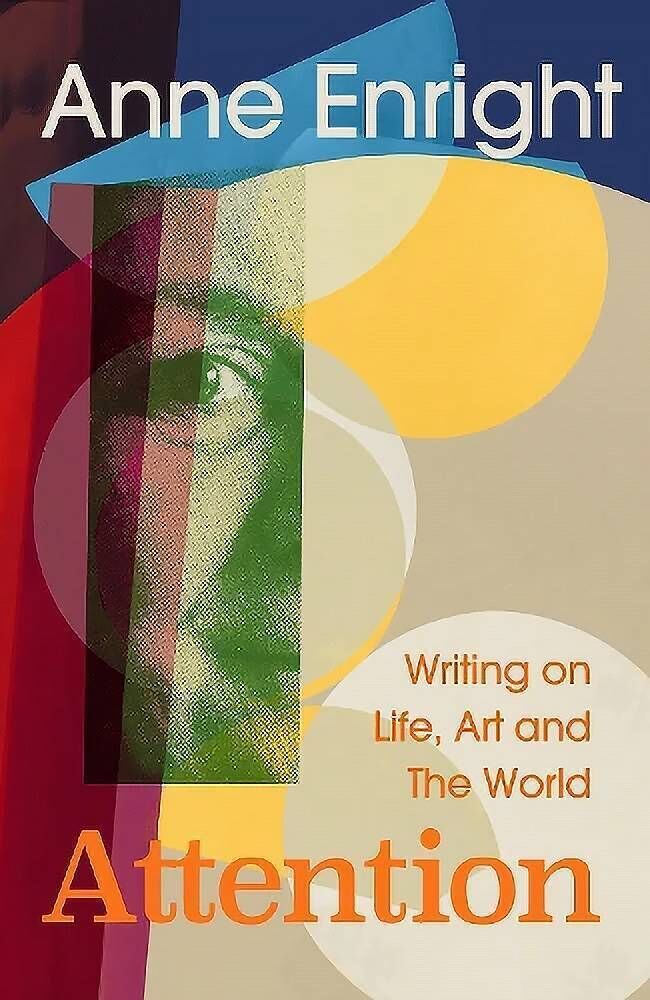
  • Attention: Writing on Life, Art and the World
  • Anne Enright
  • Jonathan Cape

The majority of the essays in Anne Enright’s Attention have been published elsewhere but bringing them together in one volume gives us a unique insight into the mind of one of our most acclaimed living writers. 

The book describes itself as ‘Writing on Life, Art and the World’ but Enright is mostly concerned with writing about writing. Indeed, Enright’s intense focus is directed at one writer above all others — herself.

Attention is divided into three sections — Voices, Bodies, and Time. Many of the pieces are focused on gender, with attitudes to women in literature, and the industry that surrounds it, given particular scrutiny. 

The tone is set in the first essay, entitled The Cat Sat on the Mat, where she describes the novelist Catherine Nicholls sending the opening pages of a book she was working on to 50 agents. Seeing nothing but tumbleweed in response, she resubmitted as “George” and fully one-third of agents wanted to see more. 

This, it should be noted, was as recently as 2015. As Enright says: “If a man writes ‘the cat sat on the mat’, we admire the economy of his prose; if a woman does we find it banal.” In spite of her successes, this double standard is clearly something that Enright feels keenly.

One of the collection’s great joys is reading the author’s accounts of how other writers have shaped her as an artist and a person. It’s clear that she experiences her relationships with James Joyce, Edna O’Brien, and others as deeply personal, as if they are physically present in her life. 

This extravagant love is, of course, conditional — the writer in question must be truly great. In the essay on Alice Munroe, for example, she can’t bring herself to entirely condemn some of the darker aspects of the Nobel prize winner’s life that emerged after her death: “I find that I cannot take back my great love for her work; it was too freely given.”
Enright’s life-long relationships with the gods of fiction are organic things, constantly evolving. As she says of Ulysses, the idea of “finishing” the book is meaningless: “You can finish it all you like; the next time you pick the book up it will be different, because you are different.” 

The all-consuming role that the art of fiction plays in her life is revealed in the closing lines of the chapter as she considers what Ulysses has to offer the 21st-century reader: “Despite the maleness of the text, despite the way it exists not on the page but in your reading of the page, the answer is still ‘Everything, everything, everything’.” 

A huge range of topics are covered here, including many that official Ireland didn’t wish to confront until relatively recently such as our abortion referendums and the relationship between women’s bodies and the medical profession. 

In virtually all cases, the subject at hand is viewed through the prism of art. Antigone in Galway, for example, is a superb treatment of the dark and cruel legacies of our mother and baby homes threaded through with a poetic analysis of the Greek tragedy Antigone — another tale of bodies dishonoured by the State or, as Enright puts it, “the political use of the body after death”.

Every essay in this book is a treasure. Enright is by turns caustic, passionate, irreverent, and self-deprecating. Attention is, unsurprisingly, excellent but collectively these essays show us another side to a great writer and allow us to feel as if we’ve got to know her a little better.

BOOKS & MORE

Check out our Books Hub where you will find the latest news, reviews, features, opinions and analysis on all things books from the Irish Examiner's team of specialist writers, columnists and contributors.


More in this section

Scene & Heard

Newsletter

Music, film art, culture, books and more from Munster and beyond.......curated weekly by the Irish Examiner Arts Editor.

Cookie Policy Privacy Policy Brand Safety FAQ Help Contact Us Terms and Conditions

© Examiner Echo Group Limited