The Currabinny chefs cook with pears

In Currabinny, there is a large house right at the cliff’s edge, overlooking the whole of Cork Harbour.
At the end of the garden, where a little grassy slope leads down to an old stone wall, a small pear tree grows, its furthest branches overhanging the sea itself.
A beautiful tree in this beautiful place does not, however, make for sweet ripe fruit. The pears are small, hard and quite bitter.
The house’s owner, an artist, makes use of them by boiling them down with plenty of sugar to make a sort of interesting conserve to have with cheese, almost like a quince membrillo.
This is a perfect example of just how versatile and how useful pears are to a kitchen larder.
The following recipes focus on this adaptability.
Thinly sliced, poached, baked and pan fried in plenty of butter, savoury, sweet and somewhere in between.
Pears start to ripen in August and last until October, but they are generally best picked when mature and left to ripen off the tree.
After you have filled the kitchen with wonderful pies, salads and snacks you can preserve them in lots of different ways which will see you eating them into winter.
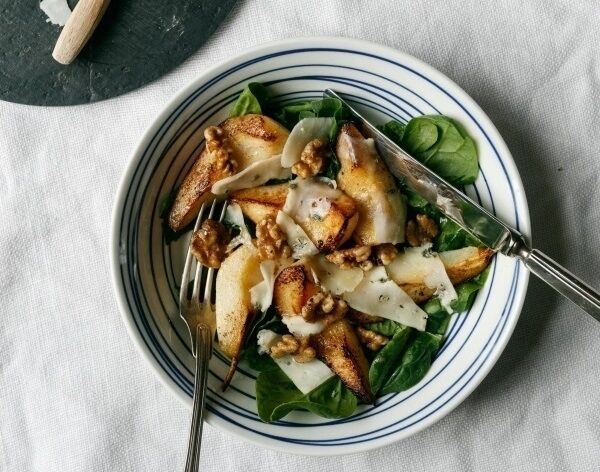
Caramelised Pear and Blue Cheese Salad
We were in a market recently where we picked up a delicious blue cheese.
It was a good hard goats cheese with thin blue lines and spots throughout.
The lady at the cheese stand let us taste a thin sliver or two and it wasn’t overpowering, being as satisfyingly salty as it was ‘blue’.
We picked up a wedge and brought it home meaning to apply it to some cheese crackers.
We both love a good strong blue, but it isn’t always appropriate to use a strong stilton or gorgonzola in a delicate or sweet salad, so with a surplus of pears and a handful of spinach this hard goats cheese, a ‘Boyne Valley Blue’, worked perfectly to compliment and not overpower the other flavours.
Preheat the oven to 180 degrees Celsius and prepare a baking tray.
Arrange the walnuts on the tray and bake in the oven for seven to 10 minutes until toasted but not burned.
Remove and set aside.
Peel the pears, remove the core with a melon baller or carefully with a fruit knife. Cut the pear into quarters.
Heat a little vegetable oil and the butter in a large frying pan on medium high.
Season well with salt and pepper and toss in the melted butter, moving the pears around the pan until golden and caramelising all over.
In a nice bowl, toss your baby leaves in a small drizzle of light olive oil, season with salt and pepper and arrange your caramelised pears on top.
Scatter over the walnuts, drizzle with a little honey and lastly shave a good amount of your blue cheese on top. Enjoy!
Ricotta toast with sliced pear
This is a great snack, really quick to make, it doesn’t involve any real ‘cooking’ apart from toasting the bread, which we recommend you do on a grill pan rather than in a toaster.
This recipe was inspired by our housemate who eats sliced fruit in a bowl with cottage cheese and honey, every day.
Neither of us have a love of cottage cheese, but we understand the satisfying combination of sweet, tart, crunchy and soft.
We thought it would do well on some grilled toast, using ricotta instead of cottage cheese.
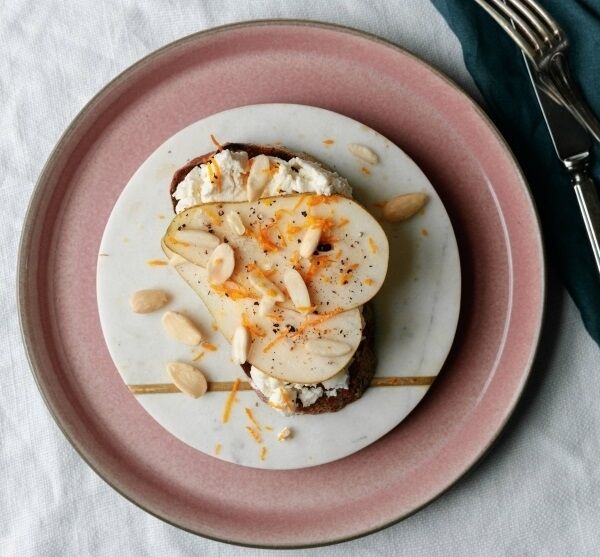
Toast your slices of sourdough, we recommend doing this on a dry grill pan which will give the toast nice charred lines which will give another flavour element.
Spread a good dollop of ricotta on each slice. Slice the pears, very thinly, using a small sharp fruit knife.
Slice down on two opposite sides of the pear until you start to reach the core, which you can discard.
Season the ricotta with sea salt and black pepper, top with the thinly sliced pear, and zest an orange over the pear toasts.
Lastly, drizzle a little honey over the top, scatter the roughly chopped almonds over it all and eat immediately.
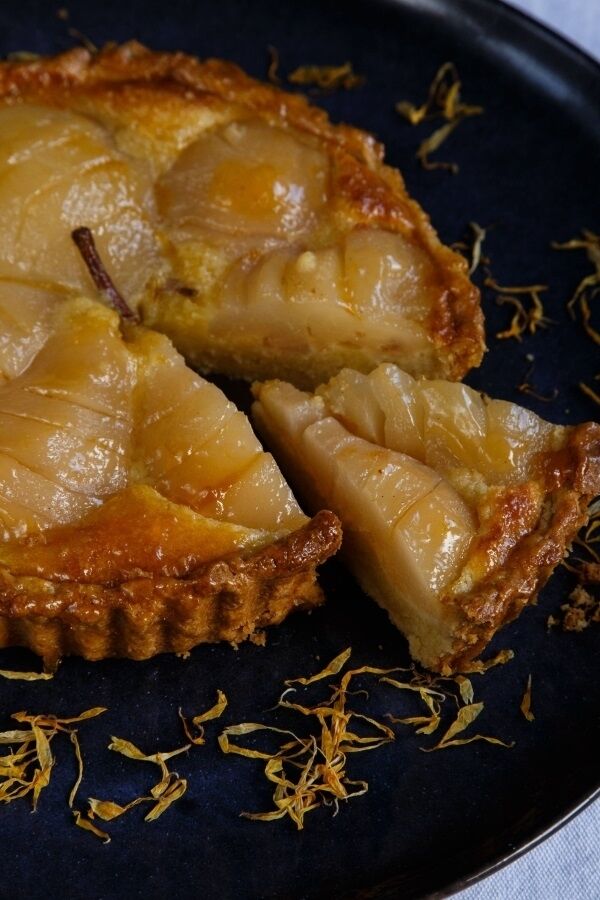
Pear and Frangipane Tart
This is a totally classic, beautiful tart to make, the key is to make the pastry as short as possible so it melts in the mouth.
I like to lace my frangipane with a good slosh of Kirsch, which brings out the subtle flavours of the pears and overall gives the tart more kick.
Use nice firm pears like conference which will hold together well after being poached and then baked in an oven.
For the apricot glaze at the end, simply heat a little apricot jam in a pot, pour through a sieve and brush with the tart all over with the glaze.
In a large bowl, sift the flour in and add the sugar and a pinch of salt. Cut the cold butter into cubes and rub into the flour to form ‘breadcrumbs’.
Add just enough egg and water to bring the mixture together into a ball.
I like it as ‘short’ as possible so don’t worry if it is a little crumbly and hard to handle.
Pat down into a thick disk, cover in cling film and leave in the fridge for at least 30 to 40 minutes.
Peel the pears and cut in half, use a melon baller to remove the core. I like to keep the stalks intact if they have them.
Heat the water in a large heavy based saucepan until boiling. Add the pears, lemon juice, lemon peel, sugar and vanilla bean.
Bring to the boil again and then reduce to a simmer.
Cover the top with a cartouche fashioned from grease proof paper and place a lid slightly ajar on top.
Leave to simmer gently for 20 minutes. Test the pears with a sharp knife, if it slides through the pears easily they are done.
Remove from the heat and leave to cool in their cooking liquid.
When everything has cooled down, remove the pears and drain on kitchen paper.
In a large bowl, cream the butter and sugar together until smooth and pale.
Add the egg beating vigorously to avoid the mixture from splitting. Stir in the ground almonds and flour until well incorporated.
Add the Kirsch at the end, I use three tablespoons which is quite strong so I recommend adding one tablespoon at a time and tasting the mixture as you go to get the flavour you like.
Preheat the oven to 200C.
Roll out your chilled pastry on a floured surface. The pastry will be a little difficult to handle given how short it is but stick with it and you will be rewarded with the most mouth watering crumbly crust.
The pastry should be around 1 cm in its thickness and the round should well be able to cover a 20cm tart dish.
Carefully flip the pastry onto the tart dish, there will be breakages, cracks and gaps but don’t panic just use the excess pastry to patch everything up.
Press gently into the sides of the tart dish and leave a rim 1cm above the side of the dish as the pastry will shrink slightly when it bakes.
Get a large piece of parchment paper and place in the tart case, fill with baking balls or beans and blind bake for 10 – 15 minutes.
Remove from the oven and take away the baking balls. Fill the case with the frangipane.
Slice the poached pears from stalk to base in 1cm pieces but leave the pear halves in their pear shape.
Arrange the halves around the tart on top of the frangipane, stalks facing inwards in a tight circle.
Bake in the oven for 20 minutes, reduce the temperature to 180C and bake for another 10 minutes until golden brown on top.
Leave to cool slightly and remove from the tart dish.
Brush with apricot glaze and leave to cool properly before serving.