Simon Hopkinson is a master at work
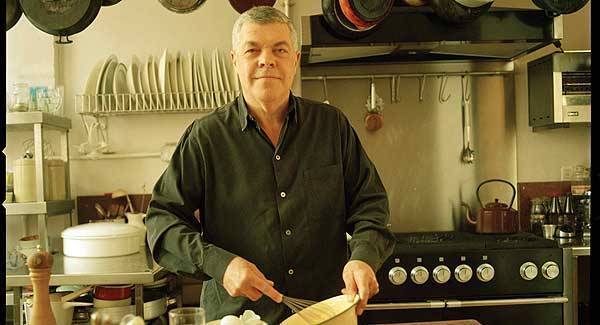
SIMON HOPKINSON has been in thrall to food and eating and cooking since early childhood; his mother, a teacher, cooked everyday, providing good wholesome food from scratch. “She’d always have something on the go,” says Hopkinson, “maybe a rabbit glazing in the bottom of the Aga.” But, rather more curiously, at a time when the only professional cooks were male while the domestic kitchen was solely the woman’s preserve, his dentist father would swap drill for skillet at the weekend to indulge his passion with young Simon beside him from the off.
“Dad had an interest in the slightly more esoteric stuff. He would get some really nice steaks, get out his copper pan, the quarter bottle of Martell brandy, cream, Worcester sauce and make Steak Diane. I suppose that was the dentist, he was very meticulous. He’d call me in because I was already interested at that stage. Every two weeks or so, we’d go to the butcher’s for ‘Lamb’s Fry’, sheep testicles. He skinned them, cut them in half and fried them in dripping from the pot. They were delicious and I didn’t even know what they were. We were among the first to go abroad on holidays, in the early 60s. I remember very exciting holidays to the Costa Brava. It’s where I tasted my first paella and the last thing my Dad bought before he came home was a paella pan. There was a fantastic market in Bury where we lived where you could get mussels, scallops, hake and he’d do moules meunieres. He loved Indian food and cooking curries. He’d go into Manchester to buy his spices and come back with all these paper bags full of spices bought loose from sacks and put them in old jars, meticulously labelling each one.”
Though a career in a professional kitchen was then rather akin to the Foreign Legion — the last resort of the desperate — his parents recognised his desire to cook and saw him apprenticed to a French chef in a Lancashire restaurant. Young Hopkinson found it hard going but by the age of 21, had opened his own little establishment, a tiny little restaurant called The Shed, in west Wales. He became the youngest chef to gain a star in the Egon Ronay guide before going on to work as an Egon Ronay inspector for three years. It was also his first introduction to Ireland at a time when Irish cuisine was a rather more rarified sport, confined to the fringes and, for the most part, a million miles from mainstream public consciousness.
“One of my first jobs as an inspector was to go to Ireland and do a sweep of the hotels and restaurants, starting in Dublin and working my way down the east coast, beginning with King Sitric, in Howth. I did a lot of places in Kerry and still remember one place, The Blue Bull, a sweet room with delicious food — I’ll always remember the phone number, Sneem 3. I loved the Arbutus Lodge and the amazing wine list. Declan [Ryan] made nettle soup and introduced me to drisheen with tansy sauce. [The late] Gerry Galvin, I loved his place in Kinsale, he was so lovely.”
After leaving Egon Ronay, Hopkinson worked as a private chef before becoming head chef and co-owner of Bibendum in London, an instant success. Many customers, including Dirk Bogarde, Stephen Fry and Francis Bacon, also became friends, but after seven years he left, though he retains a share in the restaurant. “All I really wanted was to be a cook and cook the food that I liked, which meant to be in control, just having a very small place, just four or five tables, like The Shed or The Blue Bull.”
By then he was also writing but when Roast Chicken and Other Stories came out in 1994, though much revered by his fellow chefs, it was a slow burner. Then, in 2005, Roast Chicken was selected from over 100 books by a panel of industry peers and awarded the title of “Most Useful Cookery Book of All Time”. It was a mighty shot in the arm for sales and the general public began to see the book for what it was, a bona fide classic that will stand the test of time.
“I’ve admired Simon for 30 years,” says Rory O’Connell, “we have a shared background of restaurant cooking and as a chef I’m always looking for new ideas. Roast Chicken was full of them. I cooked an awful lot of recipes from that book, not just for myself but for [Ballymaloe House] restaurant as well. His background is restaurant cheffing and despite the homecook angle that pragmatic professional voice was there.”
Neither does Hopkinson make allowances or concessions for his readers. It’s Hoppy’s way or the highway. “People who read me do quite like the emphatic stuff. If it’s a slightly too difficult or too complex a dish, cook something else. If this isn’t your bag or you don’t want to go to too much trouble, why cook something that is going to trouble you.”
He is looking forward to his return to Ballymaloe. “I first went there for a friend’s birthday but haven’t been back for years. I’m doing three ‘chatty’ sessions. I’m not good at cooking in front of people. I like cooking in front of a camera — which I was also terrified of for years and years. But I’m just looking forward to going to Ballymaloe after far too long. I’m always nervous at these things, I’m not always at my best surrounded by millions of cooks all talking the same language.”
But as O’Connell says: “I like the way he lives his life, I like the personal choices he makes. He cooks at home now, doesn’t like going out in the evening and it all adds to his story. And he’s a beautiful cook.”
“When I was interviewing young chefs,” says Hopkinson, “I never asked what’s your favourite thing to cook, I’d ask, what’s your favourite thing to eat?”