Cork: An agricultural powerhouse under threat
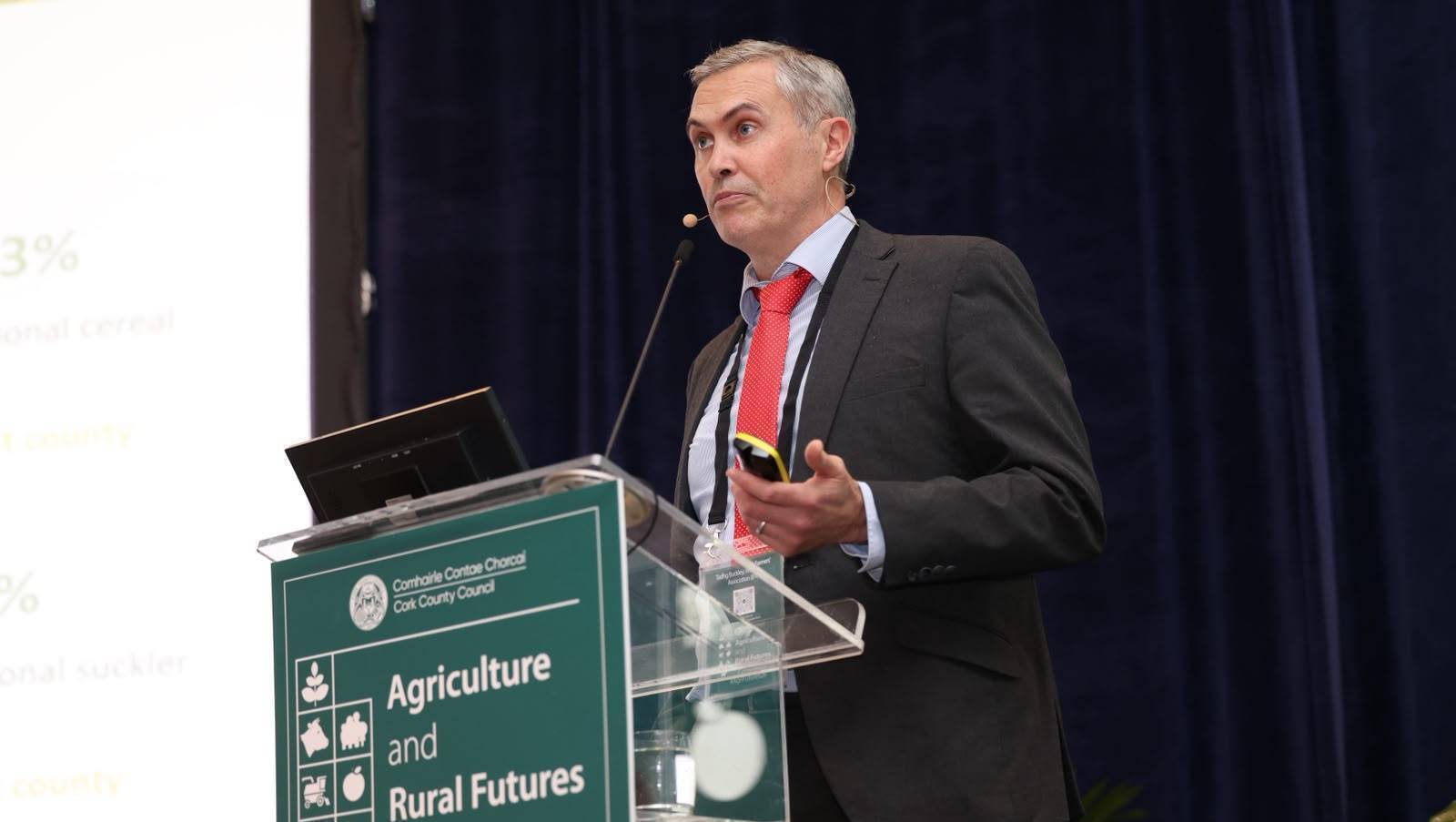
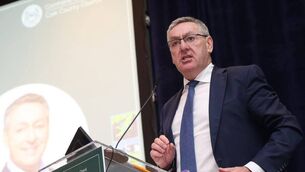
Director of Policy and Chief Economist at the Irish Farmers’ Association (IFA), Tadhg Buckley, addressing attendees at the Cork County Council Agricultural and Rural Futures Conference.
The future of the Nitrate derogation and the possibility of a tighter CAP budget were key issues brought up time and time again at Cork’s agricultural future conference.
Speaking at the Agriculture and Rural Futures Conference hosted by Cork County Council, director of policy and chief economist at the Irish Farmers’ Association (IFA), Tadhg Buckley, highlighted the strength of agriculture in the Cork region.
He noted that 12% of Ireland’s agricultural land is in Cork, which hosts 24% of the national dairy herd, 17% of the national pig herd, 13% of the national cereal area, 12% of thoroughbred brood mares, and 8% of the national suckler herd.
Tackling first the threat on farms in Cork was the loss of the nitrates derogations, Mr Buckley put forward the potential economic impact if Cork farms were to lose the derogation, suggesting an annual loss of €250m in dairy exports in Cork alone, which Mr Buckley warned of a higher knock-on downstream economic impact.
Read More
The loss of derogation would see, on average, a 19% reduction in dairy farm incomes and a 14% reduction in Cork dairy cow numbers if all impacted dairy farmers reduced cow numbers, with a corresponding drop in milk supply.
Mr Buckley explained that derogation is “extremely important in maintaining competitiveness” in the Irish dairy industry. He warned that if farmers lose derogation, Irish farmers and subsequently Cork dairy farmers will lose their competitive edge over their USA-based competitors.
Discussing derogation, Mr Buckley also touched on water quality, highlighting EPA figures showing that Cork county is ranked the fourth best in river water quality despite having the second highest share of land in derogation.
“If the derogation is causing all these issues with water quality, why is Cork the fourth best county when it comes to a water quality perspective,” he queried.
“The water quality side of it is hugely complex; the more work we are doing in it, the more we are learning how to solve that challenge… It’s a very complex issue, and the part that frustrates me is that it is directly linked to the derogation and I don’t think, if you look at any of the research and those figures, they don’t sit right.
"If it's just the derogation, then we shouldn’t be seeing the river quality numbers that we are seeing in Cork, so there are obviously a lot of other things happening.”
He concluded his analysis of derogation, warning that the loss of the programme will have a major knock-on effect on interest in the industry and generational renewal.
Discussing the future of the Common Agricultural Policy (CAP), Mr Buckley warned that the currently proposed CAP reform, and the tightening of budgets, will impact Ireland more than other EU states.
He conceded that the constricting of CAP budgets will have a larger impact on drystock and tillage farms.
Speaking on an estimated impact on Cork farmers on the current proposed CAP, Mr Buckley showed estimates of a €39m reduction in farm-level income per year, a decrease of €56m in Cork rural economic activity per annum and an average reduction in farm payments of 39%.
Concluding his presentation, Mr Buckley demonstrated the difference in electricity price among EU members.
Ireland leads in the price of electricity in the first half of 2026 at 38.71 cents/kWh. The EU-27 average is 28.32 cents/kWh, 37% below the Irish figure, making Ireland have the highest electricity price in the EU.

BLACK FRIDAY
Already a subscriber? Sign in