Paula Hynes: Why Cop needs a bit of cop on
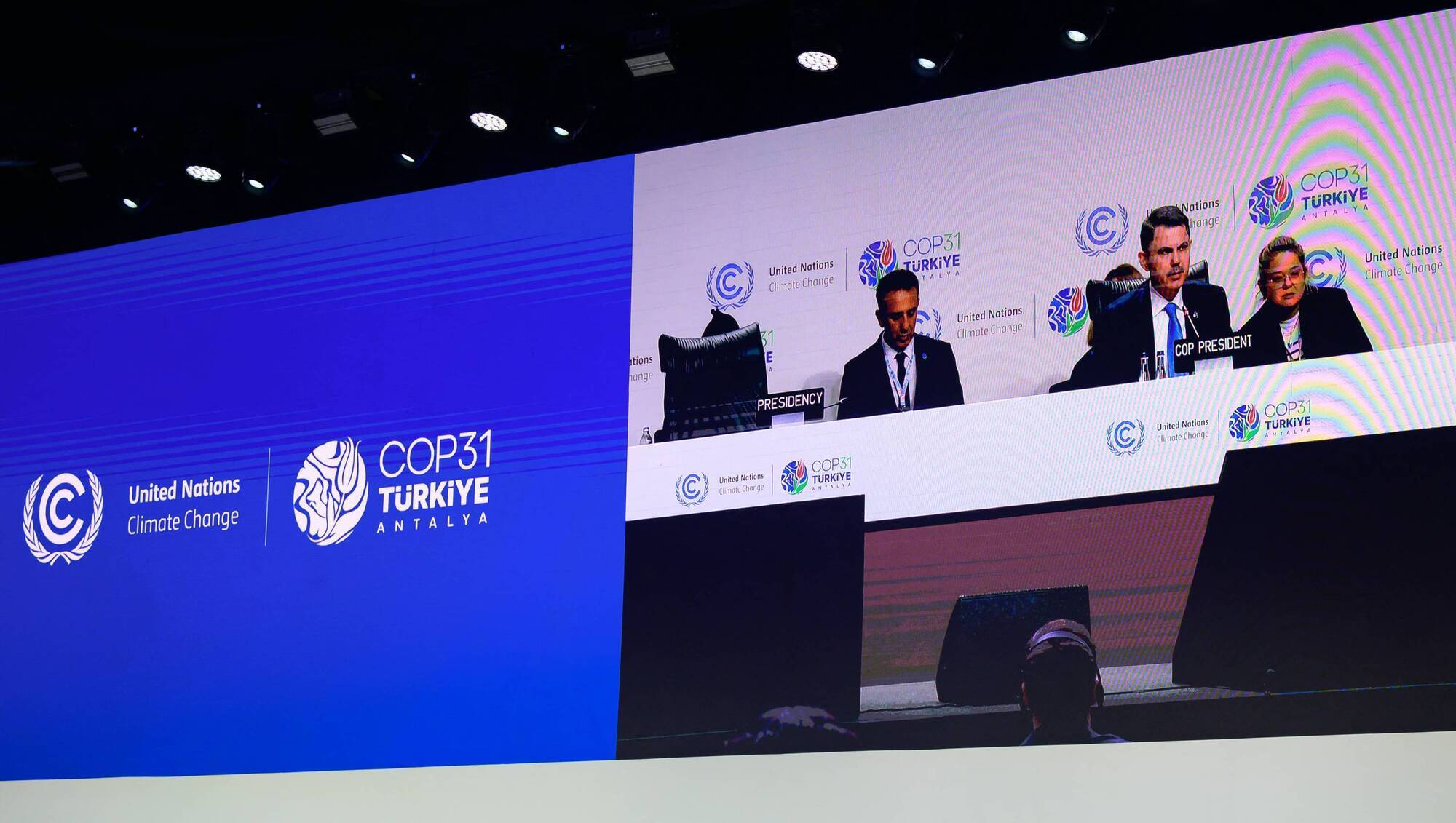
Talks at Cop31 failed to materialise into a deal, leaving some to wonder just how useful the millions of euro spent on the event has become. Picture: Yasin Akgul/AFP via Getty
Just like migratory birds fly south to warmer climates in the winter, so too do thousands of climate activists and politicians to attend a Cop event and discuss how climate change is impacting the world and also try and reach agreement on solutions.
This year's two-week-long Cop31, hosted in Turkey, had more than 92,000 people registered to attend in person.
Now, I am far from a climate change denier. It is real, and it is impacting the world greatly, but I do find it somewhat ironic that thousands of people increase their emissions by flying to an event to discuss how we should reduce our emissions.
And let’s not forget the thousands of trees that were cut down in Brazil to improve infrastructure so the country could host the 2025 event.
Read More
COP31 in Turkey finished without any overarching agreement between governments. Is that a failure, you might ask? Well, in my opinion, no, as no agreement is better than a bad agreement which countries cannot stick to.
We must remember we are also in an energy crisis, along with the fact that people are sick to the teeth of being taxed to save the world when most simply cannot afford day-to-day living.
While politicians may not have failed, it certainly seems as if Cop itself is failing, and perhaps the organisers need to go back to the drawing board as to how much political negotiation could be done online to see if agreements can be made.
Cop32 is already being planned and will take place in Ethiopia in Addis Ababa at the cost of millions of dollars.
Preparations are under way to substantially increase accommodation capacity for the tens of thousands of delegates expected to attend.
Ethiopia is also a country where more than 60% of the urban population has been estimated to live in slums.
I do wonder, though, how many of the more than 47m Ethiopians living on less than $3 a day will benefit from the event.
Thousands of inhabitants have already been displaced to make way for the city’s revamp.
It seems that a small bit of cop-on is required when it comes to selecting a city to host a Cop event, and perhaps in the future they might consider choosing a city that already has the infrastructure to actually host the event.
Alternatively, if the organisers were to encourage the tens of thousands of delegates to live in mud huts for two weeks, perhaps it would change their perspective on what it is like to live in the real world.
On a positive political note, the EU and UK reached agreement and signed a post-Brexit agreement last week, a decade after the UK voted to leave the EU.
It is good news for agriculture and food, along with food safety, as the UK will align with EU food safety and animal health rules and, in turn, border checks along with paperwork and export certificates will be eased.
It will be good news too for young people as both parties will make it easier for young people to work and travel.
It seems common sense has finally returned as regards the relationship between the UK and the EU, although the auld die-hards of Reform UK and Conservatives are none too happy that the UK does not have voting rights in the EU.
But perhaps those political parties have forgotten that the UK did previously have voting rights in the EU until they decided to leave.
The deal comes into effect as of March 1, 2028. Time does seem to move very slowly in political land when people shake on a deal but still need to get the legal nitty-gritty nailed down.
But at least for us it should be somewhat easier to travel to shows in the North and also move animals from the UK back to Ireland.
While the political world might move at a snail’s pace, I was amazed at how fast the agri-tech world moves.
Some of you may remember Daphne, who is one of Becky’s animals in Australia and one which she showed at IDW last January and again in Royal Sydney.
Thanks to the world of technology, Becky can now monitor Daphne 24 hours a day, see her grazing data, her rumination and also pinpoint her location on the farm in Australia.
Becky even rang the team down under to ask them to check Daphne as she was certain she had just calved, and right she was, as Daphne had just calved into her second lactation with a super heifer calf.
So it looks like Daphne will be show-bound with Becky to IDW again in January 2027.
All this amazing data comes thanks to the Halter collars, which were recently installed on the farm in Australia.
It is an amazing piece of kit which not only monitors health and heat detection along with calving, but also allows for fenceless grazing and moves the livestock around the farm and brings them in for milking.
Each collar has its own solar panel along with GPS, so animals’ locations can be pinpointed.
The collars use sound and vibration to control grazing and move animals.
Fenceless grazing is a huge benefit on a 1,000-acre farm where fences are constantly damaged by kangaroos. The savings in labour costs will be vast in comparison to the cost of the collars.
The technology is so advanced that farmers must complete a training course before installation.
I doubt the New Zealand manufacturers of the Halter collars thought it would benefit a young Irish woman remotely monitoring her show cow in Australia, but in time hopefully this technology will be available in Ireland as it is already available in the US and Canada as well.
The reality is Becky can sit at our kitchen table in Cork and move her cow in Australia to a different paddock.
Now that really is hi-tech.

BLACK FRIDAY
Already a subscriber? Sign in