From sheep to shop: Cavan farm finds new value in wool
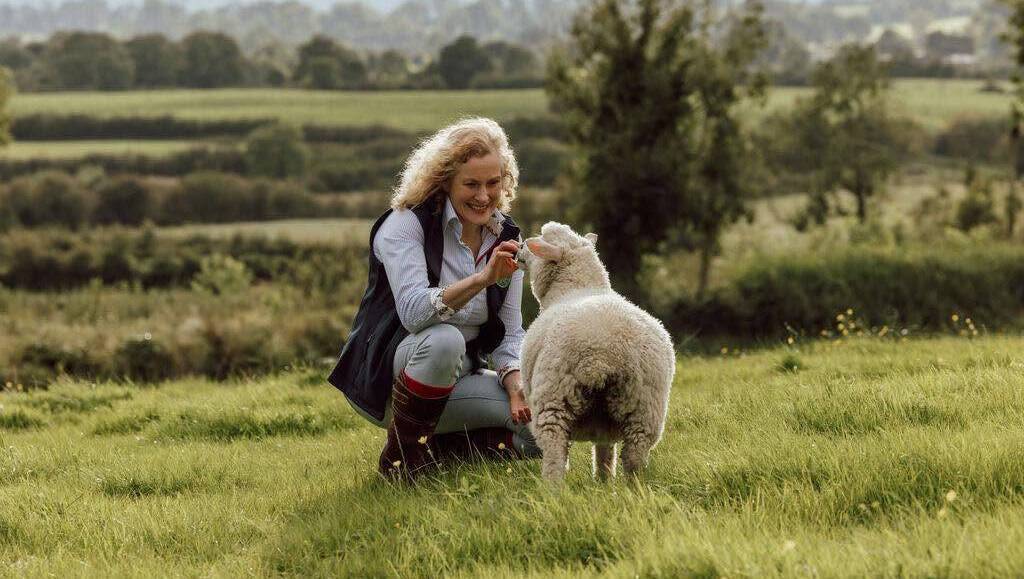
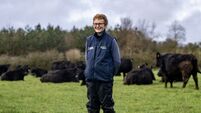
Sandra Coote on her farm in Virginia, Co Cavan.
From little oaks, great trees grow — an adage that certainly rings true on the farm of Sandra and Alan Coote outside Virginia in Co Cavan.
The couple has built a business around wool from the sheep that graze on the farm, making use of a material that is classed as category 3 waste and turning it into something “useful, creative. and of value”.
Crafts of Ireland, which is run by the husband-and-wife team alongside their son’s partner, Rachel, boasts a purpose-built craft studio and tea rooms where they teach a wide selection of craft skills through workshops and social media tutorials.
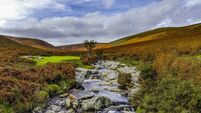
And the inspiration for it all… well, that comes from the site’s location, perched on a hill along the Cavan/Meath border gazing over the megalithic tombs of Loughcrew.
Sheep are only a small part of the farm, but as Sandra adds: “They are my end of it”.
“We have two breeds— our native Irish Roscommon sheep, which are an old breed. We also have some Bluefaced Leicester, which provide a different type of wool and are one of the finest of the British wool breeds.
“As we have an obligation to share them and look after them, their wool is shorn every year at the end of May or early June. So, from our Roscommon sheep we could have up to four kilos of wool per sheep.”
Sandra explained the family then uses that wool for a range of purposes, including washing and dyeing it themselves in the workshop on the farm.
“That means it never leaves us until it becomes the end product; this makes our business more sustainable and we have won sustainability awards as a result,” she continues.
“I use that wool to create needle-felted pieces for exhibition, for commissions, and for our wool spinning workshops. I teach wool spinning and we have our own wool available for that rather than buying fibre from outside of Ireland or elsewhere.”
Meanwhile, Sandra and her team create needle felting kits using the wool to build them. They also provide a YouTube tutorial.
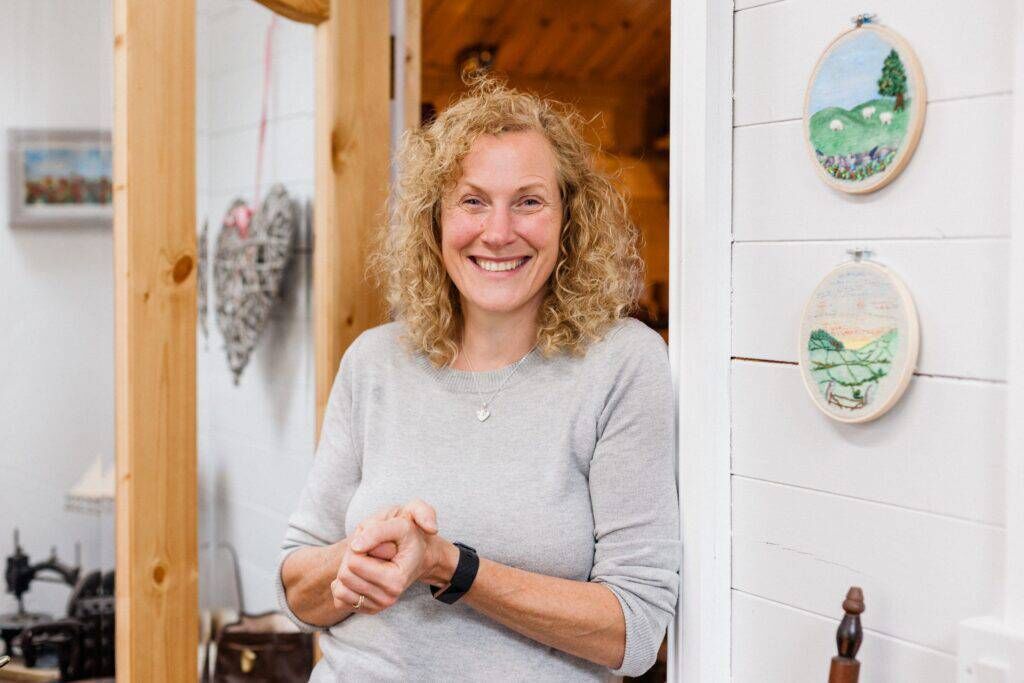
“This means we are not using paper to print, and this, of course, adds to our sustainability effort,” she adds before pointing to how the wool is used for making felt.
“Initially when I began creating the larger needle felt pictures I wanted to make them entirely from Irish wool but I ran into a stumbling block in that I needed wool-felt fabric as a background for to needle felt — this is like painting with the wool fibres onto a wool background — but I couldn’t find 100% Irish felt, it just wasn’t available, so we actually imported a machine that was built in America.
“This has allowed us to now make wool-felt fabric from our own wool. We have all the equipment to do that, and it involves washing and carding and then using the machine to create wool felt.”
These days, the family also produces socks that are knitted from high-quality yarn with the toes closed by hand to produce durable, comfortable, seam-free socks.
“We still hold needle-felt workshops on the farm; we have run them during Heritage Week and for our local authority — Cavan County Council —
and we actually held two or three workshops this week — this is one of our most popular workshops,” adds Sandra.
“We run afternoon tea and two-hour felting workshops, full-day workshops, and twice a year we run weekend workshops. These workshops attract people from America and from all over Europe.
"It's because the workshop is of longer duration and people can justify travelling to learn the craft from us.”
The business also holds workshops in schools and has built up a strong reputation and following on social media, enabling Sandra and her team to attract customers from a broad geographical range.
“Really, the social media end of our business began by accident because of covid-19,” continued Sandra, as she explained that the family was unable to hold workshops on the farm during the pandemic.
"We were anxious about how we could stay 'live and visible' during that time," she said.
“We began doing live traditional recipes on Facebook because people were at home and wanted something to divert them away from what was happening,” she adds. “Then, because we were in the middle of calving and lambing, we decided to post videos based on everyday life on the farm.
"That extended to three videos a day, the last of which focused on bringing both traditional and modern crafts to everyone.”
Meanwhile, that led to the creation of three cookery books including and .
Over the last 18-months, Sandra and her team have “ramped up” their social media presence and now have 250,000 followers.
“There are times when we can have anything up to five million views per month, and we have videos that have hit two million views,” she continues before pointing to how she and Rachel are continuing to create videos for their followers and plan to publish their fourth cookbook over the next few months.
“We are a small family-run business, but because of the skills we have — the craft skills I have and the cookery skills I learned growing up, the combination has helped us to add another dimension to the business,” says Sandra.
“This means we have different revenue streams, and this has greatly assisted us in growing upon what we have”.
The Cootes also have an online shop, and plans are currently in the works to add more products shortly.
“We provide a range of products for people that come to the farm for workshops or private events,” adds Sandra.
“People can buy the materials after their workshop if they want to continue the craft; I produced work for an exhibition this time last year, and we have images of all those works printed into cards — they are all printed in Co Cavan — so those packs of cards will be added to our online offering.”
Expansion has gone from strength to strength since its inception in 2018. Two extensions have been built onto the premises, thus creating more space for workshops, baking and cooking, and of course planning.
“It has taken a lot of hard work to get to where we are now, but because it has all been very positive for us, it does make you feel that the amount of work that has been put in is justified,” says Sandra.
“My husband also helps out if I’m stuck — he is very interested in the heritage and the traditional crafts side of the business.
"He also has a huge interest in vintage cars and we display cars and motorbikes in our tearoom. When people become interested in these, Alan will arrive to chat to them.
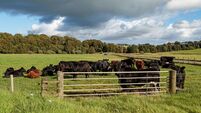
“It’s a very busy place here; some mornings you could be asked to help move cattle or help out with testing so there is always an element of getting stuck in on the farm.
"The wellies are always at the door, and I enjoy those times because I grew up on a farm, and from when we were children, we were actively involved in that.”