Signpost: Grass growth challenges managed with tight rotation and fodder planning
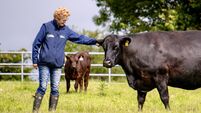
Eamon and Donnchadh McCarthy on their farm in Co. Waterford. As we mentioned last month, we had initially considered using glyphosate to desiccate the winter barley crop, but after speaking with our Teagasc advisor, we were made aware of the label change and had to find an alternative strategy for weed control. Photo: Patrick Browne
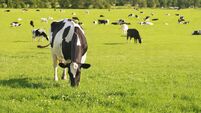
The grass growth rate on the farm has averaged 35kg of DM/ha for the month of July. The growth on the farm was affected by the soil moisture deficit.Â
We took steps to reduce the demand from over 50kg DM/ha to 33kg dm/ha. The newly reseeded ground came back into the grazing rotation at the start of July, and some of the second-cut silage ground has now come back into the rotation.Â
Also, heifers that were AI-ed have been moved to the outblock to reduce demand. There has been excellent utilisation of grass on the farm. Some baled silage has been fed to the spring calving herd at grass just to slow down the rotation until grass growth rates recover to normal.
We worked out our remaining fertiliser allowance for the farm, and a fertiliser application plan was drawn up. We had skipped a round of fertiliser during the prolonged dry period, so we decided to blanket spread the farm with a bag of 29:0:14 (protected urea) per acre once the rain had arrived.Â
Currently, the farm cover is 730kg DM/ha, meaning cows are grazing covers of 1,300 to 1,400kg DM/ha.
A portion of ground has been fertilised and closed for a third cut, and it is hoped 150 bales will be made from this area. Options for stretching fodder will be examined and put in place before the housing period.Â
Extra straw could be purchased to stretch existing fodder stocks; alternatively, purchasing baled silage or a high fibre-based straight could also be examined.
The winter barley crop was harvested and the crop yielded about 3.75t/ac. The straw yield was back so extra straw will be purchased for bedding material.Â
Approval has been granted for the construction of the new roofed slatted easi-feed unit and the bases for the stanchions for the new shed have been poured. By having this new facility ready for the winter the amount of straw required for purchase for bedding material will be significantly reduced.Â
The tillage ground will now be allowed to green up post harvest before being burnt off with a suitable glyphosate product for reseeding. A red clover silage mix will be sown in this area.Â
As we mentioned last month, we had initially considered using glyphosate to desiccate the winter barley crop, but after speaking with our Teagasc advisor, we were made aware of the label change and had to find an alternative strategy for weed control.
The first autumn calvers were due to commence calving on July 20, with the last cow due on August 31. To date, four cows have calved, with one cow having twin calves.Â
The autumn calvers are moved to the outblock for summer grazing. The outside block of ground is marginal by nature and is part of an SAC catchment.Â
This ground cannot be reseeded and as a result has more diverse older leys. We find that cows generally don’t get overfat on this ground, which is ideal for dry cows.Â
The cows are brought back for calving in batches of five or six and receive a trace element bolus on arrival. The AI bulls used on the autumn herd include AU4683, LM6172, CH4321, SI4350 and CH7503. Both SI4350 and LM6172 were both used for breeding female replacements.
The weanlings will receive their primary and booster injection vaccine for viral pneumonia towards the end of August and again four weeks later in September.Â
The spring calving herd have finished breeding for over a month, and five cows have been identified as not being in calf. This equates to an empty rate of 14% over a seven-week period.
The 2024-born bull calves have been housed and will gradually be stepped up onto their ad-lib diet consisting of half rolled barley and half of 14% high-energy beef ration.Â
There are only three bulls remaining from the 2024-born spring calving herd near finished and will be sold shortly. We were very happy so far with how these bulls have performed, with the bulls averaging over 430kg carcass weight to date.
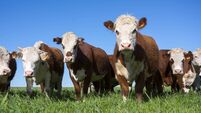
Eamon and his son Donnchadh are farming in Carrigeen, Glendine, Youghal, Co Waterford, and are part of the Teagasc Future Beef programme with the Signpost programme. They run a suckling to beef enterprise split into 60% spring and 40% autumn-calving, consisting of 55 suckler cows. The males are finished as under-16-month bull beef, while the heifers, not retained for breeding, are finished at 18-20 months. Their own heifers are kept for breeding.