Getting to grips with the Irish Cattle Breeding Federation's Mart Tracker
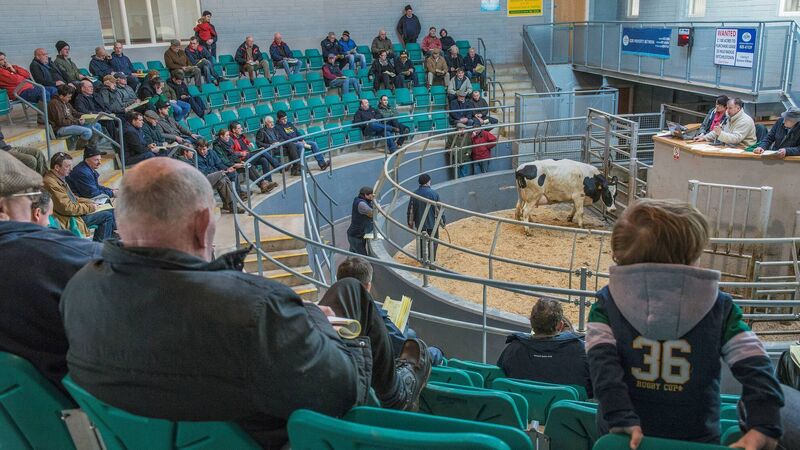
'If you think traditionally how farmers had to buy animals in the mart, they went to a mart not knowing really what animals were going to be there and available.' File Picture: O'Gorman Photography
How the Mart Tracker tells you the best lots to buy before you start bidding at the mart was explained in a recent Teagasc Beef Edge podcast.
This new online tool which lists what animals are for sale in marts each day was described by Chris Daly from the Irish Cattle Breeding Federation, to podcast host Catherine Egan.
“The farmers will have the information on the animals, potentially before they even come to the mart. In the morning, or before the sale, they could access the Mart Tracker from home.
"They can put in criteria. They might be looking for animals of a certain breed, of a certain age, of a certain sex. They might be looking for higher replacement index animals, high-CBV animals. They can enter those criteria and filter down the list of animals in the mart and, before leaving home, write down the lot numbers”, Chris explained.
"When animals are presented for sale, their blue cards, or their passports, are scanned at the intake, and as soon as the card is scanned, the mart sends that tag number to ICBF to look for any genetic information, such as Euro-Star information, or EBI for dairy animals, or the CBVs. Once that tag number comes across to ICBF, ICBF knows that the animal has been presented for sale at that mart, so we can list that animal on the Mart Tracker for that mart”, Chris explained.
“The Mart Tracker is available on the ICBF website. It’s available on a laptop or a desktop computer, and I suppose more importantly, it’s mobile-friendly. It’s available on a mobile phone. If you browse to the ICBF website, through whatever app you’re using, Chrome or Internet Explorer, whatever the case may be, on the ICBF homepage, you’ll see the Mart Tracker. If you click into it, you can access it there.
“If you think traditionally how farmers had to buy animals in the mart, they went to a mart not knowing really what animals were going to be there and available. They would probably walk through the penning area and maybe write down lots on a piece of paper or the back of their hand, lots that they thought might be suitable, from visual appearance.
"Oftentimes, they didn’t know any more information about those animals, until the point when they came into the ring. Animals are sold very quickly in a mart, so they wouldn’t have an awful lot of time to make up their mind, based on the information available”, Chris said.
The Mart Tracker, however, allows farmers who have studied in advance what’s available, to go directly to the pens where the lots of interest to them are being held.
Mr Daly said:
Catherine asked if SCEP farmers can select animals suitable for purchase using the Mart Tracker.
“Yes, absolutely. Again, they can go into a mart, and they can filter the animals on age. For the coming spring 2025 requirement, animals would have to be 16 months on October 31, 2025. So farmers could put in that they’re looking for females born before June 30, 2024, and a minimum of four stars in the replacement Index, and it will bring back the animals that meet those criteria”, Chris explained.
Farmers can also use the Mart Tracker to discover what high-CBV animals are coming to the mart.
“The Commercial Beef Value is a tool for non-breeding beef farmers when they’re purchasing stock. It includes the traits that are of importance to a drystock system. For farmers that are buying stores, weanlings, only interested in the traits that are of economic importance to their system, things like carcase weight, carcase confirmation, feed intake and docility, they’re the traits that are included in the Commercial Beef Value,” Chris said.
“CBV star ratings are broken into three breed type categories. Suckler animals are ranked together. Dairy beef animals are ranked together, and dairy animals are ranked together. The purpose of within-breed star ratings is to tell farmers where an animal ranks,” Chris explained.
“For example, on the current evaluation, Friesian bull calves with a CBV of €24 and above would make it a five-star animal. That would be the top 20%. On the dairy beef, a figure of €130 or above would be five-star. And for sucklers, the bar is much higher, a CBV has to be at €297 to be a five-star. It’s very different depending on the breed type,” Chris said.
“That information is available on the boards at the marts. If farmers are buying animals directly off a farm, the person selling the animals can provide them with that information as well. The CBV will allow farmers to differentiate between the best and the worst within those breed types. The farmers who are selling the best of those calves can be rewarded for the high genetic merit”, he said.
Farmers can access the CBV of their stock via their ICBF profile. This is currently free of charge, a farmer does not have to be in HerdPlus to access that information.
“We have put together a new catalogue that will allow the dairy farmer to go in and select the animals that they’re selling, and they can generate a pdf with the CBVs of those calves,” Chris explained. That information can then be shared with potential buyers.