Using clover and multi-species sward management to push for more milk
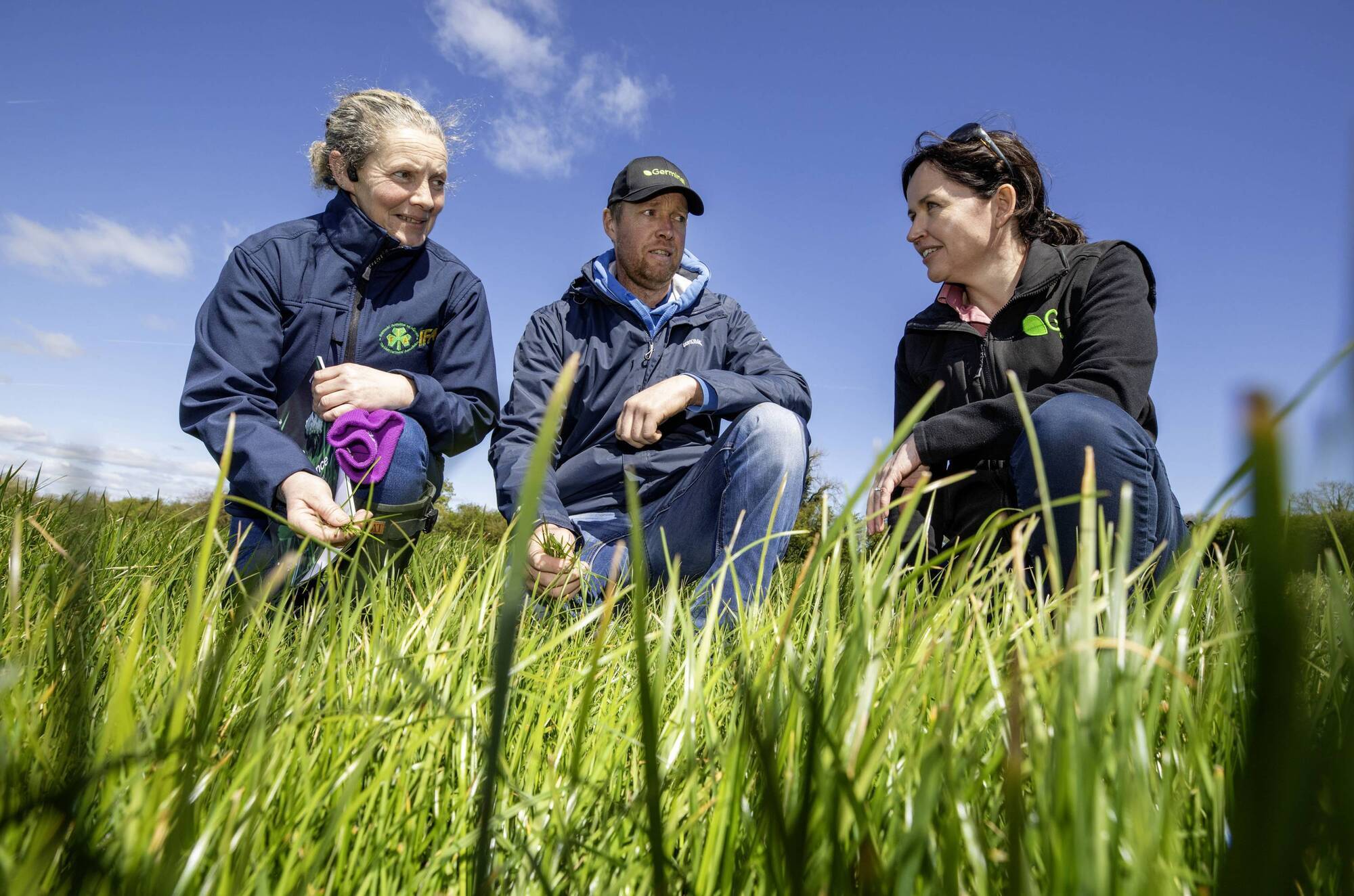
Erica O’Keeffe, who is farming near Cashel, Brian Hogan and Dr. Mary McEvoy, Technical Director at Germinal.
Over 60 farmers and seed trade reps attended a recent farm walk on the farm of dairy farmer, Brian Hogan at Horse & Jockey, Co Tipperary.
Organised by Germinal Ireland, those present heard how Brian set about establishing and managing clover and multi-species swards on his farm, which straddles the N7 at Horse & Jockey.
Brian’s farm comprises two blocks: a near-farm grazing block of about 39 hectares and an outside block of around 50 hectares.
Brian’s philosophy is to produce high-quality milk from grass. To make this happen, he said that he always needs grass ahead of his cows. The farm has a mix of dry and wet land. Although the farm walk was on a very fine day, the first field showed the effects of the very wet spring with a little unevenness underfoot.
Brian has had his cows out since January but continued to take them in at night. However, they have been out day and night for the ten days prior to the farm walk.
Until now, he has been feeding silage at milking and a 14% protein nut. He was on his third round of grazing but still had some first-round paddocks left to graze, which he intended to alternate with the third round.
About seven years ago, he set about a strategy to reduce his chemical nitrogen fertiliser use with clover.
Working with his Teagasc adviser, Thea Broderick, and Dr Mary McEvoy from nearby Germinal at Horse & Jockey, he set about a strategy to increase the clover content right across the farm for both grazing and silage ground.
"You must also build up fertility with Ps and Ks, and lime is also very important.”
In 2023, Brian sowed a red and white clover grazing mix for the first time alongside the top grass varieties of AberGain, AberChoice, Ballyvoy and Ballintoy.
He said: “Following reseeding, red clovers start fixing Nitrogen straight away in Year 1. White clovers won’t get going until year two. Temperature is also very important and we cut chemical nitrogen fertiliser use almost completely from about the middle of the grazing season from June, and certainly from July 1.”
Brian pays a lot of attention to herd health and integrates his grazing management with the condition of the cows.
He said: “With clover, it is important that you pay close attention to your cows and how hungry they look. I don’t let them into paddocks with a lot of clover if they look hungry. We haven’t had problems with bloat. But we manage it carefully.
"Also, at this stage, our cows are used to clover in their diet.”
Echoing Brian’s views, Germinal’s Diarmuid Murphy provided a checklist for reseeding with grass-clover swards.
He said: “Farmers need to plan their reseeding. This must start with identifying which paddocks for reseeding and then soil test. This will determine what the fertility is like and if you need to build up fertility by applying adequate P and K. Lime is also critical.
However, if min-till - such as discing - is used, you should wait longer to ensure that the old sward has been properly removed, maybe up to three weeks before sowing.” Diarmuid strongly advised rolling.
He said: “The advice we all got from our fathers is that the seedbed should be firm enough to cycle a bike across. Rolling the ploughed field after tilling, and then after sowing seed is still advisable. The grass and clover seed should barely be below the surface, just a few millimetres.
“We recommend sowing your chosen mixture at a rate of 14kg per acre. As mixtures are sold in 12kg bags, this works out at a recommending sowing rate of a bit over a bag to the acre, or about six 12kg bags for five acres.”
Diarmuid emphasised early weed control in the newly sown sward. He said there is an increasingly limited range of herbicides available for weed control later, especially in swards containing clover, so getting in early with an effective herbicide before weeds become established is important.
Target pH Germinal sales manager Claire Bailey Archibald emphasised the importance of soil pH and how to interpret soil pH results.
“The measure of soil acidity using pH can be a bit misleading. The pH scale itself is not linear but logarithmic, so while you may only have a difference of 0.2 or 0.3 between a recommended or target pH level, the actual differences between how acidic your soil is and the recommended target could be five times or 10 times or even 100 times," she said.
"If the target pH range is 6.3 to 6.5, then it is important to apply lime to achieve this and not be satisfied with a lower level even if it just appears to be out by just a few points of a decimal.”
Dr Mary McEvoy, Germinal’s technical director, emphasised the advantages of grass-clover swards.
“Grass clover swards provide improvements in the quality of the sward, higher performance in terms of milk yield and quality, and a significant reduction in nitrogen fertiliser requirements," she said.
"he productivity of grass-clover swards in dry matter is particularly marked at lower application rates of nitrogen fertiliser.” “The full benefits come from a full reseed followed by management of the sward to ensure good establishment. This will include proper weed control and grazing management.”
Mary also spoke about over-sowing existing grazing swards with white clover.
She said: “We recommend, when oversowing clover, that you can easily see the soil beneath the sward and sow at 3kg to 4kg per acre. We would also recommend controlling weeds prior to sowing and spread with a P and K fertiliser.”
“If spreading with a product, such as 0:10:20, mix the clover and the fertiliser in the field, not in the yard. Clover seed is very small and can separate in transporting from yard to field resulting in uneven spread. We would also recommend frequent grazing of the over-sown sward to give newly sown clover every advantage in getting established.”
Mary highlighted that farmers could again this year avail of Department of Agriculture supports for sowing red clover and multi-species swards of up to €300 per hectare. Applications are through the BISS online application system and close on May 15, 2024.