Minister meets with tillage farmers as production declines
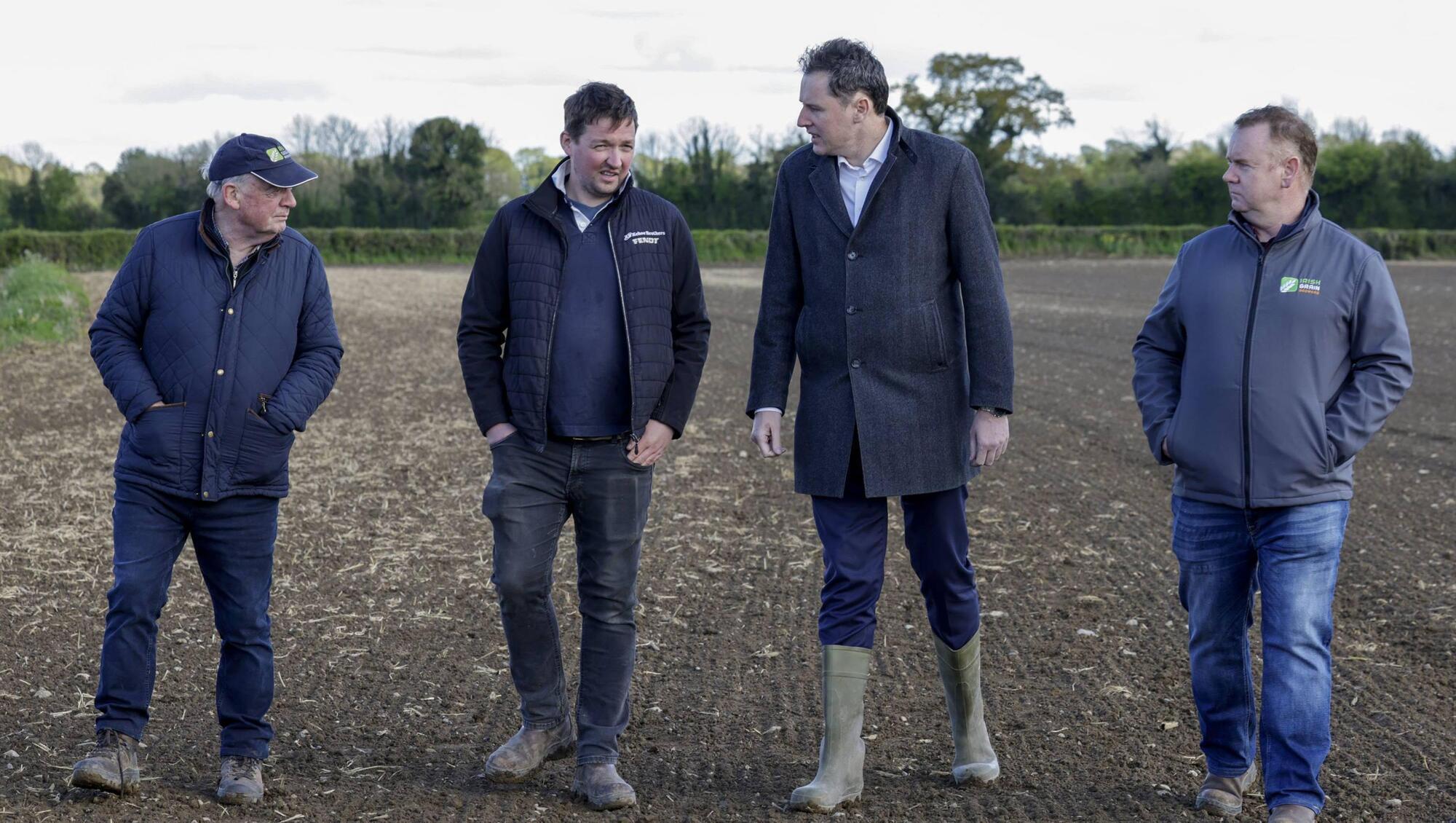
Agriculture Minister Charlie McConalogue with landowners Pat Cleary and Darragh Cleary and Bobby Miller, chairman of Irish Grain Growers Group, in Ballybrittas, Co Laois. The field had a failed crop of winter wheat and was redrilled with spring barley. Picture: Maxwell Photography
Agriculture Minister Charlie McConalogue this week met with tillage growers to hear their concerns about current challenges.
Persistent wet weather resulting in the delay in getting spring crops planted has had a significant impact on tillage farms.
After speaking with members of the Irish Grain Growers Group in Co Laois, Mr McConalogue said that "thankfully, there has been some return to spring work on tillage farms in the last two weeks with the improvement in weather conditions".
“With later spring sowing than normal and the risks associated for farmers, I recently announced that I will work to deliver €100 per hectare in financial support for crops planted for the 2024 harvest to give confidence to growers to plant crops this year, and to give them confidence in the future of their industry," he added.
He said it is important that a "vibrant and sustainable sector" exists so it can play a significant role in "increasing Ireland’s food and feed security while also contributing to climate change objectives".
"The tillage sector is an important and integral component of the agri-food industry and is a sector that I want to see grow and develop," he said.
"That is why I established the Food Vision Tillage Group in May 2023 to set out a roadmap for the sustainable growth and development of the sector to 400,000 hectares by 2030. I recently received the final report from the group, and I am considering its recommendations.”
This comes as recent data published by the CSO shows that the production of the three main cereals of wheat, barley and oats decreased by 531,300 tonnes to 2,015,700 tonnes in 2023 (20.9%).
Wheat, barley and oats yield dropped by 1.4 tonnes per hectare (12.8%), 1.3 tonnes per hectare (16.1%) and 1.5 tonnes per hectare (17.9%) respectively.
However, beans and peas production rose from 65,700 tonnes to 81,300 tonnes in 2023 (23.8%).
Oilseed rape production was up by 19,500 tonnes to 97,300 tonnes in 2023 (25.1%).
Potato yield decreased from 43.4 tonnes per hectare to 39.2 tonnes per hectare in 2023 (9.5%). Production of potatoes was down by 45,800 tonnes (12.4%) to 322,200 tonnes in 2023.
Irish Farmers' Association president Francie Gorman said these CSO figures show that the tillage sector is "battling to survive".
“Tillage farmers have faced a perfect storm since summer 2023, with falling grain prices, input costs remaining high, loss of rented land, and heavy rainfall in the period since,” Mr Gorman said.
“There is no question that our tillage sector is fighting for its very future. The Government says it wants to have more tillage production and this will only happen if they step up and support growers."
The minister acknowledged the difficult year last year for tillage farmers and said that there were additional supports provided to the sector in 2023.
These additional supports included a top-up of €3m for Protein Aid bringing the total budget to €10m.
The Straw Incorporation Measure provided €16.5m and the Tillage Incentive Scheme provided €8.3m to growers in 2023.
The €7.147m secured from the EU Agricultural Reserve was topped up with a further €7.147m in state funding.
These funds were used to support growers with unharvested crops by way of an Unharvested Crop Support Scheme with the remaining funds being used as a once-off flat rate payment on the area of oilseed rape and cereal crops.
In March, the minister also announced an exemption to the crop diversification element of GAEC 7.
The IFA has proposed a Tillage Survival Scheme with a €250 per hectare, five-year payment for tillage farmers, which it says is "essential to prevent a decimation of the national tillage area".