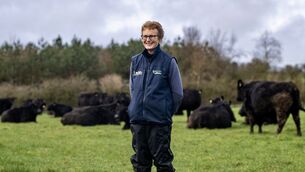
'Only makes sense' for agriculture community to produce more fuel and fibre
"Climate change is one factor obviously, but also security and supply now is a major factor"
'Only makes sense' for agriculture community to produce more fuel and fibre

Farmers are "very good at not just taking on something new, but developing it".

With fossil fuel use “on the way out” and farming looking towards a future of increased decarbonisation, “it only makes sense that agriculture will come back to producing more fibre and more fuel” while still producing food, an industry expert has said.

Russia’s invasion of Ukraine and its fallout has “galvanised” European attitudes, and it has been “strongly accepted that we need to get independence of energy”, said Noel Gavigan of the Irish BioEnergy Association.

“Climate change is one factor obviously, but also security and supply now is a major factor,” Mr Gavigan told the Irish Examiner.

“So there’s a double incentive.”

Mr Gavigan was a member of the Irish industry delegation that travelled to the Agricultural University of Athens in Greece this month to attend the first transnational workshop on greenhouses as part of the EU AgroFossilFree project.

Following the workshop, he stressed that Ireland needs “to figure out how we can be more energy-efficient, but there’s also huge potential to produce our energy, and agriculture has got major potential there”.

“And where there is a food-versus-fuel debate, agriculture used to produce a lot of energy and it used to produce a lot of fibre, and it’s only in the last half-century that it’s been moved away from those produces and is predominantly producing food,” he explained.

“Because all the fibre and all the energy was being produced by fossil fuels.

“Now, with fossil fuels on the way out, it only makes sense that agriculture will come back to producing more fibre, producing more fuel, and still producing food.”

Mr Gavigan said that identifying the right opportunities for farmers will become increasingly important.

“We see sectors embracing solar, and it makes a lot of sense, and farmers are wisely investing in that,” he said.

“We see farmers in the poultry and pig sectors investing in biomass boilers to replace kerosene which has doubled and tripled in price over the last while, so they’re finding that biomass is very worthwhile and very cheap in comparison, and farmers will adapt, and if there is an opportunity there, they will take it.”

He added that farmers are “very good at not just taking on something new, but developing it”.

He said the adaption that will be seen in Ireland over the next number of years “will be very interesting”.

“Solar for the electric, biomass for heat would be the two big areas we would expect to see over the next number of years,” he said.

Barriers to adopting new technologies

According to the results of surveys carried out with farmers across eight EU countries, environmental concerns among Irish farmers are a particularly strong motivation for adopting renewable energy sources.

Those who adopted technologies on their farms had similar characteristics of having bigger farms; better education and digital skills; more innovative personalities and keener to experiment; younger; and fewer years of experience in farming.

However, affordability remains a significant barrier.

In relaying these findings to the Irish Examiner, AgroFossilFree project co-ordinator Thanos Balafoutis said that for non-adopters, “the main problem was mainly they didn’t have the economic capacity to go forward” with adopting new technologies.

He said that another “very big issue” identified through the study was the lack of training in relation to new technologies.

“Another thing we found out is in the agricultural knowledge and innovation systems’ environment — researchers, industry, farmers — they are not really well connected,” he added.

Mr Balafoutis also said that policies and incentives are “very important” in encouraging the uptake of clean-energy technologies.

The results of the study, which will be published in a report in due course, showed that solar energy was by far the most used renewable energy source on the farms of adopters who took part in the farmer survey, with biomass the second-most used, followed by heat pumps, Mr Balafoutis said.

Renewable energy on these adoptive farms was mostly used for building heating, cooling, and lighting.

With regard to what Irish farmers consider to be the most important sources of knowledge and awareness on renewable energy sources, their own experience, advisory services, and the internet were the front-runners.

CLIMATE & SUSTAINABILITY HUB

More in this section

Farming

Newsletter

Keep up-to-date with all the latest developments in Farming with our weekly newsletter.

Cookie Policy Privacy Policy Brand Safety FAQ Help Contact Us Terms and Conditions

© Examiner Echo Group Limited