‘Strong and favourable market conditions for Irish beef must be maximised’
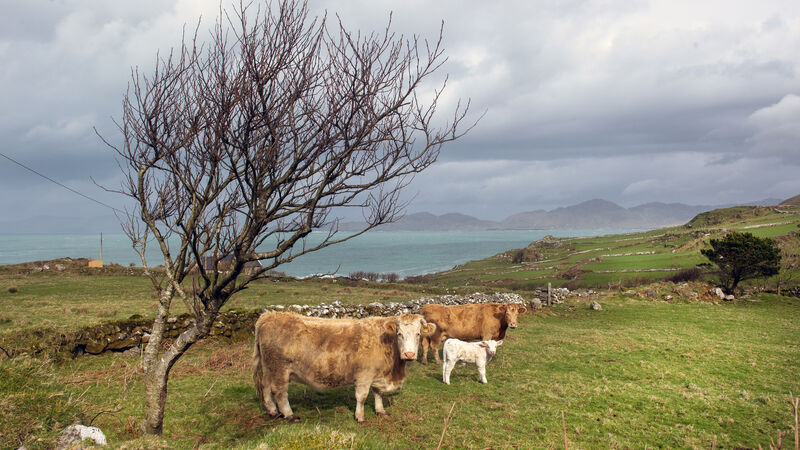
Cattle grazing in a field at Garinish on the Beara Peninsula, West Cork. Picture Dan Linehan
Cattle supplies at export meat plants totalled 30,390 head during the week ended April 17, increasing by 898 on the week previous, as processing plants returned to a normal week of production, according to Bord Bia.
Prime cattle throughput also increased by 226 head on the previous week, with overall supplies currently running 11.7% lower than they were 12 months ago.
Throughput levels for the past week were 3,267 head above the same week in 2020.
A total of 478,462 head of cattle have been processed in the 15 weeks of 2021.
This figure represents a decline of 58,627 head on the corresponding period in 2020 (-10.92%).
Heifer throughput has decreased by 12.28%, while steer throughput is back 6.63% on the same period 12 months ago and the appetite for good quality cows remains strong - this is reflected in current quotes being received in export meat plants.
Quotes for P grade cows are ranging between €3.20-€3.25/kg, with good quality O grade cows achieving prices of €3.30-€3.35/kg.
R grading cows are receiving quotes of €3.50-€3.55/kg, and maybe slightly more in some cases depending on carcass quality and demand.
The average prices paid for prime cattle for week ending April 17 - as recorded by the Department of Agriculture, Food and the Marine - were €3.97/kg for R3 steers, and €4.00/kg for R3 heifers.
The same week average prices paid in Northern Ireland saw R3 grade steer and heifer quotes increasing to £3.92/kg each.
These prices were equivalent to €4.52/kg, excluding VAT.
Meanwhile, in Britain prices paid for R3 prime cattle saw further changes in the past week, with steer prices increasing to £4.08/kg and heifers increasing to £4.09/kg.
Across Europe, average R3 young bull prices are equivalent to €3.80/kg excluding VAT, which is 17c/kg lower than the Irish R3 steer price.
The Irish composite cattle price for week ending April 17 was €3.75/kg deadweight excluding VAT, compared with the Export benchmark price of €3.76/kg.
IFA’s Livestock Committee chairman Brendan Golden said the updated cattle supply projection points to tighter supplies of finished cattle for the year with 120,000 fewer this year compared to 2020.
“The projection is based on a number of factors, including the very strong export performance of forward store and finished cattle to Northern Ireland so far this year,” he continued.
“This trend is expected to continue, where exports to-date are up 117% on last year to 24,513.
“Coupled with the estimated 5% reduction in the UK kill for the year, this points to strong and favourable market conditions for Irish beef which must be maximised by factories here and returned in beef prices to farmers.”
Meanwhile, the full reopening of the food service sector in mid-May in the UK is expected to increase demand for Irish beef, in particular.
“Beef prices continue to rise as factories struggle to meet demand; steers are making €4.05 to €4.10/kg and heifers €4.10 to €4.20/kg base prices, with higher deals available,” added Mr Golden.
“Young Bulls R/U grades are making €4.00 to €4.30/kg.
“Cull cow demand is very strong, with prices for P grades starting at €3.25/kg and moving upwards depending on numbers.
“O grades are starting at €3.30/kg, with good quality continental cows making €3.50/kg to €3.70/kg.
“The gap with the Prime Export Tracker Price has closed in the last week, but increasing UK prices and the additional demand from the food service sector there for beef is driving the trade.
“Farmers should sell hard in favourable market conditions.”