All in the breeding: Seven times more liver fluke disease in the progeny of some bulls
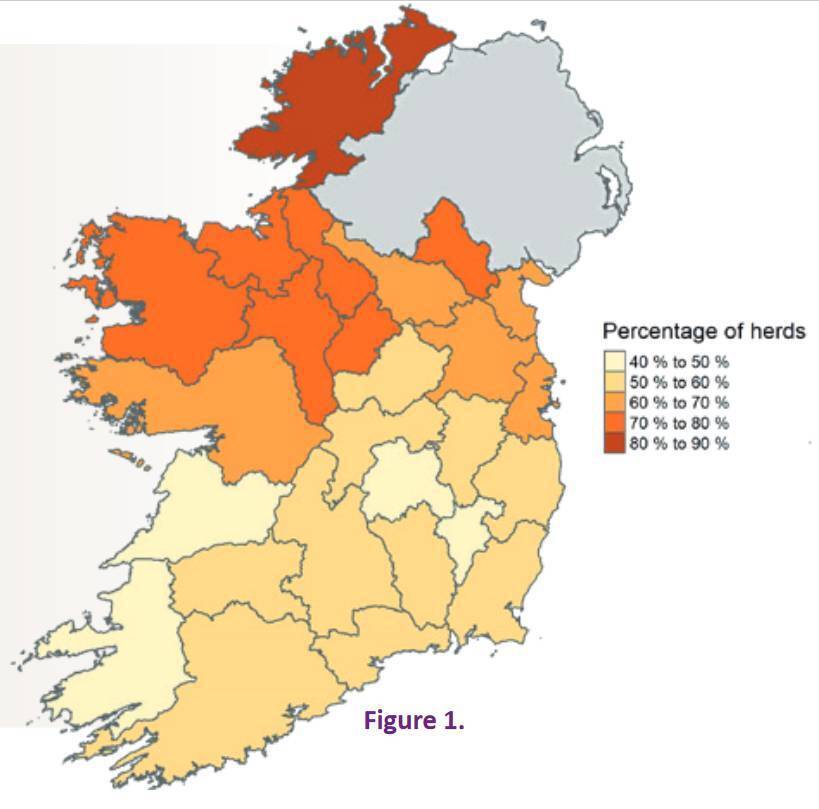
Liver fluke incidence in 2019 are highlighted in the map. File Picture.
Try from €0.25 / day
SUBSCRIBELiver fluke infection was found in 70% of the progeny of some bulls, compared to under 10% for other bulls’ progeny which originated from the same herds.
It was revealed that certain family lines of cattle are more prone to liver fluke infection than others, in research undertaken at Teagasc Moorepark by Dr Alan Twomey, in conjunction with Animal Health Ireland and ICBF.
Carcass inspections of livers at slaughter, in Animal Health Ireland’s Beef HealthCheck programme, in conjunction with a number of beef processors, revealed the fluke results.

Following this, and years of other research, the Irish Cattle Breeding Federation (ICBF) has made breeding values for resistance to liver fluke freely available for AI bulls and genotyped animals.
Farmers can use the breeding values to identify how likely bulls are to produce offspring that will be susceptible to liver fluke infection.
Cattle with lower breeding values for liver fluke are less likely to be diagnosed with liver fluke disease, thus reducing production losses due to liver fluke and, in time, reducing the need for anthelmintic doses.
For convenience, ICBF has colour-coded listed bulls based on their liver fluke breeding value, using a traffic-light system where green is best, orange is average, and red is worst.
In 2020 (up to December), Beef HealthCheck data indicated 1.4% of animals had live liver fluke seen at slaughter, and 8.4% had liver damage likely due to liver fluke.
Animals younger than 30 months old tended to have lower levels of live liver fluke (1.1%) compared to older animals (1.9%), as well as lower levels of fluke damage (4.9%) compared to older animals (16%).
In 2020, 4,354 herds (14%) had at least one animal with live liver fluke parasites seen at slaughter, and 53% of herds had animals at slaughter with any sign of liver fluke.
The counties with the highest percentage of herds with any sign of liver fluke damage seen at slaughter were Donegal, Sligo, Leitrim, Roscommon and Longford, ranging from 73% to 81% of herds.

Cancel anytime
Newsletter
Stay ahead of the season. Sign up for insights, expert advice and stories shaping Irish agriculture.
Newsletter
Stay ahead of the season. Sign up for insights, expert advice and stories shaping Irish agriculture.
Newsletter
Had a busy week? Sign up for some of the best reads from the week gone by. Selected just for you.
Newsletter
Get a lunch briefing straight to your inbox at noon daily. Also be the first to know with our occasional Breaking News emails.
Friday, July 10, 2026 - 6:00 PM
Friday, July 10, 2026 - 7:00 PM
Friday, July 10, 2026 - 12:00 PM

© Examiner Echo Group Limited