Extra payments in 2023 for farmers who do more for the environment and climate
All farmers must undertake additional environmental measures to maintain their payments.
Extra payments in 2023 for farmers who do more for the environment and climate

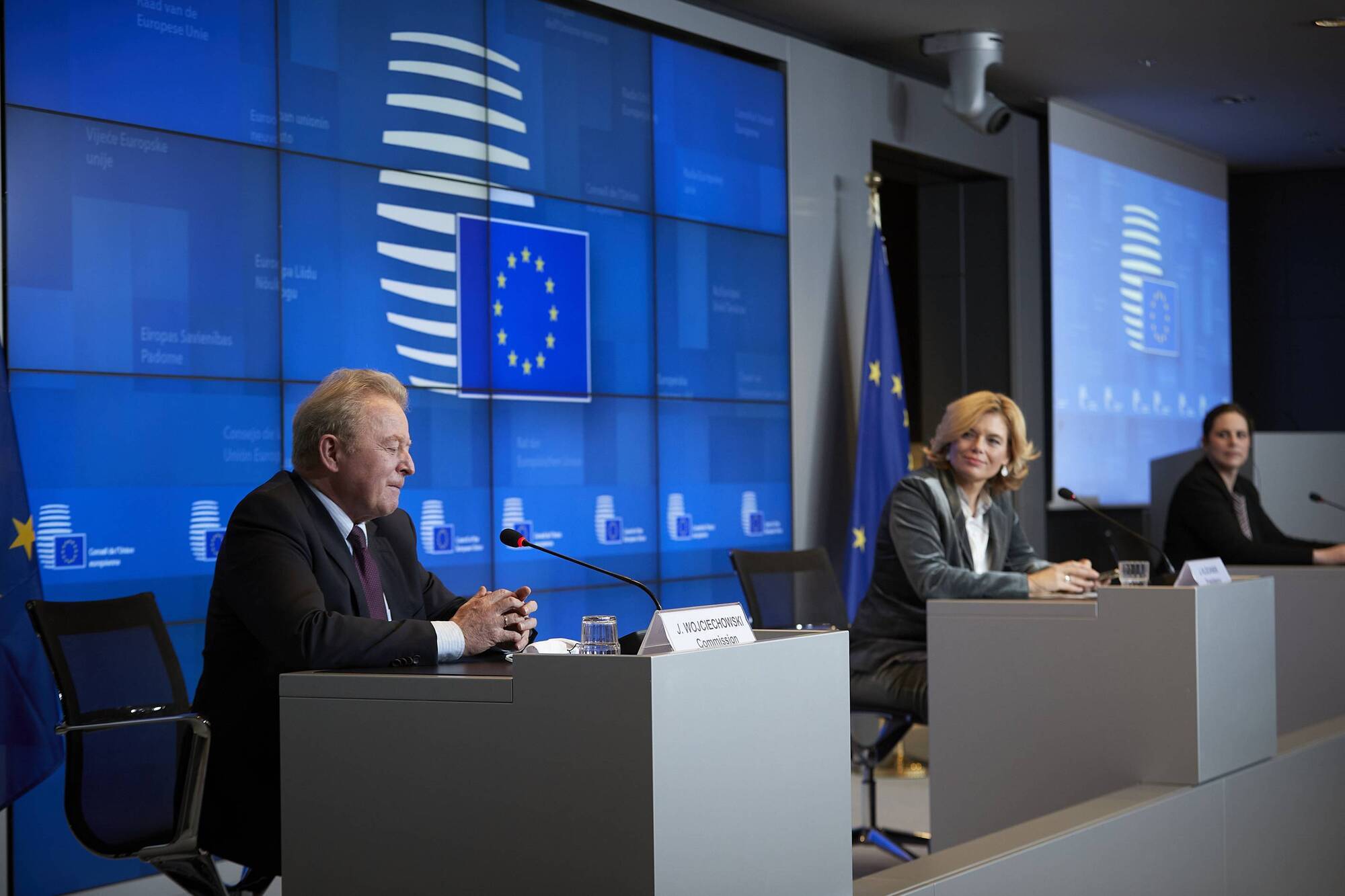
European Commissioner for Agriculture Janusz Wojciechowski and German Federal Minister for Food and Agriculture Julia Klockner at the 4 am, Tuesday press conference after a marathon two-day EU-27 agriculture ministers council to agree their CAP reform requirements. Picture: European Union


Mandatory environmental schemes as part of direct payments to farmers moved closer when EU farm ministers agreed on the shape of the post-2020 Common Agricultural Policy.

These proposed eco-schemes are a major issue for member states, because if insufficient farmers sign up for them, and qualify for eco-payments, the foregone funding could be lost to the member state, reverting back to the EU.

Measures to avert this potential loss of unspent funds for member states could include a ‘two-year’ learning phase in which member states will try to draw down all the eco-scheme funds available.

This was agreed in response to fears in some countries that the eco-schemes would be impossible to implement, resulting in the loss of EU funds for farmers.

Agriculture Minister Charlie McConalogue said the CAP reform will support farm incomes while helping build a sustainable agriculture sector contributing to the EU Green Deal.

IFA President Tim Cullinan said the agreement reached by Ministers would be challenging.

He highlighted ring-fencing of 20% of direct payments for eco schemes, meaning all farmers must undertake additional environmental measures to maintain their payments. “There is a long way to go before the full details are agreed and come into force on January 1, 2023,” he added.

He also noted that MEPs voted to ring-fence 30% of direct payments for eco-schemes.

ICMSA President Pat McCormack said farmers will be hugely disappointed because ministers are asking farmers yet again to do more with less pay, while nothing put in place to ensure sustainable prices are paid to farmers for produce.

“The bottom line here is that every farmer will see a reduction of at least 20% in their Pillar 1 BPS/Greening payment, and will only get this back if they join an eco-scheme, the conditions of which are unknown. What’s absolutely certain is that this agreement will mean more regulation on farmers with no additional reward.”

He said farmers carry by far the biggest cost in the transition to a low emissions food production system, while retail corporations that control the whole system escape yet again from any cost or real contribution.

ICOS, representing Irish co-ops, said the Ministers’ agreement raises the level of environmental ambition for the CAP.

German agriculture minister Julia Klöckner, who chairs agricultural issues during Germany’s EU presidency, confirmed that ministers agreed on mandatory eco-schemes being introduced.

“Eco-schemes are not left to the free choice of member states which can decide whether or not to apply them and how many resources to allocate,” said Ms Klöckner at the 4 am, Tuesday, press conference after an EU farm ministers’ agreement was reached. Ministers had negotiated until 2.30pm the previous day, as the German presidency pressed them to agree their mandate on CAP reform, because the Covid-19 pandemic may rule out in-person meetings of ministers in the coming months.

Only when mandates are agreed can the European Parliament and the EU Council and the Commission meet in the trilogue negotiation which will decide the definitive rules of the EU’s next €48 billion-per-year Common Agricultural Policy, from 2023 to 2028.

Also this week, the European Parliament supported their CAP mandate, which EU Agriculture Commissioner Janusz Wojciechowski said is more ambitious that the one agreed by ministers.

As a result, trilogue negotiations will be difficult, and may take even longer than the 18 months of talks needed seven years ago.

MEPs will not finalise their required CAP negotiating mandate until the end of this week. They must vote on more than 1,700 amendments to the CAP reform proposals which were launched in 2018.

An agreement among the three largest parties, the Christian-Democrats (EPP), socialists (S&D) and liberals (Renew Europe) is dominating the Parliament’s deliberations this week. Up to mid-week, the only compromise amendment proposed by the coalition to be rejected was one supported by the Greens and leftists, to reject the Commission’s entire CAP proposal.

MEPS have agreed to look for at least 10% of landscape elements beneficial for biodiversity, 35% of the rural development budget for environmental and climate-related measures, and at least 30% of direct payments for eco-schemes.

MEPs want 5% of arable land devoted to ecological focus areas, and crop rotation to be compulsory.

The ceiling for direct aid is set at €100,000 per farm in the Parliament’s mandate (excluding eco-scheme aid, young farmers aid and wage costs).

NGOs and environmental campaigners bitterly opposed the coalition’s compromise amendments.

Swedish climate activist Greta Thunberg also stepped in, complaining that the CAP reform completely ignores climate and biodiversity. “Neither council nor parliament appear to care about the climate and biodiversity crises as they strip away conditions for farm subsidies and push for greenwashing loopholes,” she said

Ministers also agreed on more flexibility between the CAP’s two pillars of direct payments and rural developments.

On Tuesday, they endorsed the farm to fork strategy goal of a European sustainable food system, saying member states want sufficient and affordable food while contributing to EU climate neutrality by 2050 and ensuring a fair income and strong support for farmers.

Ministers agreed farmers would receive financial support if they adopt practices beneficial for the climate and the environment. Farmers going beyond the basic environment and climate requirements would get additional financial support through eco-scheme direct payments.

Examples of eco-schemes include precision farming, agroforestry, and organic farming, but member states would be free to design their own instruments. All farmers would be bound to higher environmental standards, even smaller farmers.

Ministers also want the new CAP to favour farmer performance over compliance.

The next step in the CAP reform is a negotiation that will begin in November between the European Parliament and the EU Council of Agriculture Ministers.

x

More in this section

Farming

Newsletter

Keep up-to-date with all the latest developments in Farming with our weekly newsletter.

Cookie Policy Privacy Policy Brand Safety FAQ Help Contact Us Terms and Conditions

© Examiner Echo Group Limited