Defeat for Dutch plan to put cows on diet so homes can be built
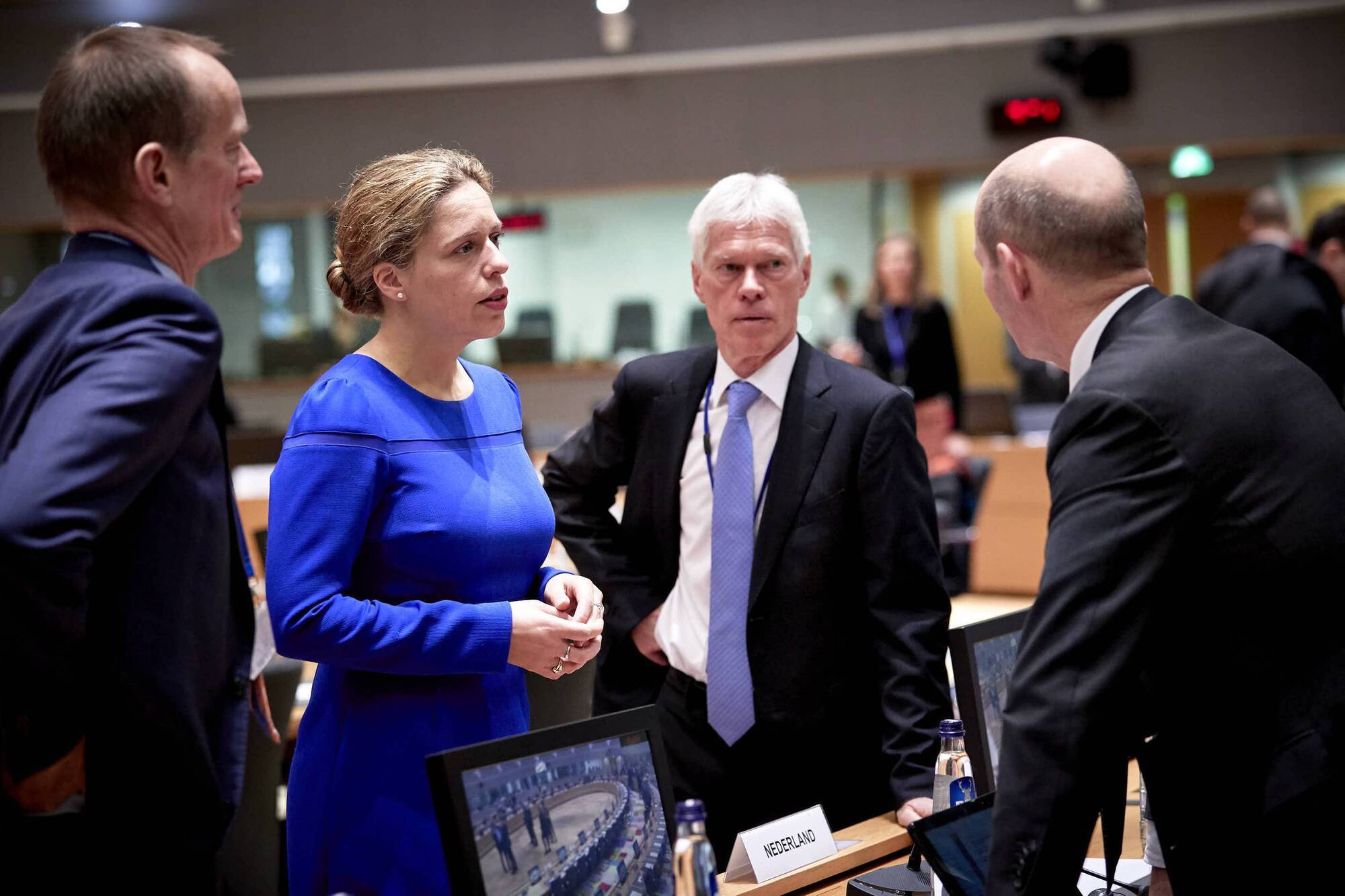
Dutch agriculture minister Carola Schouten with her ministry officials: she has had to drop a proposal to force dairy farmers to feed less protein.
Animal feed measures to limit nitrogen emissions have been abandoned in the Netherlands, but are going ahead in Ireland.
Here, concentrate rations fed to livestock at grass on nitrate derogation farms from April 1 to September 15 cannot be more than 16% crude protein (CP) this year, and no more than 15% CP in 2021. But Dutch agriculture minister Carola Schouten’s similar proposal has been scrapped after strong farmer opposition.
However, the contexts are different, with only a limited amount of concentrate feeding at grass on Irish farms, whereas feed concentrate is one-quarter to one-third of a Dutch dairy cow’s diet.
Dutch dairy farmers were no doubt annoyed by Ms Schouten’s scientific explanation that they had to adjust feeding in order that more residential property could be built. Last May, she said she would temporarily limit proteins in feed as of September 1 (until the end of 2020) to reduce nitrogen emissions by 0.2 kilotons.
This would be enough to cancel out emissions from construction of 75,000 homes, to help combat a severe housing shortage.
Farmers would have to observe an average limit of 15.5% CP in dairy feed (compared to the current Dutch national level of 16.5%). The maximum crude protein would be differentiated according to farm intensity and soil type. Dairy farmers who do not meet the standards could risk a fine.
It was one of the measures from a committee tasked last year by the Ministry of Agriculture to find ways to reduce nitrogen-based pollution in the Netherlands, after the country’s highest court (the Council of State) ruled that the government had to reduce emissions, in order to meet its climate goals.
Dutch nitrogen emissions must be reduced by 50%, to no longer cause additional damage to nature.
Ms Schouten claimed that the proposed feed measure would have no effect on milk production or quality, nor on animal health. Several animal experts, however, disputed this. University of Utrecht veterinary researchers said, “...animal health risks have been made subordinate to the enforceability of the regulations.”
Some researchers further argued against the regulation not focusing on the total ration, but only on feed concentrates.
Jan Willem Erisman of the Louis Bolk Institute said the frustration among farmers was “mainly the result of the uncertainty that farmers are facing at this moment. Farmers lack a long-term perspective. A dark cloud hangs in the air, but farmers don’t know what type of rain will fall down on them.”
He said the Dutch Cabinet had not yet presented solutions, more than 15 months after the Council of State nitrogen decision.
Predictably, the Netherlands Agricultural and Horticultural organisation argued that pressure was being put on farmers to create “space” for other sectors.
The Dutch dairy sector developed its own proposal to reduce livestock farm nitrogen emissions. However, Ms Schouten said their proposal was impracticable; it would require each farm to draw up an individualised plan that would have to be approved and reviewed.
The Dutch Environmental Assessment Agency was asked to study the Ministry’s and the farmers’ proposals, and a combination of both.
The Farmers Defense Force action group now entered the picture, staging protests that blocked roads.
But in the end, the weather decided the issue. In late August, the LTO said summer drought in the Netherlands had exacerbated the situation. They were backed by Wageningen University researchers who said lack of rain had led to a shortage across the Netherlands of grass, one of the most important parts of a cow’s diet, and the protein in concentrates must be increased in order not to endanger cow health. Minister Schouten announced she would no longer pursue the proposal.
Meanwhile, the Dutch Environmental Assessment Agency published its assessment, saying the proposed feed measures were surrounded by too many uncertainties.
But Dutch livestock farmers aren’t being left off the hook. Instead, the Cabinet said it would like to use part of the nitrogen gains from an ongoing voluntary buy-out scheme for pig farmers who want to retire.
Ms Schouten said the proposed nitrogen leeway will become available a little later than planned, but this is not expected to be an obstacle for construction to continue as planned, given the turnaround time.