Rollout of Dutch-made €5 per soil test scanner
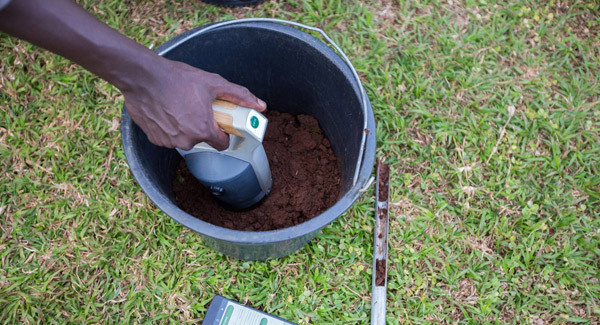
For those who think soil sampling and laboratory analysis are too slow and costly, the arrival of hand-held soil scanners will offer an alternative.
They are already available from Soilcares, part of Dutch Sprouts, a company in the Netherlands which aims to bridge the world food supply gap, by providing farmers with affordable technology to help them sustain or increase yields.
In keeping with this philosophy, they have chosen Kenya for the launch of the scanners, which are based on near- infrared (NIR) diffuse reflectance spectroscopy.
However, they are expected to also launch their handheld scanners in the US, shortly.
They offer a soil analysis for €4-€5, but the rollout of the technology worldwide will be slow because many thousands of samples must be taken and analysed to build a big database on which future soil nutrient analysis results will be based.
Rabobank Foundation, also in the Netherlands, has donated €400,000 to provide over 150 Soilcares scanners for smallholder farmers.
Already, this is helping Kenyan farmers to determine which fertiliser inputs are needed, and at what quantities.
Of the world’s 500m farmers, it is though that only about 20m can currently afford soil testing by “traditional” laboratories.
The soil scanner will determine the amount of nitrogen, phosphorus and potassium in the soil, and the pH, electrical conductivity, soil temperature, and organic matter level.
It will tell you what crops are suitable for your soil.
Fertiliser and lime recommendations are delivered within 10 minutes.
SoilCares say they have a subscription model (and fixed monthly fee) for every need, and prices adapted to every market, whether the user is a smallholders who will analyse 250 samples a year, or a service provider analysing 250 samples.
The price per analysis is expected to range from €4 to €4.75.
The procedure is to scan the soil, and to upload the scan via an app on your smartphone (with Android 4.3 or higher), into the database which must first be built up for your particular region, based on thousands of soil samples results.
You should have the soil report within 10 minutes.
Soilcares say it is a tool that can be used by every farmer on the planet with a mobile internet connection, with no prior experience in soil testing.
The scanner compares the results for your soil to its cloud computing global soil database, which the company aims to develop for the entire world.
Your scans are compared with the data in the cloud, and crop-specific fertiliser recommendations are given via your smartphone.
No chemicals are needed for the soil test.
The scanner determines soil acidity and temperature, organic matter content, and the content of nitrogen (N), phosphorus (P), and potassium (K).
The user can enter his target yield for a specific crop, and the scanner shows the best suitable combination of fertilisers and lime.
“The selling price of the scanner is our production price,” according to the company.
“At SoilCares, we make no profit on the sales of the hardware, only on the connection to our database that produces the report.”
The scanner has won several awards, the most recent being one of the 103 Red Dot awards of 2017 for examples of high design quality around the world.
The Soilcares scanner has also won in the ‘Fair Food’ category of the Accenture Innovation Award 2016.
Soilcares has won the ChangeAward 2017 in the Netherlands, for “change makers” in business.
Award judges said the precision technology which the company develops has been applied successfully in several countries, and contributes substantially to bridging the world food supply gap.
Soilcares also markets a Lab-in-a-box which provides a complete soil status report in two hours.
For large farmers and service providers, they recommend using the Lab-in-a-box before planting, and the scanner for monitoring after planting.
For small-scale farmers, they recommend using the scanner only.