US expert says calf rearing skills are key to dairy profit at Volac Heifer Rearing Conference
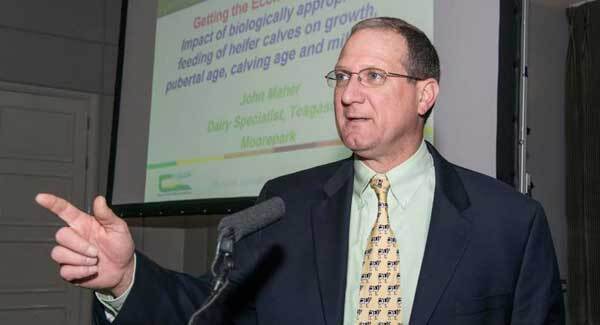
Cornell University calf rearing guru Mike Van Amburgh said the performance of dairy heifer calves from birth to weaning at 8-12 weeks is the single biggest determinant of lifetime milk yield and profit in dairy farming.
“Research worldwide and numerous on-farm assessments have shown that 70% of milk yield is due to management with the remainder due to genetics,” said Prof Van Amburgh.
“One quarter of the variation in first lactation milk yield was explained by growth rate during the first seven weeks of a calf’s life.”
Prof Van Amburgh, who has led the field in research on young animal nutrition, said achieving top performance in calves in the critical first weeks of life results in additional milk yield of at least 800 litres in the animal’s first lactation alone.
These cows have a longer milking life, are healthier and leave a substantially higher profit.
He highlighted the importance of setting performance targets for dairy heifer calves.
The minimum target should be a doubling of birth weight from birth to weaning.
Dairy heifers should be 45% of mature weight at puberty and around 55% of mature weight when they go in calf.
“To achieve a doubling of body weight from birth to weaning at eight weeks, a calf needs to gain 0.75kg/day,” he said.
“This requires feeding up to 1kg of a high quality milk replacer/day.
"The normal feeding levels on Irish and US farms is 0.6 kg of milk replacer/day which is not adequate to achieve maximum growth rates.”
Prof Van Amburgh said the age of dairy heifers at first calving is the critical barometer of lifetime milk yield, milking longevity and profitability in dairy farming.
The results of research on 1.5m dairy cows across the US show that lifetime milk yield and profitability is optimised from calving heifers at 22 months of age.