Rollercoaster world dairy markets bounce back
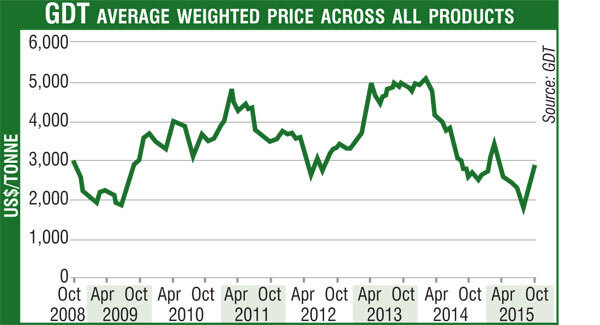
Since October 2008, this measure of the world price fell from $3,000 per tonne to $2,000 in 2009, recovered to nearly $5,000 in 2011, fell to nearly $2,500 in 2012, topped $5,000 in 2014, before plummeting to under $2,000 a few months ago — bringing fears of a difficult start to Ireland’s milk expansion drive, under way since EU milk quotas were scrapped last April.
But the roller coaster has bottomed out, with Tuesday’s 9.9% rise the latest in a string of strong auctions since August, which has brought the price index to $2,834, its highest level since last March, after a 63% jump in two months.
Although the recovery will be welcomed by Irish dairy farmers who fear low prices next spring when their milk supply increases, they are advised to beware of a market which seems to have become even more volatile than is justified by supply and demand trends.
This time round, the GDT price rise is attributed mainly to buyers stockpiling products ahead of an expected production slump of at least 5% for the year to next June in New Zealand, the world’s top dairy exporter.
Low milk price forecasts in New Zealand have led their dairy farmers to cull a lot of their poorer cows, and a cold and wet southern hemisphere winter and spring have inhibited grass growth.
Dairy product buyers also appear to be factoring in the potential for New Zealand milk production to be further squeezed by a forecast El Nino weather pattern which could bring drought.
New Zealand’s National Institute of Water and Atmospheric Research says the El Nino weather pattern is “virtually certain” to bring sub-average temperatures and rainfall for most parts of the country over the next three months.
It is tracking close to the 1997-98 El Nino, which brought estimated drought damage equivalent to €360 million in New Zealand’s dairy-dominated economy.
Already, drought is hitting milk production in eastern Australia, and irrigators have started watering drought-prone areas of New Zealand which have minimal soil moisture reserves facing into the milk season.
However, the latest GDT auction price recovery has led to warnings from the Australia and New Zealand Banking Group that the market may overshoot in the short term again, expecting supply to dry up more than it does.
Growing EU production in the first quarter of next year could also add to market volatility.
The Global Dairy Trade online auction, owned by Fonterra, the main dairy co-op in New Zealand, takes place twice per month, with dairies from Europe, India, the US, New Zealand and Australia selling commodities to 650 buyers from more than 90 countries.
* IFA President Eddie Downey told this week’s Oireachtas Committee on Agriculture that extreme income volatility has been the norm since 2007 for dairy farmers, and they need tax policies and milk price instruments to help them manage this reality.
IFA National Dairy Chairman Sean O’Leary said: “In the short to medium term, the biggest issue for dairy farmers is cash flow, and it will get more problematic in spring, with lower constituents depressing milk returns further.
Industry stakeholders, banks and government must move to urgently take action individually and collectively to help farmers deal with the new reality of extreme income volatility for the long term”.
Meanwhile, ICMSA Deputy President Pat McCormack has advised milk processors not to cut prices, warning that production would fall due to farmers drying-off cows.