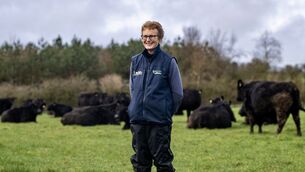
Minister has plenty to chew on for tricky cross-border talks
The Council was established under the Belfast/Good Friday Agreement (1998), to develop consultation, co-operation and action within the island of Ireland on matters of mutual interest. Ministers of the Northern Ireland Executive and the Irish Government work together to take forward co-operation between both parts of the island to mutual benefit.
T he February meeting comes just a few weeks after a comprehensive investigation revealed that cheap cattle south of the border are one of three major reasons why farmers in Northern Ireland get 14p/kg less for beef cattle than their colleagues in mainland Britain.
It’s such a big topic north of the border that the North’s Livestock and Meat Commission appointed Oxford Economics, a world leader in global forecasting and quantitative analysis for business and government, to investigate the price differential.
It found there is an extensive trade in live cattle and beef between North and South, and that NI beef and southern Irish beef are sometimes substituted for each other on the GB market. Inevitably, the availability of a cheaper supply in the Republic of Ireland tends to cut Northern Ireland prices, relative to GB.
This can be interpreted as good news for southern cattle farmers. Because anything the Agriculture Ministers north and south, Michelle O’Neill and Simon Coveney, can do to improve beef prices in the south will help farmers in the north also.
Prices weren’t discussed at the 21st North South Ministerial Council Ag riculture meeting in Ar magh last November. The only matter discussed likely to affect farmer’s pockets was continued investigation by officials of the possibility of a joint contingency plan in relation to rendering capacity on the island of Ireland.
A lot of Irish cattle carcases are rendered in the North.
However, southern farmers now say fewer dead animals will go to rendering plants in Northern Ireland, because Minister Coveney has set a new haulage limit of 125 km (as the crow flies) from animal collector to renderer.
Horse was the only other meat on the council’s agenda last November, with Ministers O’Neill and Coveney agreeing that if significant equine welfare and abandonment issues arise over the winter, any required action will be on an all-island basis.
But beef prices should definitely be on the menu in November, if only to consider the Oxford Economics findings on the additional cost of, and barriers to, the beef trade from the island of Ireland into GB markets. They found the additional cost of transport of live cattle to GB processors from Northern Ireland was 10-12p/kg. The additional cost of transporting beef to GB is estimated to be 3-6p/kg.
TB restrictions on move-ment were are also identified as a barrier to the sale of live cattle from Northern Ireland to GB.
The complexity of cross-industry relationships was also seen as affecting trade between NI and GB, adding costs for the NI beef industry.
And the more seasonal cattle supply in Northern Ireland, with 27.4% of cattle slaughtered in the autumn, was blamed for reducing prices in Northern Ireland, and adding to processor costs.
There are several interesting findings there for Simon Coveney and for the south’s beef industry — such as the figures on the cost of transport to GB, and the cost of seasonal cattle production.
Now that Oxford Economics are so well versed in the Irish sea gap in beef prices, perhaps he could get them at a reduced price to investig ate the question plaguing 100,000 cattle farm-ers south of the border all year — why did Irish beef cattle sell as much as €350/ head less than comparable cattle in the UK (where nearly 60% of Irish beef is consumed)?
If northern farmers have their way, there may be difficult questions for Minister Coveney at the February meeting.
The Northern Ireland National Beef Association says beef coming north across the border is not up to the North’s Farm Quality Assured Standard.
Hopefully, that kind of allegation is just northern farm-ers venting their frustration at low southern cattle prices dragging down their profitability, and Minister Coveney can assure them of the high quality of southern beef.