Harvest celebration will be a great day
If the harvest of nuts and grains was good, along with meat, fish, fats and fruits that might be preserved, you might make it through to spring.
But if it was a bad summer, then it was a certainty that people would die before growth returned to the earth again. Such crop failures were regarded as a wake-up call for people who felt that they had somehow failed to appease the relevant gods.
Harvest festivals have traditionally been held on the Sunday nearest the full moon, often around Sept 23. And with the advent of Christianity, celebrations gradually came to involve special services and decorating the church with baskets of fruit and food, often donated by parishioners from their allotments or farms, food that is later donated to the needy in the community.
While many of us may have lost our sense of the work, effort and ultimately miraculous renewal of life involved in planting and harvesting crops, services of thankfulness still persist.
Before the advent of machinery, harvesting was hard, hot and dusty work that required many hands to complete. Without friends, neighbours, hired hands, if you could afford them, and hard-working heavy horses, it was an impossible task. It is hardly surprising that when this period of intense physical labour was finally over, it was time for a bit of a community get-together.
In Cornwall, where I lived for a while, the last patch of corn to be cut in a field was known as the “neck” and it was believed to have special properties. Cutting it signified the end of all that hard work and the beginning of the feast. There would be a race to finish first, and the winner would cry that he was “bringing in the neck”.
Corn dollies were made from the last of the corn and hung in the barn to keep cattle free from disease. Ears of grain from the dolly were ploughed back into the soil the next spring in the hopes that this will bless the new crop.
It all seems a far cry from today, and the weekly trip to the supermarket that has left many people unaware of where their food comes from or how it is produced — something that vexed Mick Forde for some time, before he finally became the proprietor of The Farm in Grenagh, near Cork.
I spoke to Mick about his own plans for a special harvest celebration.
So Mick, what have you got planned for September 15?
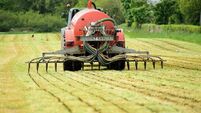
It’s going to be all systems go by 12 o’clock that day, a spectacular display of machinery from the 50s, 60s and early 70s. This is going to include a silage harvesting demonstration of single-chop, double-chop and other very early systems. A collection of over 10 combines, dating back to a Massey Harris from the 1940s that was bought in Merchants Quay in 1949, a Clayson New Holland bought in Cork City’s OK Garages in 1973. This machine cut corn on the farm here in 1975, and it’s going to be driven by John and Willy O’Connell of Blarney, the men who operated it until it was retired in 1998. The straw will be baled, collected and loaded, using what, at the time, were modern systems.
It sounds like it’s going to be quite a day. But of course, vintage machinery isn’t all there is to see at The Farm, is it?
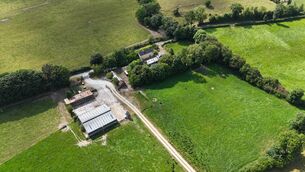
Far from it. For some time now, I’ve wanted to do something more to remind people about how their food is produced, where it comes from. And because things move so fast these days, people often forget how things were in their own or their parents’ lifetimes. It’s not as if we’re talking about 100 years ago either. So we’ve tried to show farming life in rural Ireland in fairly recent times. We have animals that would have been found on the farm then, and the equipment that would have been used too. There are miles of walkways, a model cow that shows kids where milk comes from, a farm shop, and a playground.
And I believe that you recently opened a Heritage Centre?
Yes, we did. Alice Taylor performed the honours for us. I’m very pleased with it, and it’s been very popular with the visitors. There’s the old village shop with the telecommunications centre, and a hardware shop with all the old equipment on display, and a kitchen set up, as it would have been in the 50s, even down to the colour of the paintwork. Children are amazed to realise that as late as 1984, phone calls had to go through an operator.
What are your own favourite memories of the harvest, Mick?
Without a doubt, it was the excitement of waiting for the combine to arrive. The whole place was on edge, waiting for it to pull into the yard. When the combine arrived at my aunt’s place in 1949, people came from all over, walking for miles and on bikes, just to see it. And with every piece of vintage machinery, there are great stories that go with them too, of the men who had to struggle to buy them, those who used them and who kept them running. At The Farm we’re always coming up with something new. Everyone is welcome on the 15th, for what’s going to be a great day out.”
* www.visitthefarm.ie