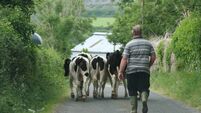
Next six weeks are criticalfor productive capacity
According to Teagasc, reports from knackeries around the country suggest that the percentage of fallen animals has increased this spring, compared to last year — which may be linked to inadequate feeding of cows, leaving them too weak after calving. It is feared that inadequate feeding is taking a toll on livestock. even though calving and lambing have not got into full swing yet.
Teagasc nutritionist Siobhan Kavanagh advises that the next six weeks are critical for maintaining the productive capacity of dairy and beef herds, and sheep flocks. She said a lot of effort and cost has gone into ensuring that cows and ewes were adequately fed for the last few months, and it’s important this is maintained until calving or lambing.
*What is the advice for farmers with bad quality silage?
>> As a general rule of thumb, expect to feed 1-2kg more meal than you would normally feed, to all classes of bovine.
Keep a close eye on cow condition. Get a neighbour to come in and take a look at your cows. When you are looking at them every day it’s hard to judge their condition.
*How is calving going?
>> There have been a lot of reports of cows going down at calving. One of the major contributory factors to this is cows on bad silage losing condition in late pregnancy.
Continue feeding meals to dry cows on bad silage, which may also be in poor condition.
Don’t be afraid to feed some meals up to calving. This will not cause calving difficulties, because the meal is simply filling the gap in what silage alone would supply on a normal year.
Overfat cows are a bigger risk factor for calving difficulties.
Some of the problems associated with losing condition before calving include displaced abomasums, immune system insufficiency (retained cleanings and infections), fatty liver, ketosis pre-calving, and potentially, milk fever and low intakes after calving.
*What kind of problems can bad quality silage cause?
>> Protein levels in silage are low in many cases and dairy and suckler cows are short of about 250 grams of protein. This can be supplied in 0.5kg soya, or 1.0kg of distillers grains, or by feeding 2-3kg of a 16% crude protein ration.
Check that a good quality pre-calver mineral is being fed. Animals are stressed on bad silage, and their immune system is under pressure. This can create problems for the cow (retained cleanings, infections, etc) and the calf.
*What’s the advice on milk fever type problems around calving?
>>If you see problems such as slow calvings, retained cleanings, low intakes, displaced abomasums, check energy, protein and mineral intakes. Are cows getting enough feed energy into them? If silage is less than 64 DMD, you need to feed 2 kg of meals. Are cows getting enough protein?
Ask yourself, do I need to feed that 0.5 kg of soya?
Watch mineral intake, particularly magnesium intake. If the magnesium percentage on the bag is 15%, feed an additional 30 grams of sweetened calmag.
*What about suckler cows?
>> Calved suckler cows on good quality grass silage will not need meals, provided they are turned out to grass within one month of calving.
But cows in poor condition or on bad quality silage will need some supplementation (2-3 kg, depending on silage quality), regardless of turnout date.
*What about weanlings on poor quality silage?
>> Continue meals until turnout for weanlings on silage of 62 DMD or less. Reduce meal feeding to 1-2 kg for the last month before turnout.
*What’s the advice on ewes?
>> Ewes pre-lambing will need an additional 0.2 to 0.3kg of meals per day to compensate for bad quality silage.
This will help avoid problems such as weak lambs, light lambs at birth and weaning, and twin lamb disease.
Don’t forget protein supplementation. Protein levels in silage are very low this year.
Ensure adequate protein supplementation for the last three of four weeks before lambing.
*What is the advice for farmers short of silage?
>> It is important to act now, don’t wait until you have run out before taking action. Your options include the following:
Buy silage (it’s worth €25-€30 per bale, depending on quality). Buy meals (more predictable than bad silage), or buy straw.
Sell surplus stock.
If finishing animals (including cull cows), remove silage from the diet, and use high concentrate diets plus minimal roughage.
Weanlings can be offered restricted silage plus 2kg to 3.5kg of meals, or ad lib straw plus 3kg of meals.
Keep the best silage for the cows after calving. These animals cannot be restricted on silage or straw.
There is an option to put late calving dry cows on restricted silage plus meals (3 to 3.5kg) or silage plus straw plus meals (assuming 3kg of straw plus 2kg of meals), or straw plus meals (5kg of meals).
Avoid making big changes to cow diet in the three weeks before calving.
Consider ad lib concentrates plus minimum roughage for ewes before lambing.
*Where can farmers get fodder help and advice locally?
>> There is help available to you if you have difficulties caused by the bad weather.
Teagasc is available to help with both clients and non-clients. Please do not hesitate to call into the local office. The DVO, IFA, co-ops and marts are also sources of information and advice.
The Department of Agriculture runs a Farm and Rural Stress Helpline.
This is a freephone helpline open from 6pm to 10pm daily targeted specifically at farmers and people who live in rural areas.
It is aimed at people who may be feeling down, suffering from stress or depression, or those who are concerned about someone.
The number for this helpline is 1800-742645.