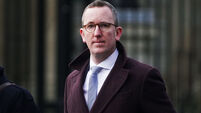
Doughty Dillon keeps delivering
But the current leader, John Dillon, now coming towards the end of his first two-year term in office, took to the task like a duck to water and with a lot more energy.
The first Limerick man elected to the post, he has a style that combines a reputation for being a tough and tenacious negotiator, with a tendency for public protest when all else fails.
A non-drinker and former cross country runner, he was elected on the catchy slogan of "Dillon delivers" and with pledges to tackle falling farm incomes, growing bureaucracy, increasing costs, environmental and other issues.
He speaks in earthy but occasionally hesitant tones, is respected as a decent man who has been known to travel the length of the country to visit friends in hospital, and is close to his people and their problems.
Dillon's supporters are fiercely loyal to him and point to his first term successes in difficult times, but his critics say he can be impulsive, could show more vision and is sometimes reluctant to compromise. All agree, however, that he is totally committed, direct and without pretence and will never call a spade an agricultural implement.
Last year, he led action against beef processors that initially halted a slide in cattle prices, and then secured an increase worth over 50 per head. Another threatened price drop was prevented with staggered protests outside plants over a period of five weeks.
He also led a lobbying campaign on milk price in Ireland and Brussels. Seven EU increases in skim powder aid and three in casein aid followed talks involving Minister Joe Walsh, EU Farm Commissioner Franz Fischler and the dairy industry.
Less successful was his effort to secure aid for fruit and vegetable growers who suffered serious losses and higher costs due to the wet weather. But changes in Farm Assist helped low-income farmers who were under pressure Dillon said a sheep identification system imposed by the Minister was impractical, unfair and not needed. IFA members returned some 2,000 registers.
"We got some positive results. Reconciliation is being sorted out and we are negotiating to see if we can get a more practical and more simplified system than is there at the moment."
A grain industry meeting discussing prices was controversially gate-crashed in Dublin by the IFA "I rushed in myself. I had 300 farmers with me. Eventually, after a period, we got the best possible price for grain, which was in Dairygold."
Dillon recalled that the IFA made a submission to the Government last year on the farm income crisis in general, met 100 TDs in Dublin and had discussions with the Taoiseach and his Agriculture and Finance Ministers.
"Nothing happened and we went into the social partnership talks. But when the book of estimates was published, it contained cuts, cuts and more cuts, a doubling of disease levies and other changes. The budget later confirmed these proposals."
Dillon believed it was time for stronger action if he could get the members to back him. The seeds of a week-long countrywide tractorcade protest were sown. But it was a high-risk strategy.
"We knew at that stage the Government or the public did not recognise or understand that we had an income problem. The tractorcade was a problem for me as well.
"Most of the people of Ireland and most of my own very close allies did not want to go with it. "Eventually, after about three weeks saying we had to go with something, as there was no alternative, the tractorcade got the go ahead," he said.
Starting off in the cold sleet on January 6 in Bantry, farmers on tractors moved on Dublin from various parts of the country over the course of a week. They were headed for a rally outside Government Buildings in Merrion Street. Public support increased and so did the spirits of the farmers.
Dillon recalled: "During all that week Minister Walsh was in denial, saying our income was 45,000 while we knew it was 15,000.
"Teagasc came out and confirmed our income the previous year was 15,800. That clearly showed Minister Walsh was wrong.
"When he found himself in trouble he said 'come into the social partnership process and we will try and deal with your concerns'.
"We went back into partnership but after three weeks of discussions, we had not got one cent for Irish agriculture or Irish farmers.
"At the same time there was 2 billion for the public sector and others. We were effectively pushed out of partnership."
Dillon said himself and IFA general secretary Michael Berkery, in particular, worked extremely hard behind the scenes with as many officials and ministers as they could.
"We eventually came up with an agreement that went from a position of zero to one that was worth 250 million per year to farmers.
"We also have the strongest possible commitment from the Government that the disease levies, which were doubled in the last budget, will be brought back to what they were in the next budget."
However, the partnership outcome was hotly debated within the IFA with some claims that Dillon did not secure enough for farmers. He accepts it was not a good deal but insists it was the best possible one in the prevailing economic circumstances.
He said: "Dillon has delivered and is going to deliver more. I believe I have 95% of the support of the farming community, particularly the members of IFA."
Recently elected vice-president of COPA, the committee of agriculture organisations in the EU, he loves the challenge of leading the IFA and said he will be seeking a second two-year term in office next November.
John Dillon, who has called a national council meeting in Dublin today to discuss the CAP reforms, believes he is the best person to lead the 85,000 member IFA for another two years.
But should anyone be thinking of challenging him for the post, he has friendly but typically blunt advice "don't waste your time."