The factory of the future: Why DMI wants the world to make things here
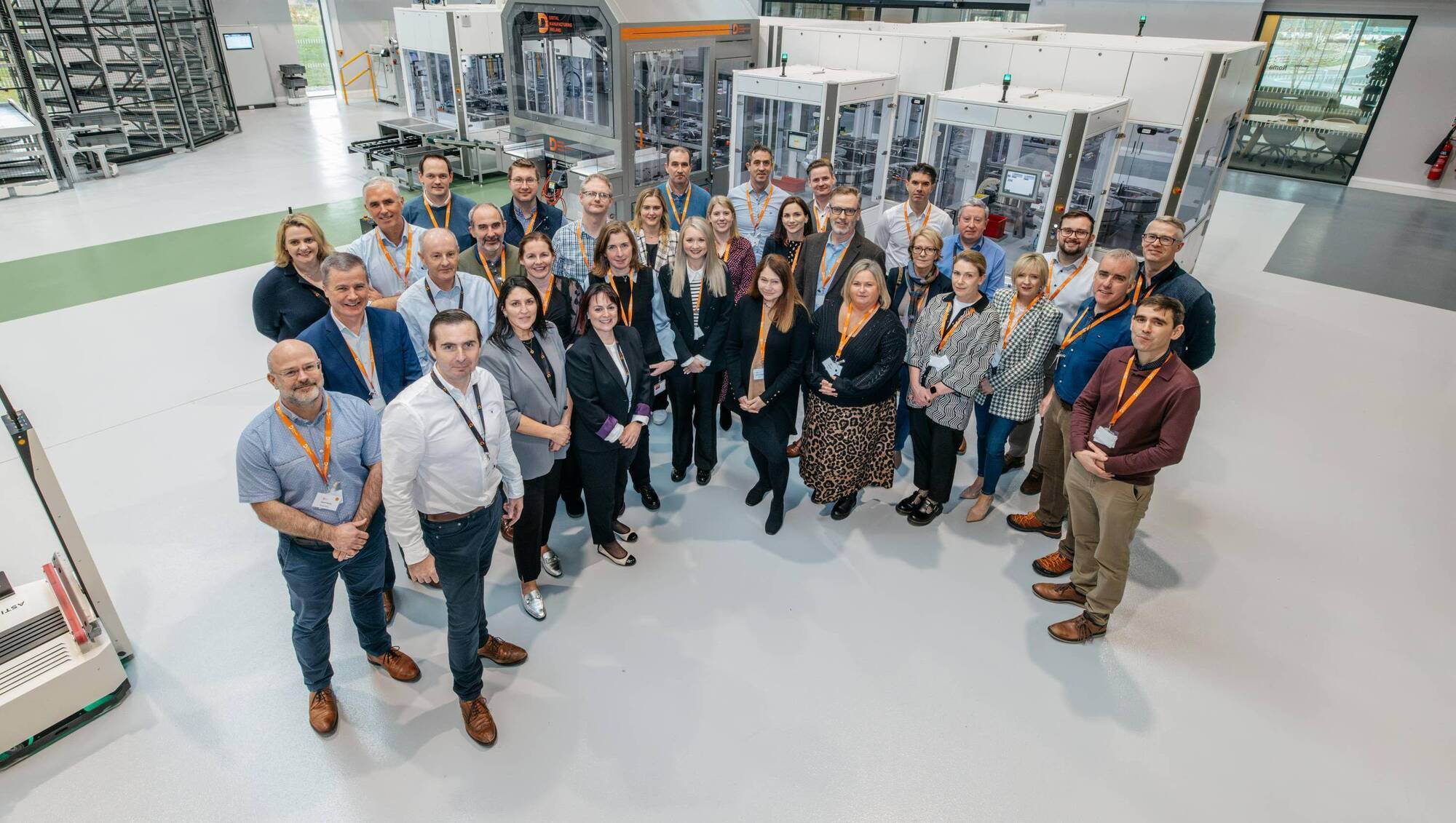
Representatives of 11 leading manufacturers who participated in Digital Manufacturing Ireland’s HCM study on digital transformation with Massachusetts Institute of Technology (MIT) and the International Academy of Automation Engineering. Picture: Sean Curtin
Walk into an Irish factory five or ten years from now and the most striking thing may be what you don't see.
There could be far fewer people moving around a production floor, less noise and less obvious activity. Instead, a small number of employees may be sitting at computers while automated systems carry out much of the physical work behind closed doors.
The factory will still be busy. It just may not look busy.
That is the direction Domhnall Carroll, CEO of Digital Manufacturing Ireland (DMI), believes manufacturing is heading as automation and digital technologies become embedded in industries once considered difficult to automate.
“People are always surprised when, if you go into a factory now and you're used to seeing lots of people running around doing stuff, and then five or ten years' time you go in and there's two or three people looking at computers and things are pretty quiet, but there's still lots of stuff happening,” he says.
For DMI, helping Irish manufacturers prepare for that transition is at the heart of its role. The organisation works exclusively with manufacturing companies, helping them identify, adopt and integrate technologies that can improve their competitiveness.
That can mean determining which technology is appropriate in the first place, demonstrating how it could be deployed, helping integrate it into existing operations and ensuring employees have the skills required to use it.
“Anything that you need to adopt new tech is what we help with,” Carroll says.
It is an increasingly important brief. Ireland has built a formidable manufacturing base, particularly across pharmaceuticals, medtech, engineering and electronics, but the technologies underpinning production are evolving rapidly.
For manufacturers, adopting technology is rarely as straightforward as buying a new piece of equipment. A technology has to solve an actual business problem, work within an existing manufacturing environment and ultimately make the company more competitive.
DMI is designed to help bridge that gap between technology and its practical application on the factory floor. The organisation occupies an unusual position in Ireland's enterprise landscape. It is a private, not-for-profit entity but is supported by Government through IDA funding.
Its work with manufacturers operates at several levels. Some activities are provided as part of its wider ecosystem role, allowing companies to visit DMI, see emerging technologies and explore issues such as workforce upskilling without charge.
It also undertakes collaborative projects where several companies share an interest in a particular technology and contribute towards the cost of exploring it. Companies looking for a proprietary solution can work with DMI on an individual commercial project.
What DMI does not aim to become is a permanent outsourced technology department.
Carroll describes its role instead as temporary support: bringing specialist skills and manufacturing experience into a company when they are needed, helping it develop and implement a solution and ultimately leaving the business capable of taking that work forward itself.
That distinction matters because DMI's ambition extends beyond the success of individual projects. The longer-term objective is to strengthen Ireland's overall ability to manufacture increasingly complex products as international competition for investment intensifies.
Carroll believes the physical appearance of manufacturing will continue to change as part of that process. He points to brewing as an example. Once highly labour-intensive, modern brewing has become heavily automated. Similar changes, he believes, will spread into industries that have traditionally appeared less suited to automation.
“Manufacturing will get cleaner,” he says. Much of what is happening will increasingly take place inside closed systems, with employees controlling and monitoring processes remotely rather than carrying out every physical task themselves.
That does not mean people disappear from manufacturing. Rather, their relationship with the production process changes.
Behind an automated factory are people designing products and processes, programming equipment, analysing performance and making the decisions that allow those systems to operate. The transformation therefore involves people and skills as much as machinery.
For DMI, however, the ultimate measure of success is bigger than the number of technologies adopted or companies assisted. Carroll's ambition is strikingly simple.
“We want that anyone who's looking at making or building a manufacturing site, they look at Ireland first because Ireland is the best place to make things.” DMI already receives international visitors from companies considering Ireland as an investment location. Carroll says those visits give prospective investors an opportunity to understand not simply what manufacturing capabilities exist in Ireland, but what support will be available if they establish operations here.
Ireland's proposition has also evolved. While corporate tax has historically been an important part of the country's appeal to international investors, decades of investment have also created manufacturing expertise, university programmes, skills and specialist organisations such as DMI.
The aim now is to turn that accumulated capability into a competitive advantage that is difficult to replicate elsewhere.
Carroll wants international companies considering where to manufacture sophisticated products to reach an instinctive conclusion: “We've got to go to Ireland if we want to make something, especially if it's complex.” It is, he acknowledges, bigger than DMI itself. “It's kind of a national ambition as much as it is a DMI one, but we hope to play our part in it.” If that ambition succeeds, the Irish factory of the future may be quieter, cleaner and considerably more automated.

CONNECT WITH US TODAY



Be the first to know the latest news and updates