Investing in innovation is key to growth, say AmCham members

The American Chamber of Commerce in Ireland has advocated for the outlining of a significant multi-annual investment plan to enhance and build Ireland’s ecosystem for research.
Ambitious companies operating in Ireland and the US are increasingly seeing the value of investing in innovation and new technology, an ethos that they closely align to talent development and retention.
The American Chamber of Commerce in Ireland has always been keen to promoted the benefits of investment innovation, applauding those companies that do, while also warning those that don’t of the ways in which they may be limiting their own potential.
In September 2023, AmCham published its 2024 pre-budget submission ‘Building an Impactful Ireland – For 2050 and Beyond’, in which it noted that one-third of firms in Ireland have yet to put an innovation strategy in place.
The report noted that Ireland’s spending on Research and Development (R&D) is significantly lower than the average across EU countries. AmCham believes that this funding gap could place Ireland at a disadvantage in the race to attract new, high value, businesses into the country.
A spokesperson form AmCham said: “AmCham has advocated for the outlining of a significant multi-annual investment plan to enhance and build Ireland’s ecosystem for research.
"This will be integral in achieving a vision for Ireland which includes Ireland being number one in the EU for research in A.I., cyber, and quantum computing and in Ireland becoming a global centre of research excellence in digital manufacturing and healthcare as a digital service.
"It has the potential to ensure that Ireland remains a preferred destination for MNCs but also could set Ireland on the road to being a hub for global research and innovation.”
According to AmCham’s survey of firms in Ireland, 90% of large firms are open to collaborative innovation, however, 39% said the sensitive nature of the business is the largest barrier to working with a third party, while 29% said the lengthy procurement process or onboarding of suppliers was an issue.
Other barriers to implementing a collaborative innovation strategy included the direct cost for third-party involvement at 29%, lack of technical staff at 27% and lack of managerial staff and innovation leaders at 24%.
While 80% of large organisations expect that innovation will become more important to their business in the next one to three years, 34% of large businesses who responded to the survey do not have a defined innovation strategy.
Further, 45% of those do not expect to have an innovation strategy in place in the next three years.
Meanwhile, the companies featured here are all making strategic investments across areas of innovation that they view as beneficial to their company and to their participating team members.
Each of these companies is a member of the American Chamber of Commerce in Ireland. They share the AmCham view that investing in innovation is beneficial both for themselves as individual companies and for the global reputation of Ireland’s highly skilled workforce.
BT believes that the depth of its talent pool ensures the company delivers excellence for its customers across innovation, customer experience, workplace culture and societal impact.

Here, Dr Nicola Millard, principal innovation partner in BT’s innovation team, answers questions about how the company uses innovation to deliver on its commitments to both its own staff and across its range of individual and corporate clients.
Over the past number of years the hybrid work model seems to have settled into business as usual for many organisations.
But hybrid isn’t an easy model to get right. A lot of the conversation tends to be about the number of days that people should be in an office — but this probably isn’t the most important conversation to have. We need to figure out how to make work work … for people, productivity and the planet. them “value for commute”.
Then there are particularly horrible hybrids — such as the hybrid meeting. These can be nightmarish because people coming in remotely often get forgotten by people in the room because they are only represented by a few pixels on a screen. Solving this issue requires everyone to be on the default common ground — which is the digital platform. Utilising digital tools have the added bonus of increasing the accessibility of meetings for everyone because they can be recorded and shared, transcribed, subtitled, and even translated into multiple languages.
One of the key productivity questions for the hybrid model is what an office is for? Connecting office assets to the cloud to figure out how people are using buildings, how energy is more sustainably deployed to support areas that are occupied, and what is and isn’t working can help attract employees into physical spaces and give
Future technologies such as augmented and mixed reality, 3D video, and holograms may also migrate from the realm of science fiction films and become a meeting room reality. These technologies enable us to move from two-dimensional meetings on screens to a richer, more immersive three-dimensional space. They could also change the ways that we collaborate — imagine a remote hospital clinician using augmented reality and haptic technologies (transmitting touch via a glove) to guide an onsite paramedic through a basic procedure that they normally wouldn’t be able to do on their own.
Customers expect companies to provide excellent customer service. It’s not so much a point of differentiation anymore, but a hygiene factor. They also like things to be easy. The reality is that many organisations are attempting to orchestrate a complex and diverse set of end-to-end systems and processes which often work against that expectation.
Global Fabric, BT’s future network strategy, is designed to help solve this issue on an infrastructure level. It is a network and security platform which connects and protects different components of a customers’ digital ecosystem — from contact centre to mobile workforce and beyond. It lets companies choose how their data travels around the world, and works closely with cloud services, giving them more control, more options, and better deals. This means that companies can reach new markets quickly and apply new technologies, such as artificial intelligence (AI), to customer interactions to improve and connect the end-to-end customer experience.
It all starts with research.
One key piece of customer experience research is our autonomous customer survey which we have done every 2 years since 2010. This takes the temperature of global customer opinion about customer experience across all sectors and industries. This includes what they think good service is, what channels they use, and their attitudes to new technologies such as AI and the metaverse. This enables us to innovate and future-proof our portfolio as well as enabling us to have more strategic conversations about effective customer experience strategies. It helps us to help our customers serve their customers through enhanced contact centre and digital services.
Keeping pace with change in a volatile world can be a challenge. The workplace is evolving to become a flexible, digital-first environment with ubiquitous connectivity to the internet and the cloud. This allows employees to take advantage of step changes in computing power, disruptive technologies such as AI, advanced collaboration platforms such as virtual, augmented and mixed reality, and tools that will help them work more sustainably.
A challenge facing the entire technology sector is achieving greater gender balance and encouraging more women to pursue careers therein.
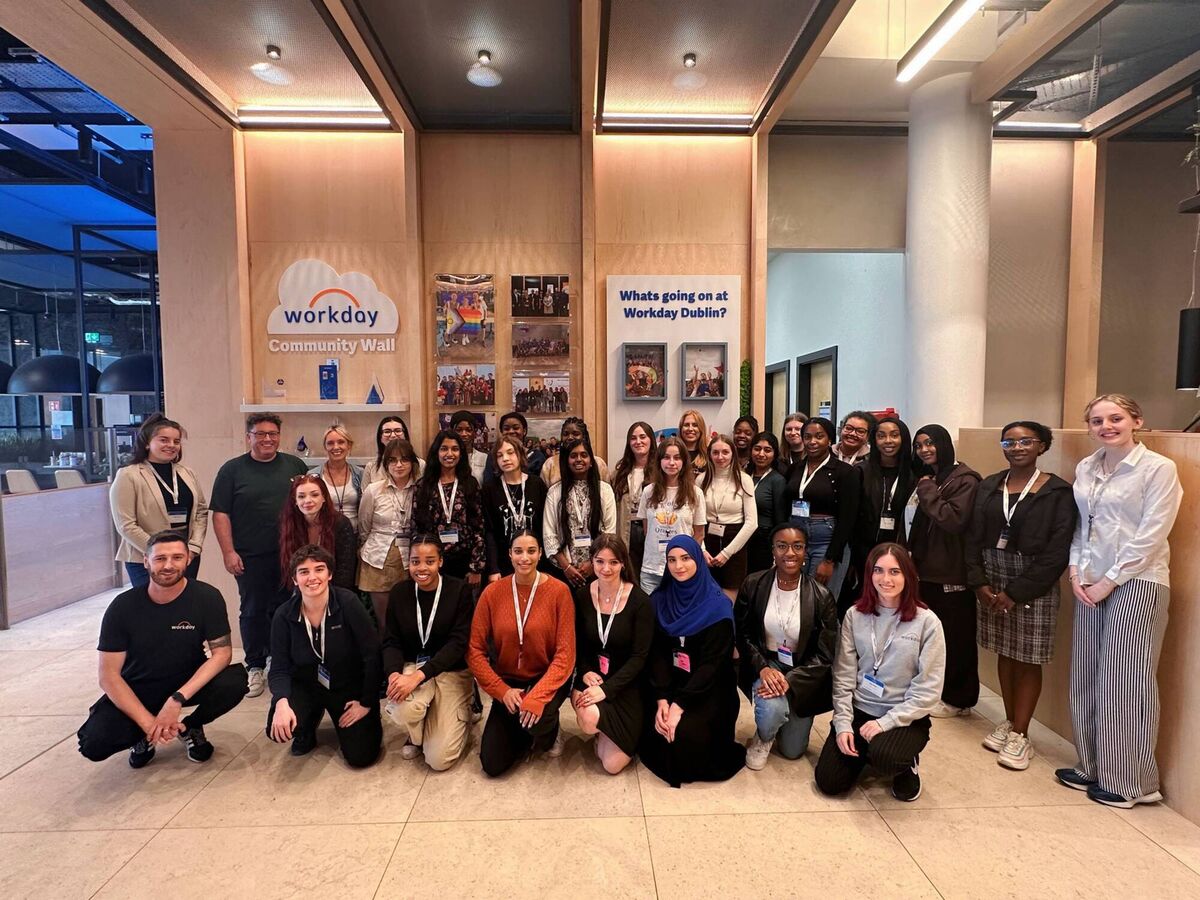
One effective approach to attracting more female participation? Provide real-world experience for third-level students, showing the diverse opportunities available. This is precisely the goal of Workday's ‘Future Females in Tech’ initiative — and the results show its working.
A leading provider of enterprise cloud applications for finance and human resources, Workday employs around 2,000 people in Dublin, with a substantial 75% dedicated to product and software development. Given the company's strong emphasis on innovation, attracting a talented and diverse workforce is crucial.
‘Future Females in Tech’ plays a pivotal role in addressing gender balance by dispelling myths and stereotypes associated with tech careers and showcasing the wide range of roles available for women.
The initiative was launched in 2018 after Workday found that there was an unusually low number of female applications for internships. Recognising the need to build career awareness and promote potential opportunities for female third-level students pursuing technical degrees, the initiative focuses on experiential learning and mentoring.
Anchored by a two-day immersive conference hosted at Workday, ‘Future Females in Tech’ features leadership stories, career skills workshops, design-thinking challenges and team shadowing. The event is about real-world experience - participants partake in problem-solving, teamwork and networking activities.
After the conference, to sustain their newly acquired skills, participants stay connected through social media groups, college meet-ups, and mentorship.
Then comes further career opportunity — in their penultimate year at third level, the female participants can apply for a six-month internship, with the potential for full-time roles upon graduation.
The results are encouraging — in six years since the programme’s launch, the number of female interns has increased seven-fold.
The enthusiasm and excitement surrounding “Future Females in Tech” have resonated with employees across Workday. Led by the Early Talent Acquisition Team, "Future Females in Tech" receives support from over 70 volunteers spanning every discipline. Through ‘Future Females in Tech’, Workday plays a significant role in enhancing gender diversity, as evidenced in the increased percentages of female applicants and positive impacts on gender balance in its cohort.
Moreover, the programme’s success has been widely recognised, including the Gradireland Diversity Recruitment Award (2021) and the Diversity and Inclusion Award (MNC) at the Chambers Ireland Sustainable Business Impact Awards (2023).
The great news is engagement around ‘Future Females in Tech’ continues to grow year on year — and it is contributing to a more diverse and balanced tech sector in Ireland.
with Dr Mary Coghlan, Partner, Head of Health Data Analytics & AI, EY.

Artificial Intelligence (AI)-powered tools and solutions, such as automation, machine learning and predictive analytics, have been deployed routinely in many organisations for some time now and in many cases have had a material impact in helping to automate routine tasks, reduce errors and increase productivity. Predictive analytics is a powerful tool in strategic and operational planning especially where there is a complexity in day-to-day logistical operations.
However, the momentum around Generative AI has become impossible to ignore since last year, particularly since the launch of ChatGPT. We know that many businesses globally are keenly focused on the adoption of Generative AI to drive productivity, efficiency and critically, innovation and are hiring talent and re-allocating capital from other investment projects or technology budgets to drive their planning.
The most recent EY CEO Outlook Pulse survey found that the mention of AI or Generative AI in earnings calls more than doubled over the past year. This combined with a surge in companies offering AI expertise can leave CEOs struggling to identify priority use cases – in a sense separating the wheat from the chaff – unsure where to invest or with whom to partner to drive opportunities in their sector. As a result, they can be unclear about where AI factors into their business strategy.
The relevant decision-makers in businesses know they need to act quickly and embrace AI and generative AI, but, equally know that some of the information to agree their strategy is currently unavailable or evolving at a manage that is difficult to manage.
Thanks to the increased popularity of Generative AI models like ChatGPT, conversational AI tools are now being used to create more efficient solutions in the world of work. Whether that’s to speed up regular tasks, like drafting emails, summarising text, or to help with brainstorming. From customer service in the form of chatbots or virtual assistants handling simple queries to personalised tailored experiences for clients, based on data analysis of customer behaviour and preferences, to supply chain optimisation, recruitment and helping to identify and mitigate risk in areas like cybersecurity, fraud detection, and compliance, AI is already a hugely valuable tool in the day-to-day workings of many businesses.
A good example is EY’s own private large language model, EYQ, for its staff globally (including more than 5,000 people in Ireland) which is enabling and encouraging our people to harness the power of Generative AI. Our view is that EYQ is a co-pilot - it augments human potential by supporting ideation and research, boosting productivity, automating repetitive tasks and more. Importantly, to ensure our quality assurance standards are maintained at all times, we’ve built bespoke AI learning and development for EY people, on the use of EYQ, to ensure responsible and optimised use of AI.
In the face of rapid technological innovation, organisations are navigating a complex landscape of opportunities and risks. While technologies like AI are transforming operations, there can be an amplified risk of data breaches and ethical concerns as the general population of users work hard to upskill and understand the relevant factors. Organisations know they need to prioritise data protection and ethical technology usage to ensure they better navigate the digital landscape, mitigate risks and drive more effective decision-making. This need is all the more pertinent in the era of Generative AI.
EY’s breadth of technology capabilities, industry and regulatory knowledge, finance discipline, and global geographic reach position us to help businesses transform at speed and achieve their strategic ambitions.
In spite of the potential of AI to help businesses operate more efficiently, many businesses have expressed concerns around the use of Generative AI in the workplace, with some, either tacitly or outrightly banning access to tools like ChatGPT. Security concerns, the potential use of company-sensitive data to “train” models and the potential for these to provide incorrect information (“hallucinations”) are some of the issues that have been raised.
One of the significant challenges in deploying AI including Generative AI in business environments, is ensuring that sensitive data remains secure. All companies have a responsibility to manage data in a way that meets regulatory requirements and so must understand how to utilise the power of AI while protecting sensitive information.
EY helps businesses to understand the value and risks of AI, pragmatically defining the capabilities needed for an organisation to adopt and scale AI. We work with clients to incorporate the robotic, intelligent and autonomous capabilities that will transform and innovate the way a business operates, plans and competes in the market now.
AI is only going to become more integral to business operations so it’s worth taking the time to consider an action plan that will drive value from the adoption of AI. Establishing an AI governance group dedicated to AI adoption and use can be a good place to start your AI journey. The group can work together to identify and prioritise Generative AI opportunities, while assessing disruptive risks, talent requirements and data governance needs. The group should work closely with other parts of the business to create the right internal feedback loops, making sure that employees at all levels feel that they’re part of the journey by explaining how Generative AI is being deployed and the underlying data sets it uses. This will help to build trust and confidence in AI-based outputs.
A clear area where Irish companies can take action is ensuring their data is at a level where they can maximise the use of AI technology. Generative or any other sort of AI is critically dependent on data quality. Irish and international organisations have realised in recent years that the adoption and implementation of a data strategy, the appointment of a Chief Data Officer and a continued focus on leading edge market insights fuelled by the right data are key constituents of their ability to compete in the market. We refer to Trusted Intelligence — EY’s value-first approach that reframes how organisations obtain, manage, use and scale data - and apply it to all stages of the data value chain — collection, storage, use and distribution. This is a tangible area of focus for organisations that will yield them massive benefits in their deployment of Generative AI and far beyond.
Ultimately, to be accepted by users — both internally and externally — and to truly bring value to an organisation, AI systems must be understandable, meaning their decision framework can be explained and validated. They must also be resolutely secure, even in the face of ever-evolving threats.
We see Generative AI working alongside teams and assisting in the completion of routine or complex jobs, which means freeing up time for employees to focus on more productive and higher value tasks and importantly, enabling more human interactions, more productivity, and critically, more innovation.
At EY, we believe that a key benefit of AI tools, like our own generative AI, EYQ, is to help take care of the smaller tasks and questions, so that our people can focus on the bigger and better questions to build a better working world.


CONNECT WITH US TODAY



Be the first to know the latest news and updates