AI downturn could result in lower tax receipts, investment, and employment, Central Bank warns
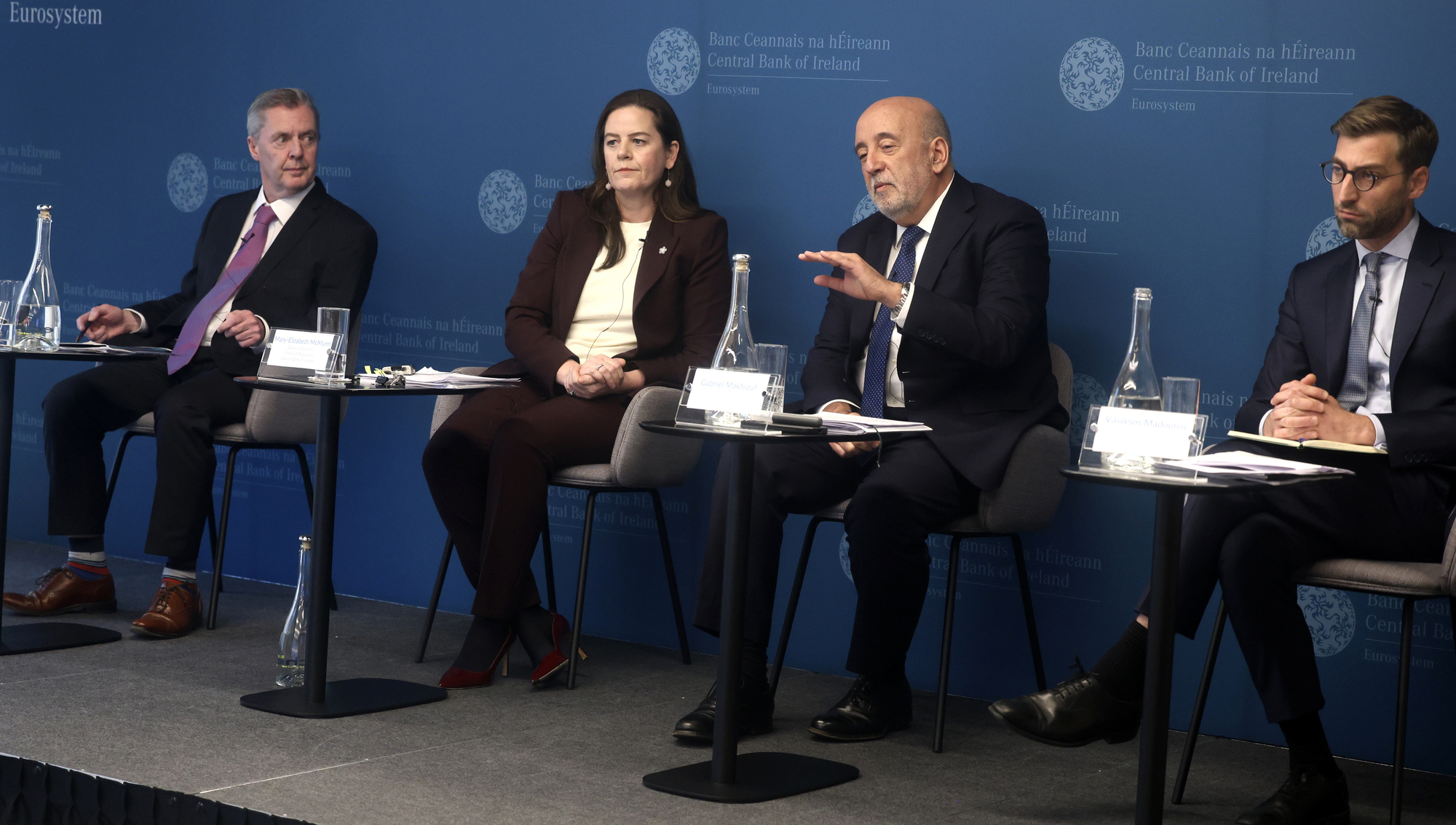
(Left to right) Director of financial stability Mark Cassidy, deputy governor Mary-Elizabeth McMunn, Central Bank governor Gabriel Makhlouf and deputy governor Vasileios Madouros at the second Financial Stability Review of 2026. Photo: Leah Farrell/© RollingNews.ie
A shock to AI-related company valuations or a slowdown in AI investment could "simultaneously" result in a reduction in multinational investment into Ireland, lower tax revenue, trigger losses in financial markets, as well as impact growth and employment, the Central Bank of Ireland has warned.
In the Central Bank’s latest financial stability review it said the global and domestic economy has remained resilient despite a number of challenges, such as the recent bout of high inflation driven by the war in the Middle East.
However, the Governor of the Central Bank of Ireland Gabriel Makhlouf said part of this resilience has been based on the strength of AI-related investment “whose future path remains uncertain”.
He said the increasing reliance on AI investment for growth, as well as geopolitical tensions, rising sovereign debt and a deteriorating cyber threat landscape are all increasing risks. He said there are several interrelated vulnerabilities that could “cause the outlook to change abruptly”.
Mr Makhlouf noted that the small number of large firms who are largely behind the data centre build-out to support AI, have doubled their debt levels in two years to fund their construction.
Read More
“If those investments fail to match up with market expectations, then we could see a sharp repricing and repayment challenges at a time when market interest rates are rising. Investors already appear to be questioning whether AI investment can generate sufficiently strong returns and the cost of insuring AI-related debt has also increased recently,” he said.
Director of financial stability at the Central Bank, Mark Cassidy, said the five largest AI hyperscalers are expected to spend, between them, $800bn this year alone to fund AI infrastructure which is over twice the amount of the previous year.
“A very notable development is that as the free cashflows that are available to the AI hyperscalers have reduced… the hyperscalers are increasingly turning to debt markets for additional finance, and rising indebtedness of AI-exposed firms leaves the financial sector potentially exposed in the event of any shock to either a large firm or a more systemic downturn in the sector,” he said.
Mr Makhlouf said the Irish economy is "structurally intertwined” with global developments “which means that domestic vulnerabilities are also growing”.
“The State’s fiscal position, external trade dynamics and investment are all heavily influenced by a handful of large multinational enterprises. A shock to these companies could have a significant effect on domestic economic growth and, through that, the financial system.”
Mr Makhlouf said a repricing of AI valuations or a slowdown in AI-related investment has the “potential to reduce investment and tax revenue, trigger losses in financial markets, and decrease employment in AI-exposed sectors, all simultaneously”.
Mr Cassidy said there are a number of potential triggers for a shock or a correction to the AI sectors including a weakening of investor confidence, political backlash against data centres, or shortages of things like energy and chips, leading to a slowdown in construction and capacity.
The review noted that a “significant retrenchment in excess corporation tax” would lead to more borrowing at a higher cost, in the absence of constraining expenditure or increasing alternative revenue sources.
Another risk Mr Makhlouf noted was a concern that “persistent budget deficits have pushed the sovereign debt of several advanced economies higher, leading to fiscal sustainability concerns”.
In terms of the Irish economy, the review said that growth has “proven resilient” since its last review, with modified domestic demand growing by 4% during the second quarter of this year due to consumer spending growing steadily, and contributions from AI-related investment.
Inflation is expected to moderate over the course of 2027, however, uncertainty is high and further shocks would increase cost-of-living pressures and stretch debt-servicing capacity of households and businesses.
CONNECT WITH US TODAY



Be the first to know the latest news and updates