Pensions: You may not work as long as you think you will

Dr Dora Tuda, ESRI report author, says that while most employees retire earlier than they plan to, those without occupational pension coverage face the greatest financial challenges.
Employees with and without occupational pension coverage retire earlier than planned, but those without occupational pension coverage face substantially lower incomes in retirement. That’s according to research published by the Economic and Social Research Institute (ERSI) during the summer.
Historically, Irish people have relied heavily on the state pension as the primary source of income in retirement. Despite the fact that occupational pension coverage has risen steadily in recent years, a substantial number of older employees still face retirement without anything more than what the state will provide.
The ESRI study shows that employees with occupational pensions intend to retire earlier – usually around 63.5 – compared to those without occupational pensions. The latter group aims to keep going until the state pension age, which is 66.
In practice, however, both groups tend to retire at an average age of 61.
The gap between planned and actual retirement age is particularly pronounced among women who rely solely on the state pension. They retire on average at around 58.5, despite planning to retire closer to 66.
Although retirement ages are similar for those with and without occupational pension coverage, the ESRI research highlights a critical difference between the groups. Those with occupational pension coverage have a median weekly retirement income of approximately €460 – exactly double the €230 those relying on the state pension must settle for.
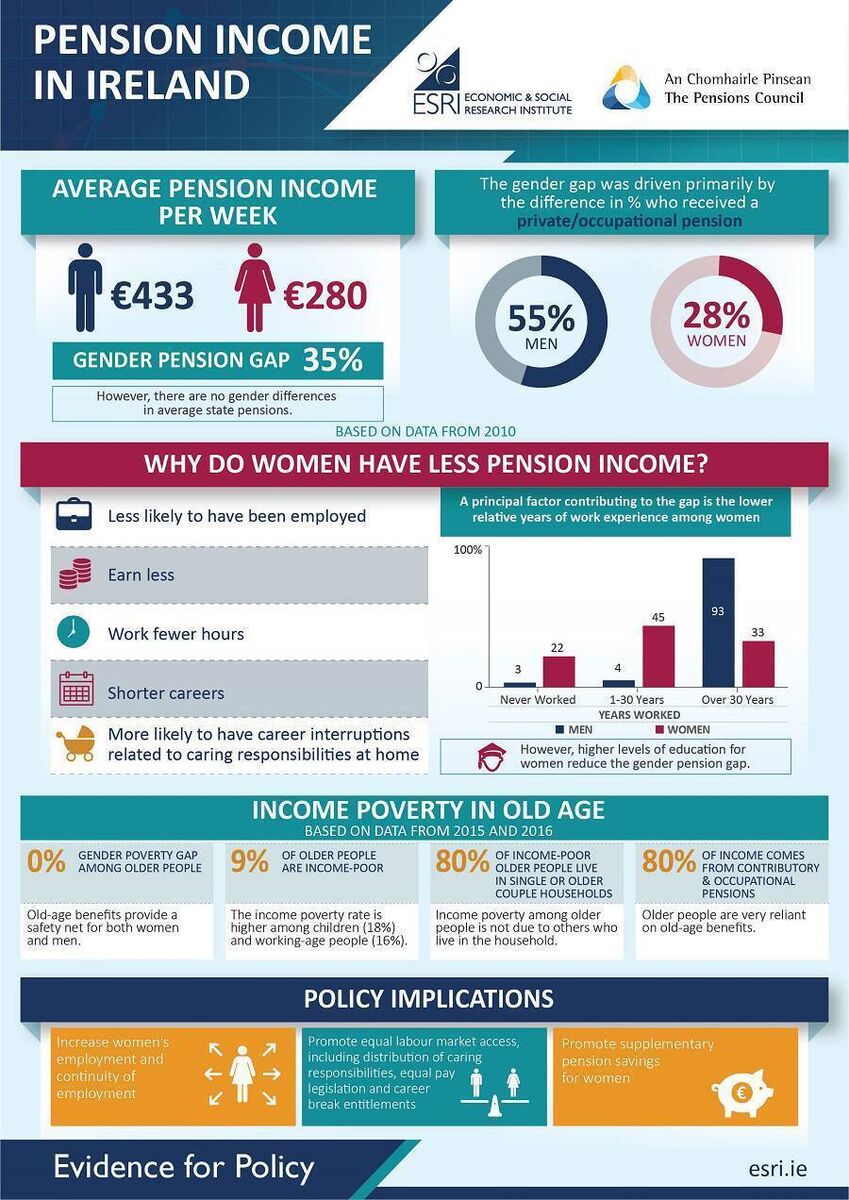
This difference is driven almost entirely by occupational pension income, as state pensions and benefits are similar across both groups. The gender pension gap is driven by occupational pension coverage, as men and women without occupational pension coverage receive similar weekly income.
Dr Dora Tuda is one of the authors of the report. She says that while most employees retire earlier than they plan to, those without occupational pension coverage face the greatest financial challenges.
“They not only retire earlier than expected,” she says, “but do so with significantly lower incomes, raising concerns about financial security in older age, especially for women.”
Another recent survey confirms that a substantial number of workers is going to have to stay working a lot longer than they want to in order to avoid financial difficulties in retirement.
Almost one in five workers say they won’t be able to afford retirement until age seventy. And for more than six in ten, retiring before the state pension age of 66 feels out of reach.
According to the annual Retirement Age Financial Feasibility Survey 2025 released by Royal London Ireland, while early retirement remains a distant hope for most, optimism is rising, with 6% of workers aiming to retire by 55, which is double the 3% recorded in the same survey in 2024.
This nationwide survey has again examined the age at which workers believe they can realistically afford to retire based on their current financial situation. It confirms what the ESRI study also implied – we have a two-tier retirement system.
52% of workers expect to retire either at the state pension age of 66, or just before it at age 65. By contrast, 18% of those nearing retirement (age 55+) say they never want to fully retire.
Mark Reilly of Royal London says this stat is a significant indicator of the financial pressures many households continue to face.
“On a positive note, we’re also seeing subtle signs of growing confidence. While the numbers are small, the proportion of people who think they could retire by 55 has doubled since the 2024 survey. The increase is particularly strong among those aged between 45 and 54, where one in ten now believes they can achieve this milestone, which is almost triple the number who felt this way in the previous survey.”
These are people who are far enough along in their careers to have built a clearer picture of their long-term finances, and the shift suggests that some are starting to feel more in control of their retirement planning.
Fewer than four in ten workers expect to retire before the state pension age of 66 however; this is very similar to the 2024 figure. However, expectations differ sharply by gender. Almost half of men believe they will retire before 66, compared with just 30% of women.
The gender gap identified in the ESRI study is also present in this one. Women are more likely than men to say they never want to fully retire, with 15% expressing this view compared with 10pc of men.
Among those over 55, there has been an increase in the number of people who say they never want to retire. It’s up from 13% in 2024 to the aforementioned 18% in 2025.
Mr Reilly cites the growing popularity of the FIRE movement. It’s stands for ‘Financial Independence, Retire Early’, and is focused on extreme saving and active investing in order to get out of the workforce at the earliest possible moment. For most workers, however, early retirement is an impossible dream.
“Fewer than four in ten expect to retire before the state pension age of 66, and for women especially, that ambition feels even more out of reach. Research shows that the gender pension gap in Ireland remains substantial: ESRI data indicates that retired women’s pension income is around 35% lower than men’s.
“We’re also seeing an increase in workers considering staying active in the workforce for longer,” says Mr. Reilly, “whether by choice or necessity. More than one in ten workers say they never want to fully retire, and among those over 55, this has climbed sharply.”
Whether driven by financial necessity, personal fulfilment or a mix of both, it reflects changing attitudes towards work and later life. And again, women appear more likely than men to say they never want to fully retire, which could be a response to financial pressures or concerns about retiring on lower pension pots.
“Regarding the introduction of auto-enrolment this year, these findings take on even greater significance. Auto-enrolment has the potential to close some of the gaps we see today – particularly for younger workers and women – by ensuring more consistent pension saving earlier in people’s careers. While it won’t solve everything overnight, it marks a step in the right direction in how Ireland supports long-term financial wellbeing.”
He points out that increased engagement with pension planning can make a meaningful difference to expectations. Getting advice from a trusted expert can help people feel more informed about their options and start to shape the kind of retirement they want.
CONNECT WITH US TODAY



Be the first to know the latest news and updates