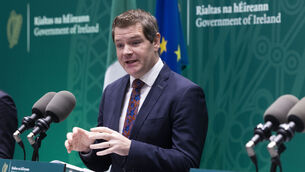
Transformational times for evolving Irish pensions

Irish pension stakeholders have developed a plan for a new strategic investment fund, a plan that aligns with the European Union’s savings and investments union strategy.
The Irish pensions landscape is being transformed and not before time.
Auto-enrolment has arrived in the form of the State-backed ‘My Future Fund’, which finally saw the light of day in January. Just over 750,000 workers were automatically enrolled under new arrangements part-funded by employers, employees and the Government.
At the same time, the process of pension fund consolidation has gathered pace. The number of group defined contribution schemes has halved. The result should be a reduction in levels of paperwork and administration together with cost efficiencies.
There should be greater visibility when it comes to measuring performance. Funds are being brought together in platforms with a wide range of investment options.
Employees who move jobs have tended to find themselves in different pension schemes due to a lack of portability.
The changes have been accompanied by some glitches due to a decision by certain legacy providers to charge high exit or transfer fees. Critics have also warned that the change could lead to a reduction in investment diversification.
Another interesting reform proposal has emerged from within the sector.
The Irish Association of Pension Funds represents companies collectively responsible for around €150bn in retirement savings.
The organisation has produced a consultation paper from which has emerged a plan for a new strategic investment fund.
A key aim is the reversal of a long-running decline in the investment of assets in the domestic Irish capital market. The IAPF has pointed to the fact that the proportion of Irish pension assets invested domestically has dropped precipitously – from a rate close to 100% – since the country adopted the euro. It is currently down at around 3%.
The idea is viewed as one that aligns with the European Union’s savings and investments union strategy.
The proposed fund would allow for pooled access to Irish and European private credit markets, infrastructure and real estate. At present, it is up to pension schemes to access such markets on an individual basis.
The fund could allow for a return of pension fund assets to the domestic market in a sharp reversal of a process that got underway at the turn of the Millennium.
A key question is whether early support from among the IAPF membership can be sustained.
It has recently emerged that around 30,000 people have opted out of auto-enrolment during the course of a two-month decision window period, ending on 31 August (Irish Times report). The figure, at first sight, may appear substantial, but it represents a relatively small percentage of the total number of people enrolled.
At the same time, an additional ten thousand or so have opted in to the arrangement.
A Government paper in the form of an internal note at the Department of Social Protection contained a suggestion/ allegation that some large companies ‘plotted’ with financial advisors to push employees into pension scheme arrangements not to their long-term benefit.
At this point, it remains unclear whether this is a ‘storm in a teacup’, or a matter to be taken seriously indeed. The jury is out on this.
Laura Bambrick of the Irish Congress of Trade Unions chose to welcome the fact that 96% of participants remain enrolled, describing it as a “major endorsement of the scheme’s benefits”.
Industry experts have raised perfectly valid questions regarding the suitability of auto-enrolment for all employees, regardless of their circumstances.
Some companies are promoting ‘Master Trusts’ on the basis that auto-enrolment schemes are ‘rigid’ and subject to income caps. They point out that lump sum contributions are not allowed under auto-enrolment, while there is not the option for an employer or employee to make additional contributions.
Master trusts are better suited to the requirements of higher earners, the argument goes. Aside from the ability to make deductible lump sum contributions, there is the availability of marginal tax relief, which increases with age.
What everyone will agree about is that there is considerable ground to make up in the whole pensions area. The auto-enrolment scheme does not cover contractors and the self-employed. It does extend to part-timers and those on fixed-term contracts.
Around one third of workers aged between 20 and 69 have no supplementary pension cover over and above the State pension, a system that is coming under great pressure with the ageing of the population.
It would appear that many employers are finding the transition to the new arrangements difficult to say the least. The challenges are in areas such as payroll administration and regulatory compliance. They have to deal with a new regulatory body, NAERSA – the National Auto-Enrolment Savings Authority.
They are legally obliged to enrol all eligible employees into the system. The benefits of the scheme must be explained clearly to them along with the drawback.
There is the impact on take-home pay at a time when the cost of living is surging. Staff struggling to pay the rent and meet other rising bills will need to be convinced that is all worthwhile.
Employers also view auto-enrolment as an added payroll cost which must be factored into budgeting and cash flow planning.
Existing pension arrangements must be examined to ensure that they meet the conditions of exemption of workforce members from auto-enrolment arrangements.
Auto-enrolment has the potential to exacerbate tensions between bosses and their workforce, this at a time of revolution in the workplace.
Opt-outs may make sense at least in the short term.
Another complication is presented by the presence in the country of many overseas-based companies.
Employees of such companies fall within the scope of AE even if they belong to a foreign pension scheme. However, employees who spend less than six months working in Ireland may be excluded from payroll withholding, provided revenue approval is secured.


CONNECT WITH US TODAY



Be the first to know the latest news and updates