Imports of electricity to Ireland surged last year as domestic generation stayed static
The CSO said electricity generation here stood at 29,335 GWh in 2025, a marginal increase over 2024 when 29,267 GWh was generated.
Imports of electricity to Ireland surged last year as domestic generation remained static despite a significant jump in wind and solar generation.
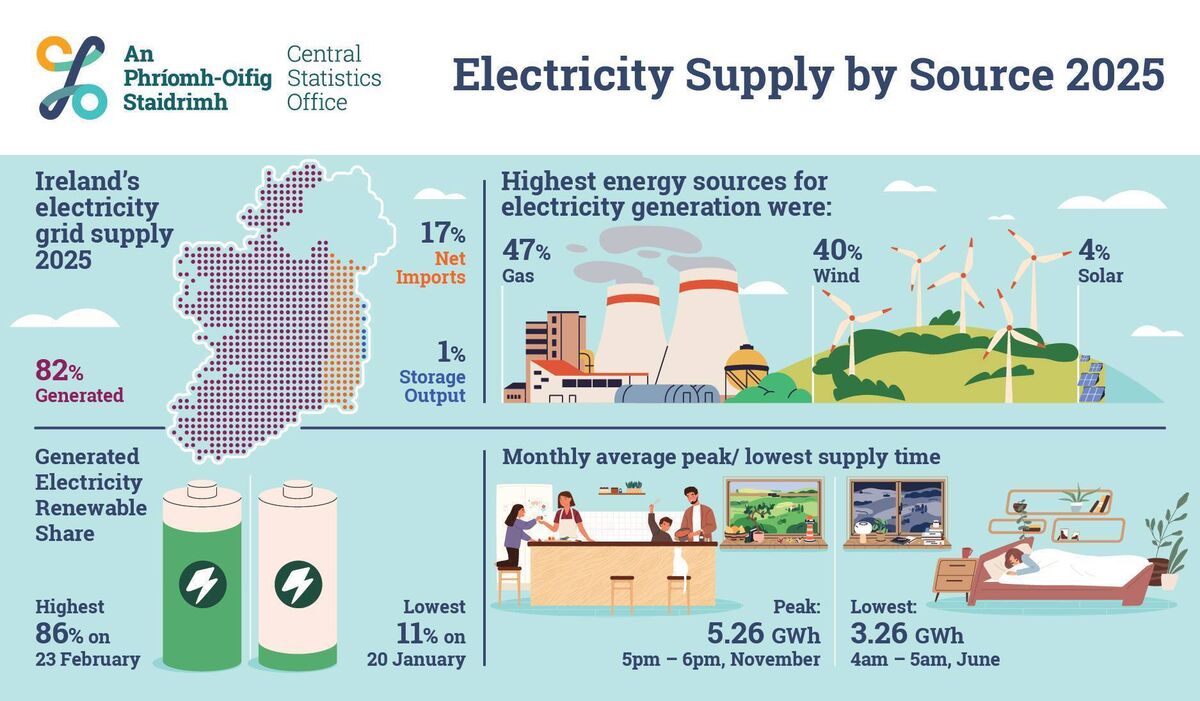
A report from the Central Statistics Office shows the country's electricity grid supply increased by 3.5% last year, with net imports of electricity standing at 6,130 gigawatt hours (GWh), an increase of 1,069 GWh compared with 2024.
Ireland has three interconnectors to England, Wales and Scotland, with a fourth connector to France being developed.
The CSO said electricity generation here stood at 29,335 GWh in 2025, a marginal increase over 2024, when 29,267 GWh was generated.
Half of grid-scale electricity generated in 2025 was from renewable sources. The highest renewable generation share in 2025 was 86% on February 23, the lowest was 11% on January 20, largely due to differences in wind generation.
Gas was the largest energy source for electricity generation in 2025, responsible for 47% of generation. Wind was the largest renewable source, providing 40% of generated electricity.
Electricity generation from grid-scale solar farms was 1,101 GWh in 2025, a 51% increase compared with 2024.
Electricity generation from coal-fired power stations showed a significant decrease in 2025, with 453 GWh generated, 52% less than in 2024 and in June 2025, Ireland stopped all generation of electricity from coal.
Read More
Orla McCarthy, senior statistician in the Climate and Energy Division, said factors such as the weather, temperature, time of year, and time of day could impact both the total electricity supply and the energy source.
"Winter months have higher electricity supply than summer months. In 2025, December had the highest monthly average daily electricity supply at 108 GWh, May had the lowest average daily electricity supply to the grid at 90 GWh, 17% lower than December.
"The electricity supply source also shows seasonal variation. In winter, a higher share of electricity is generated from wind than in summer, due to typically higher mean wind speeds. In 2025, February had the highest monthly share of electricity supply from wind at 49% of total supply, whilst May had the lowest at 22%.
"However, May had the highest amount of solar electricity generation in 2025, with a daily average of 5.66 GWh," Ms McCarthy said.
The CSO said electricity storage made up a small share of supply, at 1%, last year. However, during the high-demand period of 5pm to 6pm, electricity storage output, from pumped hydro and battery discharge combined, provided up to 13% of electricity supply.

CONNECT WITH US TODAY



Be the first to know the latest news and updates