Canada to apply dollar-for-dollar US counter-tariffs
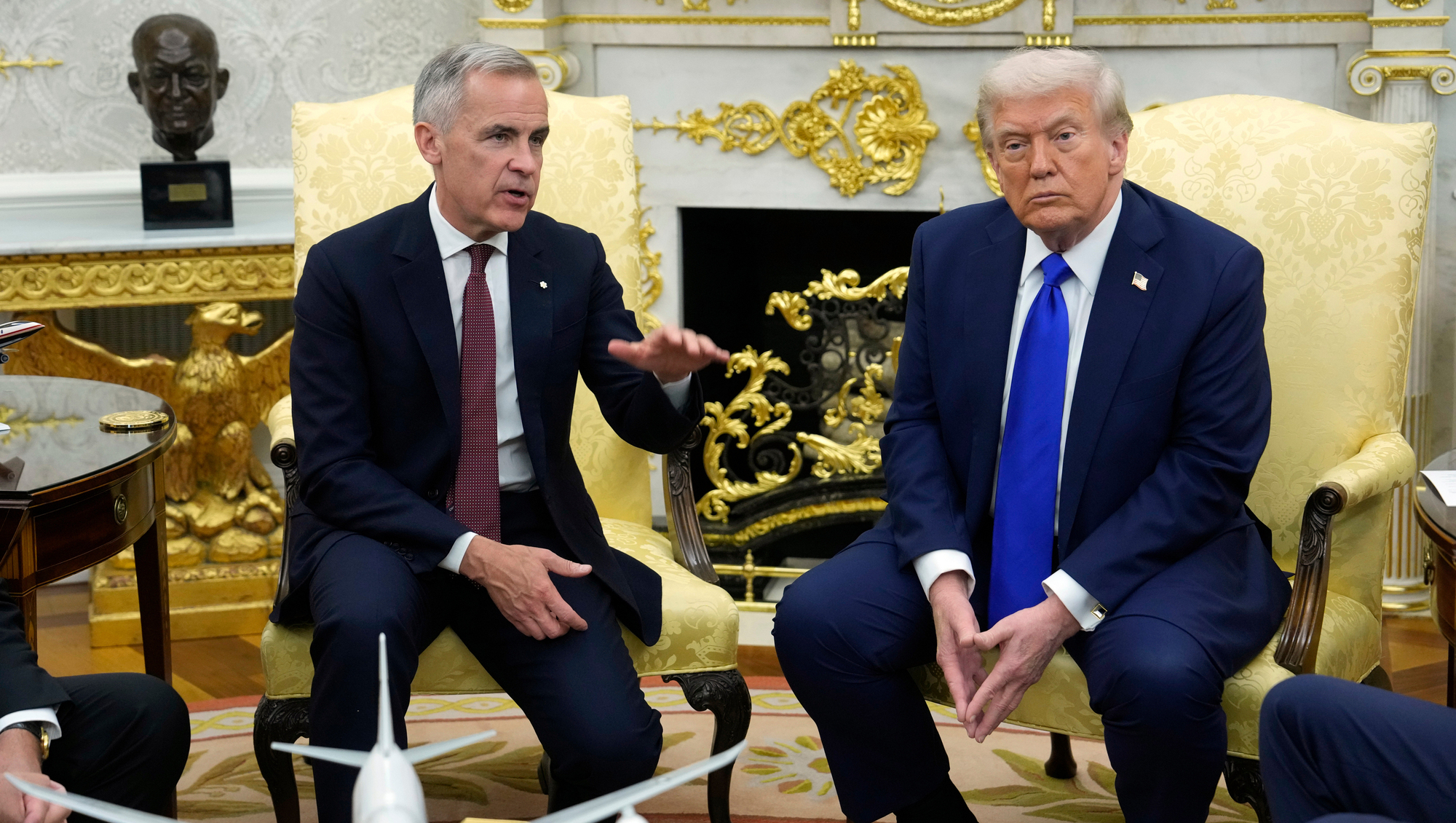
Canada's prime minister Mark Carney with US president Donald Trump at the White House in 2025.
Prime minister Mark Carney said Canada will apply counter-tariffs on $20bn of US products on September 8, escalating the feud rocking one of the world’s biggest trading relationships.
“We take this step reluctantly,” Carney said, acknowledging it will raise costs and reduce choice for Canadians, hit innocent US companies, and make it harder for the two countries to work together.
Carney said he was left with little choice after trade talks with president Donald Trump’s administration broke down on Friday night, and the US put import taxes of 50% on items such as plywood, liquor, electrical equipment and hockey gear from Canada.
“You’re at war when you get attacked,” Carney told reporters in Ottawa. “We got attacked.”
Opting for retaliation cements Canada as one of just two countries to fight fire with fire in the face of US tariffs. The other is China. As Trump imposes the new levies with a never-before-used clause of a 1930 law, Canada’s resistance, and how the US deals with it, will be closely watched.
Carney’s risky move is a reminder of how he suddenly came to power last year: stridently campaigning to lead a fightback against Trump, who started his second term saying he wanted to make Canada a 51st state with “economic force.”
Two-time former central banker Carney has in reality spent much of his time in office until now trying a conciliatory approach with the US, while diversifying Canada’s economy. He rolled back retaliatory tariffs applied by his predecessor Justin Trudeau, axed a digital services tax that irked Trump, and re-cut a deal in the US’s favour to open a bridge connecting Detroit to Windsor, Ontario.
That tactic didn’t help get a deal. On Saturday, Trump used a Depression-era authority known as Section 338 to impose the tariffs on Canadian goods totalling about $20bn in annual US imports.
Now Carney has returned to what Trudeau did in March 2025: Big counter-duties, meant to match Trump’s in dollar terms. The Canadian levies will apply to US steel, dairy, appliances, agricultural equipment, electronics, pulp and paper, with more detail to be published in the coming days, the prime minister said.
By punching back, Carney is taking an economic and political gamble, balancing short-term pain with longer-term strategy. US officials indicated Friday that if Canada retaliated, they have options to escalate — raising the possibility of a spiraling trade war between two countries that exchanged almost $900 billion of goods and services last year.
Carney said talks fell apart for a number of reasons. One involved Trump’s auto tariffs, which are set at 25% on the non-US content in a Canadian-made vehicle. The negotiating teams discussed lowering that to 15%, but the US didn’t want to extend that tariff relief to medium to heavy-duty trucks, such as the kind currently going into production at Ford Motor Co.’s factory in suburban Toronto.
The US also sought to put limits on Canada’s trade deals with other countries and made demands on cultural and French-language issues that were unacceptable, Carney said.
He added the tension isn’t good news for talks around the US-Mexico-Canada Agreement, which entered into rolling reviews after Trump declined to renew it in July.
After months of appearing reluctant to talk about the delicate, high-wire US negotiations, Carney pivoted on Saturday and revived the tone he deployed at his widely watched January speech to the World Economic Forum in Davos, urging mid-sized nations to collaborate and resist coercion by superpowers, which prompted admonition by Trump at the time.
On Saturday, Carney slammed the US for violating the USMCA trade deal with tariffs over the past 18 months and accused the White House of continuously changing its justifications for trade measures, including fentanyl trafficking, Canada’s dairy policy, a television commercial that Trump didn’t like, wildfire smoke and a trade deficit.
“Our government understood before many that America would transform all of its commercial relationships, that it would put a series of tariffs on its closest allies and use economic integration as a weapon,” the prime minister said. “We recognised that sometimes its signature was written in pencil.”
The US is Canada’s largest export market by far, with oil, vehicles and car parts among the largest categories. The US trade deficit with Canada is driven by huge imports of crude, primarily from Alberta.
“Canada fuels American growth: supplying 99% of their natural gas imports, 85% of electricity imports and 60% of crude oil imports,” Carney said in his prepared remarks. “I don’t think they want us to stop sending it.” Canada is also the largest buyer of US goods and services aside from the European Union, according to data from the US Commerce Department.
The premier of Canada’s most populous province Ontario, Doug Ford came out after days of silence and backed Carney on dollar-for-dollar retaliation. In a letter to the prime minister earlier this week but only published Saturday, he highlighted Canada’s energy and critical mineral assets as points of negotiating leverage, and he also suggested additional tariffs on products from “politically significant” states for Trump, such as Florida, Texas, Iowa and Wisconsin.
“Products from these states should face the full force of Canada’s response,” said the letter by Ford, who has previously clashed with Trump over attempts to tax US purchases of Ontario’s electricity, and running anti-tariff ads south of the border.
Surveys suggest Carney has broad public support for pushing back against aggressive US trade tactics. A poll of Canadians published this week by Leger Marketing found 56% wanted the government to “take a hard line and make no more concessions.”
The same poll found support for measures such as export taxes on energy the US buys from Canada and special taxes on US services such as Netflix.
Jason Kenney, a former Alberta premier and a political rival of Carney’s Liberal Party, praised the prime minister for walking away from the negotiations.
“Canada clearly made a serious, good faith effort to get greater stability and market access, and remains ready to find a fair, balanced agreement,” Kenney said in a social media post. “But we are not cravenly surrendering in the face of constant economic and political aggression.” Many Canadians are likely to continue retaliating in their own way — with some encouragement from elected politicians — by spurning trips south and boycotting US products. Canadian travel to the US has fallen sharply since Trump returned to the White House, hurting border states and tourist destinations such as Las Vegas.
Asked if part of his calculation in hitting back was based on polling numbers and the US bond market, which has seen yields spiking, Carney said it wasn’t. But he added: “Markets sometimes ignore these fundamentals, and then all of a sudden they focus on them.”
CONNECT WITH US TODAY



Be the first to know the latest news and updates