Alan Healy: The construction cranes are back, but who is funding them
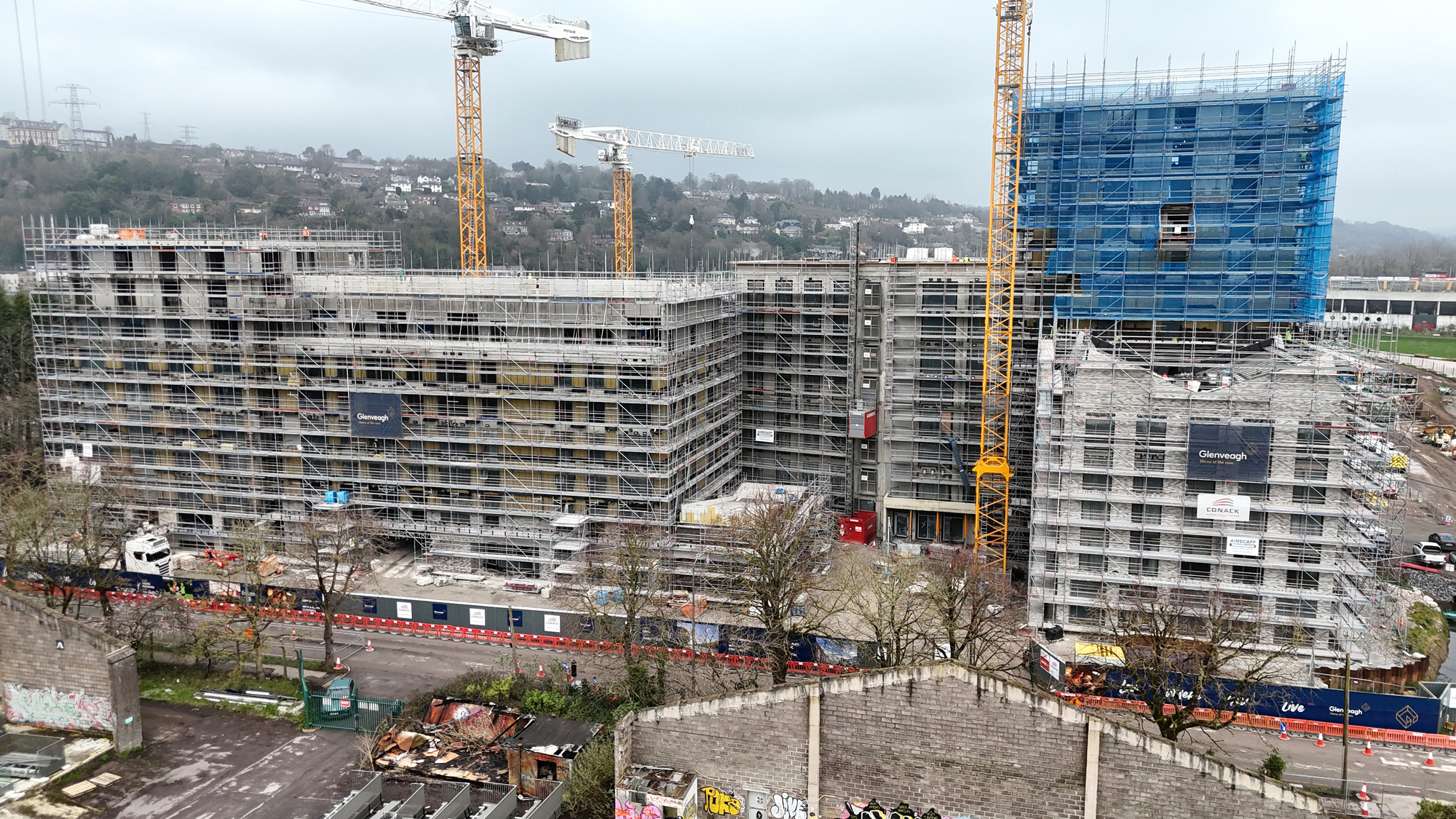
Apartments under construction at Cork's Marina Depot by Glenveagh Homes under the LDA’s Project Tosaigh scheme. Picture: Larry Cummins
Construction cranes are once again dominating the skylines in cities and towns around Ireland.
They remain a preferred barometer of the economic health of a region. And, unlike previous construction booms, much of the development is now focused on badly-needed housing.
In cities like Cork, major developments north and south of the Lee, and smaller-scale projects in the suburbs, finally give a sense that a corner has been turned.
Last year, almost 2,700 new homes began construction across Cork city and county, part of 16,400 across the entire country. Still a far distance from the various annual targets set by a variety of bodies, the Government wants more than 50,000 per year.
But it seems that Ireland is finally building. After years of crisis-level undersupply, output is finally pointing in the right direction. It is also clear that the apartment is now becoming the dominant new housing type in urban areas. In Cork city, two-thirds of new homes under construction are apartments.
Long resisted by planners and buyers alike, it is becoming a fixture of our urban landscape. The estates are still going up too, in commuter belts and county towns, but the shift towards denser, higher living in our cities is real and it is gathering pace.
While every new key to a home reduces pressure on a critically underserved market, there are alarm bells ringing over the future of housing development. Behind almost every apartment block rising is a funding model that many believe is broken. Every apartment currently under construction in Cork is being subsidised in some form, either directly by the State through social or affordable housing schemes, cost-rental projects, or through mechanisms like Croí Cónaithe. Without that support, the buildings simply would not be going up.
Former Government minister Simon Coveney was blunt about the issues speaking at the Construction Industry Federation's Southern Construct. "Our apartment market is effectively broken in Ireland. If you can't get cash input or financial support from the state, you're not building apartments in general. If you look at the projects in Cork, they're all linked to cost rental projects, they're all linked to social housing, affordable housing and some limited private for sale apartments."
The State, through 425 approved housing bodies, local councils, the Housing Finance Agency, and the Land Development Agency, is carrying the weight of housing delivery in this country to a degree that should prompt serious questions about what happens next.
The private market engine that once drove Irish housing supply has stalled. In its place, the State has become the dominant funder, client and backstop for residential construction. That has kept cranes in the sky. But to produce anything close to the targets required to have a real, functioning housing market, the private sector needs to return to building in a manner not seen for decades.
The State as the driver of new housing is not new. The great housing booms of the twentieth century in Ireland were not driven by the private sector acting alone. They were driven by the state.
Council housing, clearance schemes, land assembly programmes, the machinery that transformed Dublin's tenements and Cork's overcrowded lanes into liveable suburbs was almost entirely publicly funded and publicly organised. Private developers came later, once the ground had been prepared, the infrastructure laid, and the risk had been largely absorbed by the public purse.
The question is not whether the state should be involved in housing delivery. It should, and always has been. The question is whether the current arrangement, in which the state is effectively the market, is sustainable as a long-term model.
Access to finance remains key and is the primary challenge for smaller builders, previously the backbone of the sector. Patsy Supple, chair of the CIF's Cork branch, pointed to a KPMG report commissioned by Croí Cónaithe that laid bare the collapse of the small developer. "1% of developers are delivering 30% of the units," she said. "The small to medium-sized enterprise, less than 50 units per annum, represented 90% in numbers terms of developers and they were only delivering 29% of the housing."
Many of these smaller builders do not have the equity to fund new developments, with risk-averse banks often willing to back just 65% of a project. It is estimated that approximately €20bn of development finance will be required annually to deliver 50,000 residential units. With State capital investment projected at €3.5bn, it highlights the scale of the funding gap which must be met by lenders.
CONNECT WITH US TODAY



Be the first to know the latest news and updates