Sharp focus on renewables as innovation is redefining the future of energy
Renewable Island: Ireland watches UK, where new ‘plug-in’ solar panels will soon be available to buy in shops, offering households the opportunity to slash energy bills
Sharp focus on renewables as innovation is redefining the future of energy

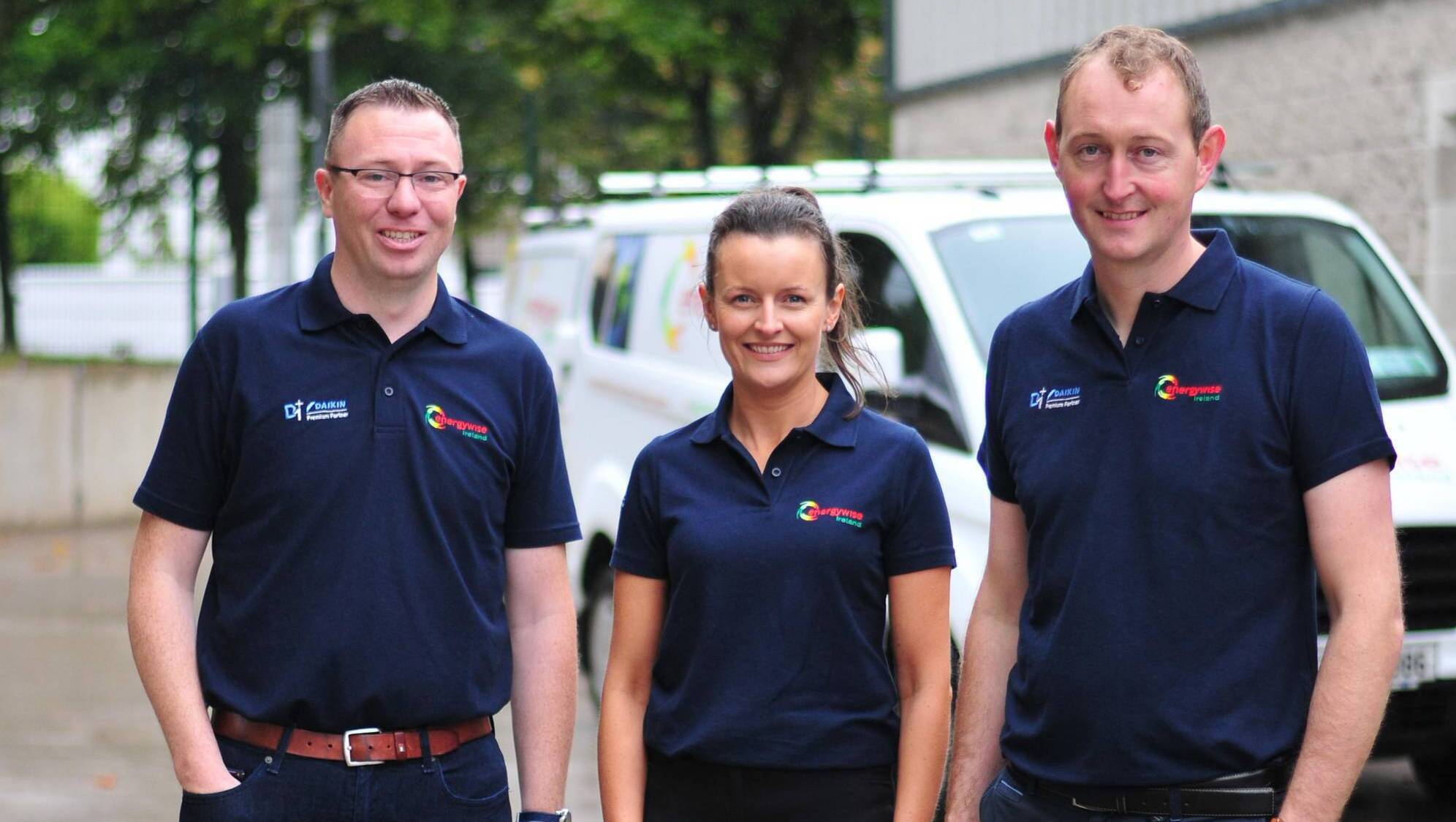
Energywise Ireland is to create 100 jobs in Munster over the next two years (L-R) Darren Vaughan, Chief Operating Officer, Energywise Ireland; Rosemarie Sheehy, Chief Digital Officer, Energywise Ireland; and CEO of Energywise Ireland, Berth Sheehy.

The electricity grid is the network that carries power from where it’s generated — whether at large power stations, wind farms, or solar arrays — to homes, businesses and industry. It keeps electricity flowing safely and efficiently.

Innovation is redefining the future of energy. Noting that electricity is becoming the defining infrastructure of the 21st century, the World Economic Forum (WEF) points out that as industry, digital services and emerging technologies electrify, power systems are entering their “internet moment” — transitioning from centralised, one-directional structures to dynamic, decentralized networks.

According to the WEF, this shift will see intelligence and connectivity matter as much as physical infrastructure in creating system value.

The International Energy Agency says the power grid of the future will be smarter, more flexible, and more resilient to integrate variable renewable energy sources, provide real-time monitoring and enable two-way flows of electricity between producers and consumers. 

This is happening. In recent weeks, the UK government announced that ‘plug-in’ solar panels will soon be available to buy in shops. The move offers households the opportunity to significantly cut energy bills. Other new rules introduced in March, will ensure that the majority of new homes in England come with solar panels fitted as standard.

Also recently announced across the water is an innovative new approach of discounted power on windy days in areas where wind farms are paid to switch off to avoid ‘wasted wind — an endeavour likely to predominantly benefit Scotland and the East of England.

Here at home, Cork-based renewable energy company, Amarenco, was founded to speed up the shift to clean energy. The company invests in long-term energy infrastructure and works to deliver projects that support communities as well as the environment.

Amarenco managing director, Declan Cullinane, says that Ireland’s energy infrastructure was built around unsustainable fuel sources that are not only environmentally unjustifiable but also finite and increasingly volatile in price.

Declan Cullinane MD of Amarenco. 

“Recent global events have exposed just how vulnerable the country’s energy market remains to international price shocks,” he says, pointing to wholesale energy costs fluctuating in response to geopolitical tensions and supply constraints that he says are far beyond Ireland’s control.

“We collectively need to switch how we generate energy, and solar offers a different model,” he says. “Unlike fossil fuels, solar power does not rely on a globally traded commodity subject to daily price swings. Once a solar development is developed and connected to the grid, its necessary fuel source — sunlight — is free and immune to market volatility. The generation cost becomes largely fixed and predictable for decades.”

Cullinane believes that unlocking the full potential of solar and other renewables requires a parallel focus on grid security and infrastructure. Also, that substantial grid investment is essential to support the transition to variable generation sources.

“While it may look ‘difficult’ right now,” he says, “the benefits for future generations are immense.”

Highlighting the need to upgrade transmission and distribution networks, enhance interconnection and deploy smart grid technologies that can manage fluctuating supply and demand in real time, he says: “Ultimately, a resilient, modernised grid is the backbone of Ireland’s energy transition.

With the right planning and investment, it will enable a secure, low carbon electricity system capable of meeting the country’s projected needs while reducing exposure to external shocks and delivering long-term value for consumers.”

Energywise Ireland is a Cork-based nationwide provider of energy services, specialising in renewable energy and retrofit solutions for domestic, commercial and agricultural clients.

CEO, Berth Sheehy, says “At the moment, a significant constraint on Ireland’s renewable transition is that our grid is still being planned and operated around a largely passive, centralised model.”

Energywise Ireland is seeing widespread export limitations applied to NC7 microgeneration applications due to local capacity constraints and harmonic concerns, even where systems are technically sound. Sheehy says these restrictions are having a real and measurable impact on the uptake of solar PV and battery storage, notably farms, businesses and homes that have ample roof space and are ready to invest.

Sheehy believes that if we are serious about accelerating renewable integration, the priority needs to shift from managing constraints to unlocking flexibility. “Where network conditions allow, maximum export capacity (MEC) should not be artificially capped by maximum import capacity (MIC). Allowing MEC to exceed MIC in suitable locations would immediately unlock significant additional clean generation without the need for new land take or largescale infrastructure.”

It’s his belief that distributed batteries should begin to be treated as part of the solution. “With thousands of homes already fitted with battery storage,” he says, “these systems could be intelligently dispatched at peak times, with owners compensated, creating a virtual power plant that supports grid stability.

“The same applies to fasttracking vehicle-to-grid, enabling electric vehicles to charge from onsite solar or offpeak electricity and discharge to meet peak demand locally. A modern grid should enable participation, not limit it. By designing the system around flexibility, local generation and active consumers, Ireland can reduce losses, lower system costs and build a more resilient electricity network fit for a renewable future.”

With bases in Dublin and Cork and operating across the country, ePOWER is a market leader in the provision of renewable energy solutions, EV chargers, and domestic and commercial solar panels.

Commenting on the future grid, ePower’s head of product, Nikitas Karatzaferis, says: “As Ireland’s largest charging point operator, and as a business developing high-power charging hubs across the country, we see every day that grid capacity is now one of the defining issues for electrifying transportation.

“The energy demand for EVs is growing but the pace at which charging infrastructure can be delivered is ultimately shaped by the availability of power.”

The challenge, he says, is not just getting power in general, but getting enough power in the right locations. “From a charging network perspective, the sites that matter most are the ones driven by traffic flows and often capacity at those locations is limited.

“In many cases, battery storage and booster solutions will have to play an important role in bridging that gap, because the grid cannot always be reinforced or augmented quickly enough to meet the pace of demand. In our view, this reality has to be recognised in grid planning and in infrastructure policy.”

Piotr Szymanski, European Commission Joint Research Centre, energy and mobility director.

As Europe charts the path to a decarbonised, resilient electricity system, the key takeaways from the FutureGrid Innovation Summit, which took place in Brussels in February, provide a glimpse of what Ireland’s own grid of the future will need.

The event highlighted the central role of Electricity Distribution System Operators, with Georgios Ioannides, deputy permanent representative of Cyprus to the EU, describing them as the veins and arteries of Europe’s homes and industries.

Piotr Szymanski, European Commission Joint Research Centre, energy and mobility director, said the main challenges for distribution grids — resilience, climate impact, and growing electrification — require flexible, digital, and collaborative solutions, with policy, regulation, and investment closely aligned.

The conference focused on three key pillars during its panel discussions: ‘Cost-Effective System’, ‘Electrification’ and ‘the Human Infrastructure.’

It concluded that by investing smartly in digitalisation, innovation, and workforce capabilities, Europe can build smarter, more reliable grids and ensure the talent behind them is ready to lead the decarbonised and resilient energy future.

While the vision for a smarter, more flexible grid is clear, questions remain around how quickly Ireland can deliver the infrastructure required to support it. 

Gavin Blake, partner with Addleshaw Goddard Ireland.

Gavin Blake, partner and head of energy and infrastructure at law firm Addleshaw Goddard Ireland, says: “Much has been written in recent months about the scale of planned investment in Ireland’s electricity grid. The €18.9bn approved by the Commission for Regulation of Utilities (CRU) under its Price Review 6 (PR6) for 2026-30, underpinned by €3.5bn in committed Government equity is significant.

“However, in light of EirGrid’s recent warning of a “potentially challenging situation” in meeting electricity demand between 2026 and 2028, we need to see this money deployed rapidly and with laser-like focus on priority grid upgrades and reinforcements.

“Also, if Ireland is to maintain a credible message internationally that it is open for data centre investment, we urgently need to see the electricity system operators set out the new connection process for data centres, following last December’s decision paper by the CRU on connection policy for the sector.”

x

More in this section

The Business Hub

Newsletter

News and analysis on business, money and jobs from Munster and beyond by our expert team of business writers.

Cookie Policy Privacy Policy Brand Safety FAQ Help Contact Us Terms and Conditions

© Examiner Echo Group Limited