Housing completions expected to hit 40,000 this year
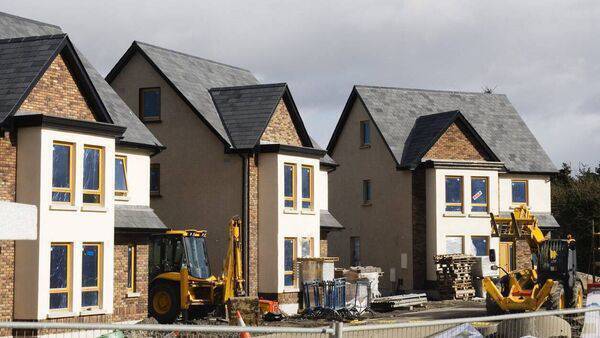
The Government is targeting 300,000 homes between 2025 and 2030.
Housing completions are expected to hit 40,000 this year before growing to 47,000 by the year 2028, but sustaining that growth “will depend on maintaining momentum” across planning reform, construction capacity, and managing construction inflation, a new report has found.
According to the latest forecasts from EY Ireland for Euroconstruct — an independent construction market forecasting network active in 19 European countries — Irish housing completions are expected to hit 40,000 this year, 43,000 next year, and 47,000 in 2028.
A total of 36,284 new homes were completed in 2025, up 20.4% from 2024. The Government is targeting 300,000 homes between 2025 and 2030.
The EY report found overall construction output in Ireland increased by 11.7% in 2025, with expected further growth of 5.3% in 2026, 5.8% in 2027 and 6.2% in 2028. EY said across the Euroconstruct region, construction output is forecast to grow by 2.0% in 2026.
Read More
EY Ireland partner and the Irish member of the Euroconstruct network Simon MacAllister said Irish construction activity was on a “very positive trajectory”, but key challenges remain to sustained delivery.
“While Ireland’s construction market is performing strongly relative to many European peers, the sustainability of this growth will depend on maintaining momentum across planning reform, infrastructure activation, apartment viability and construction capacity, as well as managing any construction inflation which may emerge as a result from the conflict in the Middle East.”
EY said infrastructure investment was critical to sustaining growth momentum which is also expected to play a central role in supporting housing delivery and broader economic growth.
Output in this segment is forecast to grow by 1.2% in 2026 before accelerating to 6.4% in 2027 and 5.7% in 2028, reflecting continued investment in transport, energy and water infrastructure.
The outlook for the non-residential construction sector, however, remains mixed, according to the report.
New non-residential output is estimated to have increased by 6.8% in 2025, but growth is expected to slow to 0.7% in 2026, 3.8% in 2027, and 3.7% in 2028, “reflecting continued softness in office development, partially offset by more stable activity across other non-residential segment”.
“Other segments, including education, health, industry and storage, are expected to record more moderate growth over the medium term,” the report said.
In terms of the European outlook, the report said the construction sector remained “cautiously positive”, but growth is forecast to be slower than previously expected.
The war in the Middle East and the situation in the Strait of Hormuz have a “significant impact” on the global economy as well as energy prices, inflation and interest rate trends.
“Consumer and business confidence in the future has fallen, and economic forecasts have been revised downwards in several countries over the spring. It is likely that this uncertainty will continue,” EY said.
“The strongest growth in construction between 2025 and 2028 is forecast for Ireland, Poland, the UK and Portugal. Growth is weakest in Slovakia, Italy and Belgium.”
EY added that Ireland continues to “stand out as the fastest-growing market”, due to strong public investment and steady demand.

CONNECT WITH US TODAY



Be the first to know the latest news and updates