My Job: Balancing work and chasing Olympic rowing glory

Irish international rower Zoe Hyde thanks the pandemic for pushing her further into the rowing side of life.
Zoe Hyde is relaxing under the Italian sunshine when we talk, but it’s only a brief lunchtime break from a training camp regime that occupies her life on a 24/7 basis these days.
“We have the World Championships starting in early September, which is the first chance of qualifying for the Olympics in Paris next year. Depending on how that goes, we do have a second chance to qualify at another event coming up next May — so our focus is totally geared to that timeline,” she explains.
“We are injury-free, thankfully, so very much looking forward to giving it our best shot.” Ireland had six boats at the last Olympics, winning two medals — and the upcoming Worlds in Serbia will be a key opportunity to qualify for spots for Paris, with the second chance in Lucerne next spring.
At last year’s World Championships, Zoe and her partner Sanita Puspure dug deep to win a bronze medal. Rowing neck-and-neck with the Austrian pair throughout much of the race, just .43 of a second separated both boats breaking into the final 500 metres. With the finish line in sight, Zoe and Sanita took the race by the horns and finished with the fastest 500-metre split of all the crews in that final quarter, securing them a third-place finish and that precious bronze.
“It was a very tight race all the way to the line, I actually thought we might have come fourth,” the Killorglin native recalled of the triumph. “It was just an amazing season. Sanita is a legend in the rowing community, I’m so glad being able to race with her.”
On training days, life begins at 6am, Zoe explains of the total focus required at this level. “On training camps, it’s actually easier because everything is done for you — you’re organised, fed and directed by the hour. Normally there would be two or three sessions, depending on the day.
"Mornings can vary between a long-distance row or else a number of high-rate movements. There’s usually a midday break to eat, rest or whatever, before going into an afternoon/evening session. Then there’s just enough time to refuel again, rest up and go to bed. Eat, sleep, repeat — that’s about the size of it — there’s no time or space for anything else.”
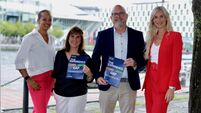
Zoe is part of Team Deloitte, a group of 19 professionals training to qualify for the 2024 Olympic and Paralympic Games in Paris. This roster is joined by a small cohort of athletes, dual-career athletes representing 14 countries in 15 different sports.
The company has a history of attracting athletes. Within the organisation today, 37 of the firm’s professionals have participated in a combined seven summer and three winter editions of the Olympic and Paralympic Games, from Atlanta 1996 to Tokyo 2020. They represent 15 countries in 21 different sports and have resulted in 16 medals: 10 gold, four silver, and two bronze.
“Basically, I was working full-time with Deloitte up until the moment last year when I got the call to join the Irish team,” Zoe recounts of the call-up that has changed her life. “They were very good in giving me flexible hours to integrate with the sporting schedule.
Members of Team Deloitte can pursue dual careers because of the working programmes in place, such as the company’s hybrid working strategy giving control over how, when and where they work. Other supports include part-time working arrangements, leave and sabbatical programmes.
“I do of course keep in touch with Deloitte, checking in every week with my boss Kevin and doing a few bits and bobs here and there to keep up the skills as such. The working flexibility is very helpful, in that even when I’m away in a training camp such as this one in Italy, I can stay in contact with the office and what’s going on in the other career side of my life.”
Having the balance of work and sport is a combination that is beneficial to both areas: “Sport on its own can be very consuming, so being able to have both helps me in an overall sense. Sometimes the work distracts from the rowing, when you need it, and vice-versa on the days when you don’t.”
Zoe does admit that her love of rowing was an activity she largely discarded during her college years, only to rediscover the passion when the exams were done. “I did find that college work required my full attention, so I generally gave up the rowing during those years. That said, I did feel I was missing rowing at various times, and in my final college year I got seriously back into it. It went from once or twice a week in the beginning to really ramp up after college finished.”
Interestingly, Zoe thanks the pandemic for pushing her further into the rowing side of life: “I actually think that if it wasn’t for covid, I might not be here trying for the Olympics today. When covid hit, I had just started with Deloitte, and was working from home, just like everybody else.
"Covid gave me a kind of lifestyle flexibility I wouldn’t normally have had, and I began exercising in my kitchen on a rowing machine every morning at 6am, and then again every evening at 6pm. I built up a really good routine, and so when the world started opening up again after covid, I was ready and set to really get into rowing full-on. So yes, I kinda have covid to thank for where I am today, trying to get to the Olympics in Paris 2024.”

CONNECT WITH US TODAY



Be the first to know the latest news and updates