The era of corporate top brass ignoring societal shifts is over
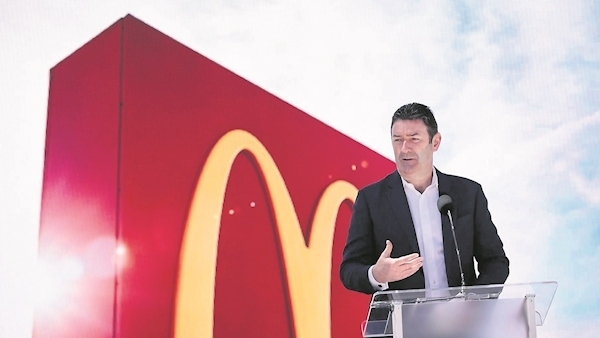
The recent McDonald's CEO sacking case shows that tolerance of board level arrogance and misbehaviour, at corporate level, has eroded, writes
Steve Easterbrook, the recently fired boss of McDonald’s, must be wondering how it came to this.
The CEO credited with reviving the fast food giant’s stalled business was in a consensual relationship with an employee. That is in breach of company rules.
The company, which has done more than most to transform the mainstream restaurant business since the 1960s, finds itself at the sharp end of a revolution in personal relationships sparked by accusations against film producer Harvey Weinstein of sexual harassment and the advent of the @MeToo movement.
Organisations cannot steam on while disregarding the forces for change that are being unleashed across all fronts. One would have thought that peddling burger mince in buns in Styrofoam boxes would be a simple enough task.
But Mr Easterbrook realised that his customers wanted better surroundings in which to eat and a wider variety of vegetarian and vegan options. He acquired an artificial intelligence firm to assist in the handling of queues.
For all this, he was well-rewarded: he took home almost $22m (€20m) in 2017, a bit more than the median McDonald’s salary of $7,500.
By June last, the company’s share price had doubled. He was the toastof the town, but around the corner,a banana skin awaited him, one that was not safely encased in a burger bun.
The CEO fell for an employee who was happy to return the compliment. The problem was that the company has tightened up its rules regarding in-house personal relationships. This has come in response to around 50 sexual harassment suits brought against the company by female employees.
There is also a real sense that the individual at the top cannot be seen to engage in any form of personal favouritism.
McDonald’s has ‘personal conduct rules.’ These were recently updated.
Policy prohibits a romantic relationship between a manager and someone reporting either directly to him or her.
This policy was the banana skin on which the CEO slipped.
Mr Easterbrook walks away financially unscathed, with a hefty payout. Some claim that he should face a substantial financial clawback for his failings.
Others suggest that a killjoy culture threatens to permeate office life.
One things is clear. A major shift in attitudes, particularly among the educated young, should not go unnoticed on the top floor, or in the boardroom.
Marks and Spencer — or M&S — is another case in point. M&S was long viewed as one of Britain’s greatest blue chip companies. Organisations modelled themselves on the company, yet, today, it is on the verge of exiting London’s Ftse-100.
It was once celebrated as a purveyor of high-quality food and clothing at affordable prices. The training programmes offered to managers were second-to-none, yet, somehow, it lost touch with its customers. Its long-serving executives and directors failed to keep a hawk’s eye on the trends out there.
The organisation was inward looking. Managers were not acting on changing trends.
Even today, a visit to one of its stores can cause one to rock back on one’s heels. Meat displayed in packs decorated with the Union Jack in Irish stores; special deals all aimed at families or couples.
Retailing presents a series of object lessons on what can happen to incumbents when the pace of change accelerates across the board.
Great names have fallen like nine pins. The great leveller has been Amazon, the driver of the online retail juggernault and, today, the company and its CEO, Jeff Bezos, attract the sort of accolades that were once showered on M&S, and the St Michael brand.
Mr Bezos is an unconventional character, who, reportedly, eats octopusand roasted iguana and has a personal ‘regret minimisation framework’: he doesn’t weep over spilled milk, that is.
Armed with a net worth of more than $100bn, he has been lambasted for failure to pay the minimum wage in many of his warehouses. His public relations team counter that the average wage across the organisation, $28,000, includes many part-timers.
Mr Bezos has sought to fend off the rise of internal bureaucracies within his corporation by devolving power to autonomous management teams. He restricts the size of meetings. This is his so-called ‘two pizza’ team rule: that is, two pizzas should suffice to feed attendees.
The company, predictably, goes in heavy when it comes to data. The key here, says US commentator, Steve Denning, is that it amasses large amounts of real-time customer feedback as well as financial data.
This means a much speedier reaction to any problems in the business. Amazon does not wait a couple of years for problems to show up in the accounts.
Amazon’s failure to curb its expansion and rein in its excesses could yet prove its undoing, as criticism of the power of monopolies and of the wealth accumulation of billionaires grows.
No organisation is — or should be — immune to the challenges of a rapidly evolving business culture. Tech titans such as Mark Zuckerberg have already begun to feel the heat, as politicians — ever alert to changes in the public mood — step up the pressure.
However, it is in traditionally run organisations that the axe has really begun to fall.
These are places with battalions of middle managers and monoclone cultures. A healthy business should foster challenge and encourage eccentricity, provided it results in creativity.
I once worked in a bank. My stay was brief, uninspired, and boring. There was a rigidity about the place. Executives insisted on their own parking spots. It was deeply conservative and, yet, this was a well-regarded organisation.
There were companies in 1980s Ireland that were worse by far. In retrospect, one can spot the link between the complacency at board and top management level and the unquestioneddecisions that culminated in the Irish banking meltdown.
A kind of ossified uniformity prevailed. We were all left with the tab. Such places still exist.
We are being told that the much-maligned HSE is set to be restructured by its new boss, Paul Reid. Managerial redundancies are said to be in the pipeline.
There may well be a large surfeit of managers in the organisation. Many — if not most — are no doubt hard-working and well-intentioned, yet many are also trapped inside situations where routines are tight, people react defensively, and backs get covered. Some are simply useless.
Mr Reid is faced with a huge task.He must engineer a shake-up without being seen to rule by fear. The day of the old-style boss — the sort of ex-army man who ran the old-style state bodies — is long gone.
Will he be able to engineer an opening of minds and a release of suppressed talent?
Can the HSE be transformed into a best-practice place that is open to the needs of its clients, while, at the same time, becoming canny in the area of cost control? Can he rid medical practice of the defensiveness that has resulted from the litigation culture?
In common with the new boss of McDonald’s, Mr Reid — a former top civil servant — will not be able to run the organisation in isolation from the society around him and, having operated close to the top of the political tree, he will be aware of the pressures of public opinion.
The financial crash of 2007/2008 removed the scales from peoples’ eyes, and the public’s tolerance of the old ways and of arrogance at the top in organisations, commercial or non-commercial, has eroded.
CONNECT WITH US TODAY



Be the first to know the latest news and updates











