As Draghi leaves, markets row back on future ECB rate cut bets
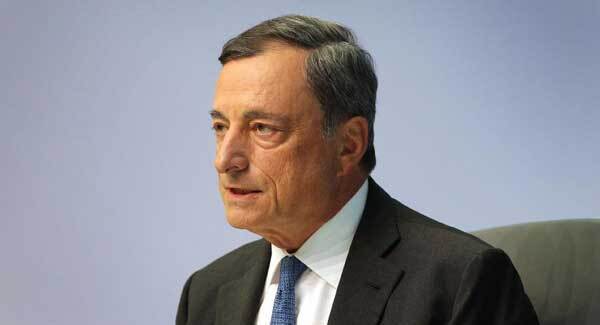
President Mario Draghi’s final meeting as head of the ECB last week saw the Governing Council keep policy unchanged.

As Draghi leaves, markets row back on future ECB rate cut bets

President Mario Draghi’s final meeting as head of the ECB last week saw the Governing Council keep policy unchanged.

These had included a cut of 10 basis points to the deposit rate, from minus-0.4% to minus-0.5% and indications it would restart its quantitative easing (QE) asset purchase programme next month at a relatively modest pace of €20bn per month. It also announced more favourable terms for its latest liquidity programme.

However, the minutes from the September meeting showed that the council was divided over the easing package, with a few making it clear they believed the policy loosening went too far, especially in relation to restarting QE.

Nonetheless, last week’s meeting showed that the ECB retains a bias to ease policy further if required.

It said that official rates will remain at their present or lower levels until inflation “robustly” converges with its 2% target. The ECB also continued to emphasise that its QE purchases would run for as long as necessary and only end shortly before it starts to raise rates.

Recent data on the eurozone economy have been quite weak and inflation continues to fall, with the annual harmonised inflation rate dropping to 0.8% in September, well below the ECB’s 2% target.

Interestingly though, despite continuing weak data, the market has become less bullish on the extent of further monetary easing by the ECB. Indeed, futures contracts suggest that the market is now expecting a further 10 basis point cut, at most, in interest rates. Previously, the expectation had been for at least 20 bais points of additional easing.

This is in line with the trend in other markets, such as the UK and US, which have also seen some rowing back on rate cut bets. This may reflect some abatement of risks to growth as a result of the progress made in US-China trade talks and on Brexit.

Meanwhile, the market does not see ECB rates starting to rise until mid-2022 and then only very slowly. Futures contracts show three-month money market rates remaining negative until 2025.

This will be one of Mr Draghi’s main legacies as head of the ECB: A prolonged period of negative interest rates and extensive QE.

There is no doubt he is held in high esteem as a central banker. Mr Draghi is viewed as the saviour of the euro, having pursued non-standard policy measures earlier in the decade to help end the turmoil in European financial markets and ease the pressures on weaker eurozone member states.

On the other hand, Mr Draghi overestimated the ECB’s ability to boost inflation in a global environment of downward pressure on prices. Monetary policy was kept too loose in the pursuit of this goal. The result of persistently negative rates and QE is that excess liquidity has wound up boosting asset prices in financial markets, rather than general inflation.

Thus, risks to financial stability have increased, with credit looking mispriced in many markets and valuations at stretched levels as a result of over-inflated asset prices.

This is a global phenomenon but no central bank has done more than the ECB in terms of keeping monetary conditions extremely loose.

Let’s hope, for the sake of Mr Draghi’s reputation, that it does not all end in tears.

More in this section

The Business Hub

Newsletter

News and analysis on business, money and jobs from Munster and beyond by our expert team of business writers.

Cookie Policy Privacy Policy Brand Safety FAQ Help Contact Us Terms and Conditions

© Examiner Echo Group Limited









