Tour de France Femmes showcases truly compelling racing
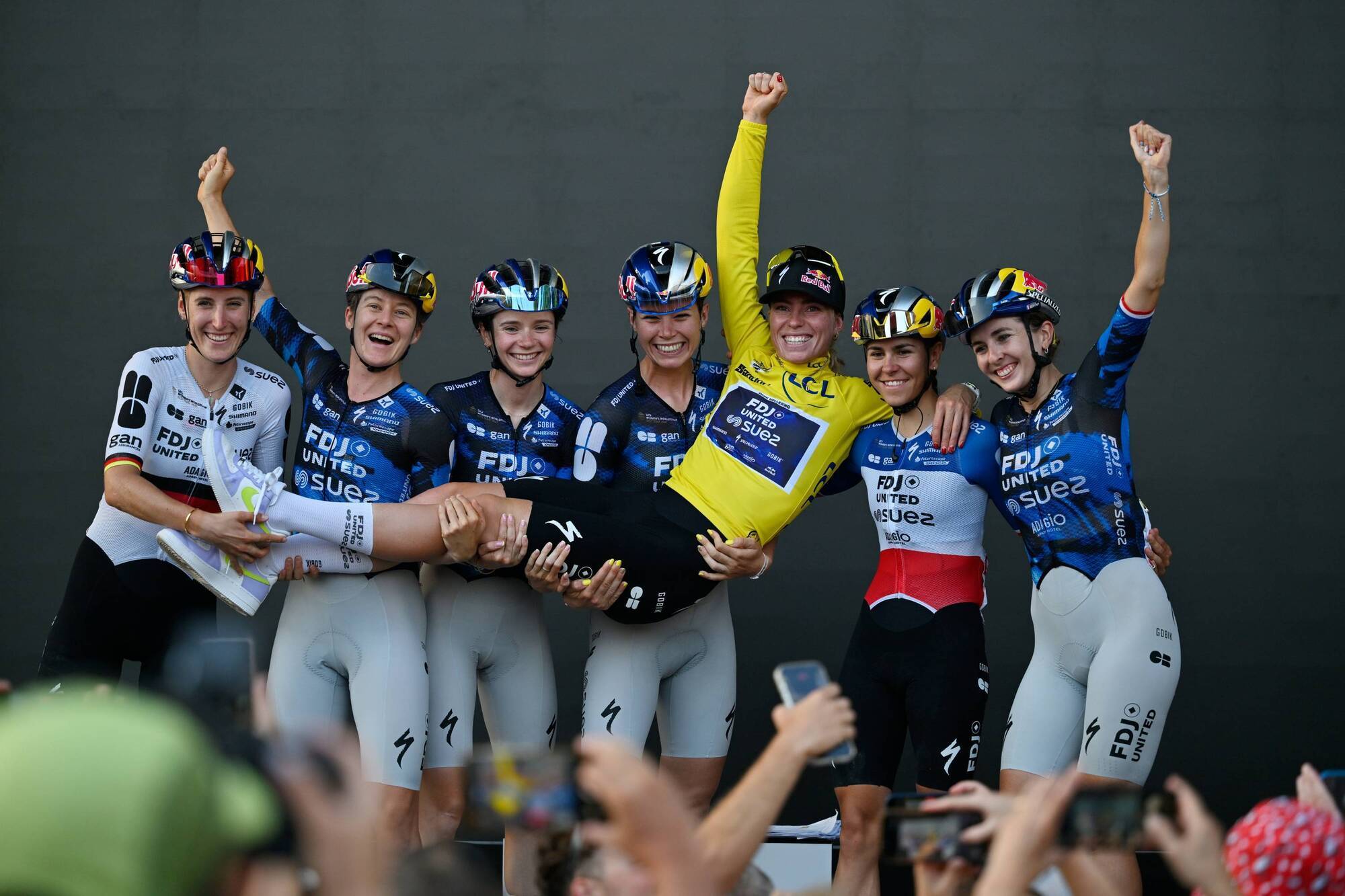
The Netherlands' Demi Vollering, centre, celebrates with her team after winning the Women's Tour de France cycling race (Tour de France Femmes) in Nice on Sunday. Picture: Philippe Magoni/AP
Demi Vollering’s second overall win in the Tour de France Femmes in Nice on Sunday was achieved after a heated dispute with Kasia Niewiadoma, but by the time the sun was setting on the Promenade des Anglais, the sisterhood that has always characterised this race had kicked back in.
On a final stage of high drama, the Dutchwoman erased the lingering controversy with an attacking win of the highest quality, further boosting the prestige of the long-dormant native cycling scene in a gutsy performance from her French‑sponsored FDJ United-Suez team.
Niewiadoma’s uncharacteristic outburst on the finish line at Vollering’s teammate Célia Gery on Saturday fuelled the controversy that dominated the final stage, but did not diminish the scale of her achievement.
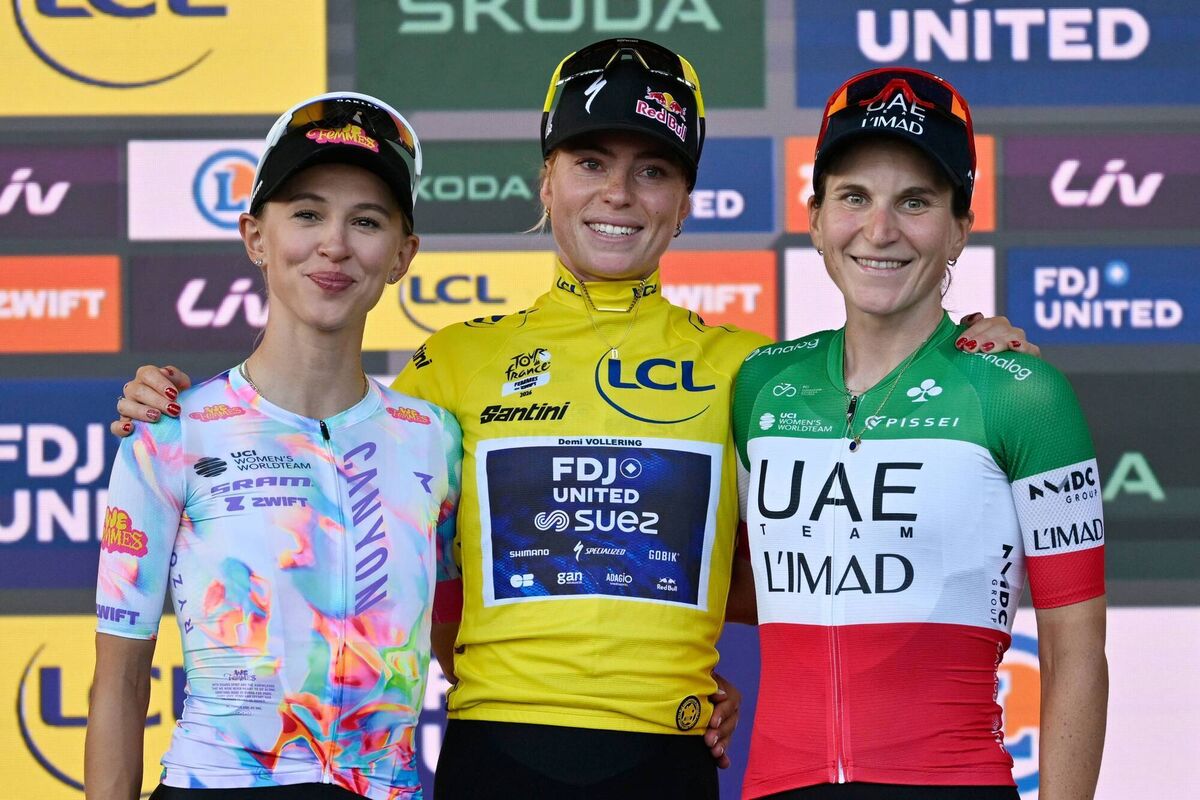
The former florist has had a golden 2026, winning the Giro d’Italia Women, in addition to Liège‑Bastogne‑Liège, the Tour of Flanders and Flèche Wallonne. Her achievements this season compare with, and arguably outstrip, those of her men’s Tour de France‑winning counterpart, Tadej Pogacar.
Vollering has long been outspoken about the wellbeing of young people and reacted angrily to Niewiadoma’s public criticism of Gery, her 20-year-old teammate. “She got a lot of nasty messages,” Vollering said on Sunday. “It makes me very angry, especially because she’s such a young girl. We should always protect young people from these kinds of stupid actions. She had a really rough time.”
Vollering and Niewiadoma had a clear-the-air conversation on their bikes during the early kilometres of the final stage on Sunday. “I wanted to have a chat with Kasia because I was a bit disappointed she let all the emotions out like that,” she said. “It was good that we had a talk together. It was all good in the end.”
The Polish rider, who won the spectacular stage on Mont Ventoux on Friday and finished in the Tour’s top three for the fifth time, was equally conciliatory. “We’ve been competing together for years. None of us ever wants to have any sort of beef.”
It was a different story for the unfortunate Marlen Reusser, another key protagonist in the nine-day drama. The Swiss rider, who began the final stage in third place, crashed at speed on the second descent of Col d’Èze. She remounted, in tears, all hopes of the podium lost, but finished the stage.
The men’s Tour de France was effectively over as a contest as soon as stage six, when Pogacar won over the Col du Tourmalet, but there was uncertainty about the outcome of the women’s race until the final narrow climb of the Chemin de Vinaigrier, a little-known lane in suburban Nice. Pogacar will go to Edinburgh for the Grand Départ on July 2 next year seeking a sixth win, but it is uncertain if Jonas Vingegaard will remain his greatest rival. While Pogacar has confirmed he will race in the Vuelta a España, starting in Monaco on August 22, Vingegaard’s future remains unclear.
Mattias Skjelmose, a fellow Dane, has revealed Vingegaard, who crashed out of the Tour with a broken collarbone, has become disheartened by Pogacar’s domination. “Jonas says: ‘I can’t do any more. What am I supposed to do? I produce the best I’ve ever done and he just rides away from me,’” Skjelmose told a Danish podcast.
Vingegaard’s crash came hours after he was subjected to a 2am visit by drug testers from the International Testing Agency. The debate over the appropriateness of such extreme anti-doping measures – and the consequences for the riders – dominated the rest of the Tour. Pogacar rode on to Paris, apparently untroubled by his own 5am wake-up call, but the UCI’s president, David Lappartient, said: “There will always be suspicion in cycling.”
The men’s Tour throws up the biggest stars and biggest controversies, but in the era of Pogacar, it is the Tour de France Femmes that offers the most compelling racing. “When you have a Tadej Pogacar, at such a high level, you’re talking more about second place,” the Tour de France Femmes director, Marion Rousse, said. “It’s not like that in the women’s race. Women’s cycling at the moment creates more suspense than you see in men’s cycling, because Pogacar is so dominant.”
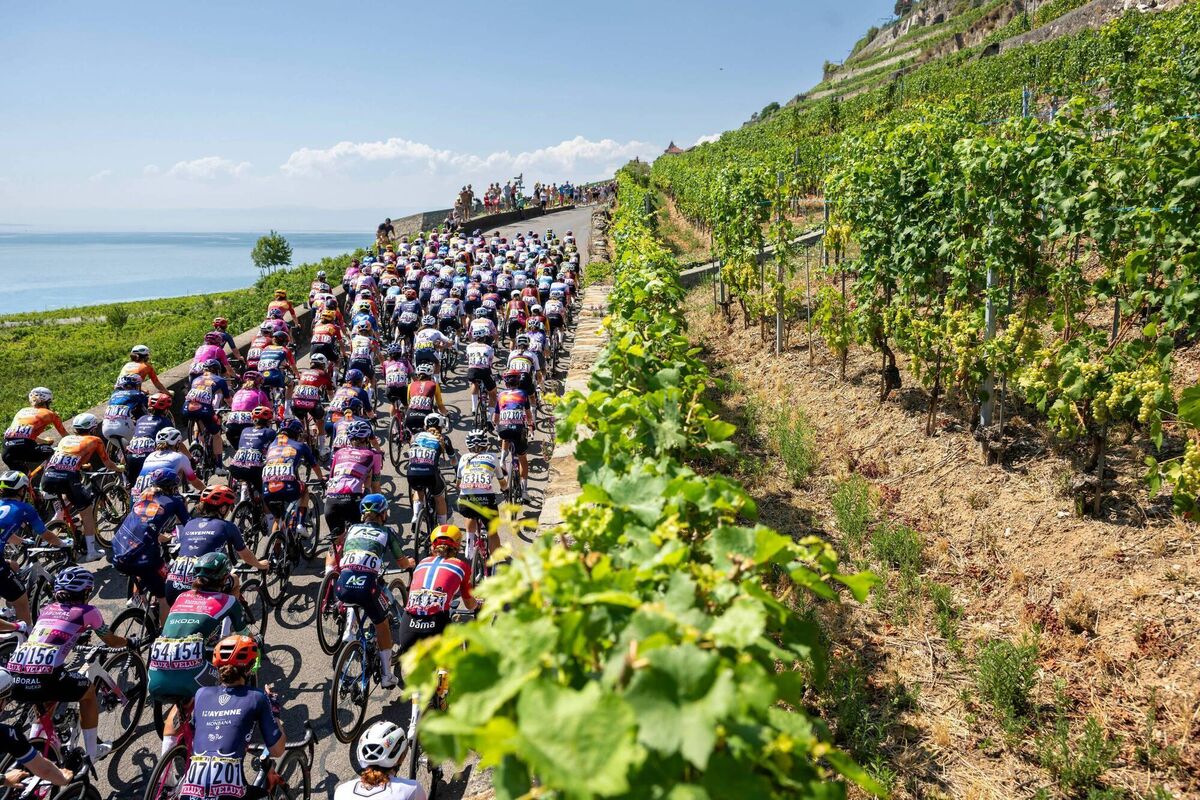
The refreshing nature of the Tour de France Femmes remains intact even as it grows at a rapid pace. Pogacar, a constant advocate of the women’s peloton, seems enthralled. He was spotted at the roadside, in beanie hat and shades, during the stage to Mont Ventoux on Friday, running alongside and cheering on his partner, Urska Zigart, and was present again at the weekend in Nice.
Rousse believes the women’s race, which will hold its Grand Départ in Leeds on July 30 next year before stage finishes in Manchester, Sheffield and London, has not lost its innocence. “There’s a freshness, which you don’t get in men’s racing because the men are more used to it,” she said. “Women’s sport is more accessible. I think it’s because before, during the years before women’s cycling had profile, there was little ‘mediatisation’ of women’s racing. Now they see the media coverage, they see so many people come to watch and it’s powerful for them. They’re moved and every time, up on the podium, there’s lots of emotion. That’s a new experience.”
Rousse said the sceptics who doubted the quality of the women’s peloton have been silenced. “Back then it was all: ‘Are the women good enough? Can they do the big climbs?’ Now it’s: ‘Why don’t you have more stages? Why isn’t it every stage shown live on TV?’ Nobody asks if the women are good enough any more. They have proved themselves, they’re champions who have shown on the road and on their bikes that they deserve their place.”
Guardian


CONNECT WITH US TODAY



Be the first to know the latest news and updates